

Introduction
Hello, everyone! It’s your favorite Korean tutor, Daily Hangul (DailyHangul.com)! 😊👋
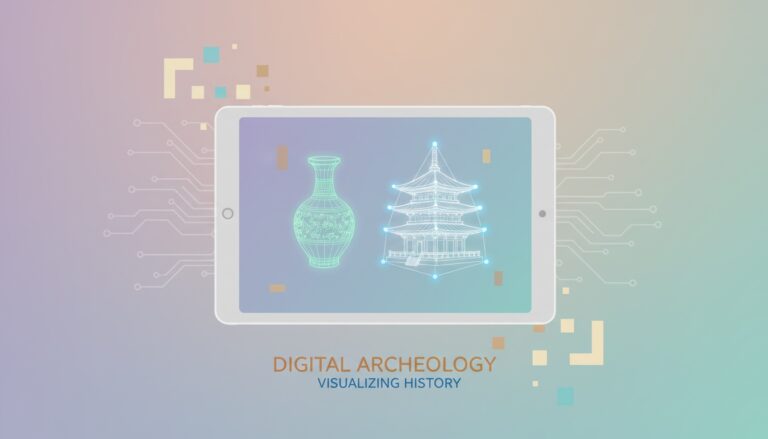
Are you a fan of history? Or maybe you love futuristic technology? Today, we are going to combine the two! 🏛️💻
Even if the topic sounds a bit academic—“Digital Archaeology”—don’t worry! These words are super useful when you visit Korean museums (which are world-class in technology!) or watch intellectual K-dramas where characters are researchers or professors (think of the smart characters in Signal or Sisyphus!).
Let’s learn how to talk about digging up the past and showing it on a screen! Ready to become a smart time traveler? Let’s go! 🚀
Key Expressions
Here are 3 essential expressions to make you sound like a pro at a museum or university!
1. 발굴하다
- Pronunciation: [Balgulhada]
- English Meaning: To excavate / To dig up
- Detail: This verb is used when archaeologists dig up artifacts from the ground. You might hear this in news reports about Korean history or in mystery dramas when finding hidden evidence!
- 💡 Pronunciation Tip: The ‘ㄹ’ (l) in ‘발’ flows into the ‘ㄱ’ (g) in ‘굴’. Pronounce it smoothly like [Bal-gul-ha-da]. It shouldn’t sound choppy!
2. 분석하다
- Pronunciation: [Bunseokhada]
- English Meaning: To analyze
- Detail: After digging things up, we need to understand them, right? This word is used in many contexts: analyzing data, analyzing a situation, or analyzing a K-pop music video theory! 🧐
- 💡 Pronunciation Tip: Watch out for the ‘ㄱ’ + ‘ㅎ’ combination! When the bottom ‘ㄱ’ meets the ‘ㅎ’, they combine to make a strong ‘ㅋ’ (k) sound. So, it sounds like [Bun-seo-ka-da]. This is called Aspiration!
3. 시각화
- Pronunciation: [Sigakhwa]
- English Meaning: Visualization
- Detail: This is the magic part! It means turning data into images or 3D models. In Digital Humanities, we take old data and make it visible on computers. You’ll see this word on signs in tech-heavy exhibitions.
- 💡 Pronunciation Tip: Again, the ‘ㄱ’ meets ‘ㅎ’! ‘각’ (gak) + ‘화’ (hwa) becomes [Ga-kwa]. Say it powerfully: [Si-ga-kwa].
Real-life Conversation
Let’s see how Minji (a history student) and Alex (an exchange student) talk at a Digital Museum in Seoul.
Minji: 우와, 이 지도 좀 봐! 정말 신기해.
([Uwa, i jido jom bwa! Jeongmal singihae.])
(Wow, look at this map! It’s fascinating.)
Alex: 이게 옛날 서울 모습이야? 어떻게 만들었어?
([Ige yennal Seoul moseubiya? Eotteoke mandeureosseo?])
(Is this the old look of Seoul? How did they make it?)
Minji: 땅속에서 발굴한 자료를 컴퓨터로 분석했어.
([Ttangsogeseo balgulhan jaryoreul keompyuteoro bunseokaesseo.])
(They analyzed the data excavated from the ground with a computer.)
Alex: 그리고 이렇게 3D로 시각화한 거구나! 진짜 같다.
([Geurigo ireoke 3D-ro sigakhwahan geoguna! Jinjja gatda.])
(And they visualized it in 3D like this! It looks real.)
Minji: 응, 기술 덕분에 역사가 살아있는 것 같아.
([Eung, gisul deokbune yeoksaga sarainneun geot gata.])
(Yeah, thanks to technology, it feels like history is alive.)
Culture Tip 🇰🇷
“Digital Restoration of Cultural Heritage” (문화유산 디지털 복원)
Did you know Korea is a leader in Digital Heritage? Because many wooden buildings (like the famous Hwangnyongsa Temple) were destroyed in the past, Korea uses advanced digital technology to “restore” them in Virtual Reality (VR) or Augmented Reality (AR).
When you visit the National Museum of Korea in Seoul, you can see these amazing “visualizations” (시각화). It’s not just boring old stones; lights and screens make history feel like a movie! Don’t miss the “Immersive Digital Gallery” when you visit! 🎬✨
Review & Quiz
Today we learned how to talk about high-tech history! Let’s check if you remember.
Fill in the blanks:
- Archaeologists
______ (dig up) artifacts from the ground.
(Hint: ㅂㄱㅎㄷ) -
We use computers to ______ (analyze) the data.
(Hint: ㅂㅅㅎㄷ) -
This 3D model is a great ______ (visualization) of the old palace.
(Hint: ㅅㄱㅎ)
Answers:
1. 발굴하다 (Balgulhada)
2. 분석하다 (Bunseokhada)
3. 시각화 (Sigakhwa)
Great job today! Now you can sound super smart when talking about history and tech! See you next time! 안녕! 👋💖
Frequently Asked Questions (FAQ)
Q: What does "발굴하다" mean in Korean and how do you pronounce it?
A: In Korean, "발굴하다" is pronounced [Balgulhada] and means: To excavate / To dig up
Q: What does "분석하다" mean in Korean and how do you pronounce it?
A: In Korean, "분석하다" is pronounced [Bunseokhada] and means: To analyze
Q: What does "시각화" mean in Korean and how do you pronounce it?
A: In Korean, "시각화" is pronounced [Sigakhwa] and means: Visualization







