

Introduction
Hello! This is Daily Hangul (DailyHangul.com), here to upgrade your Korean skills! 🚀
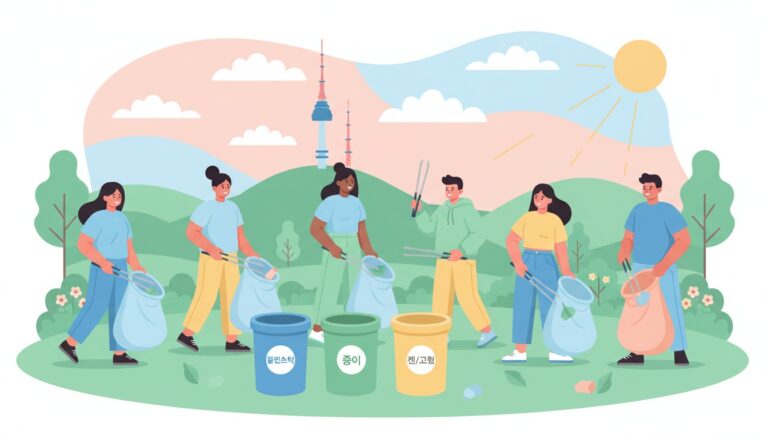
Have you ever seen your favorite K-Pop idols or K-Drama stars doing volunteer work? In Korea, volunteering (Bongsa-hwal-dong, 봉사활동) is a very popular activity to help the community! Today, imagine we are participating in a local park cleanup.
Not only is this a great way to make friends, but you also learn how to talk about teamwork and recycling! Let’s learn some warm-hearted expressions to use while making the world a cleaner place! 🌍✨
Key Expressions
1. 같이 청소해요! (Let’s clean together!)
- Pronunciation: [Gachi cheongsohaeyo!]
- Meaning: Let’s clean together!
- Detail: This is the perfect phrase to start a team activity. ‘같이 (Gachi)’ means ‘together’ and is used constantly in Korea (e.g., Let’s eat together, Let’s go together). It shows a friendly, cooperative spirit!
- 💡 Pronunciation Tip: Watch out! The word 같이 is written as ‘Gat-i’ but pronounced as [Ga-chi]. When the final consonant ‘ㅌ(t)’ meets ‘이(i)’, the sound changes to ‘치(chi)’. This is a very common rule in Korean called palatalization!
2. 이거 어디에 버려요? (Where do I throw this away?)
- Pronunciation: [Igeo eodie beoryeoyo?]
- Meaning: Where do I throw this away?
- Detail: Korea is very strict about recycling! When you pick up trash, you can’t just throw it anywhere. Use this phrase to ask where a specific item belongs. ‘버리다 (Beorida)’ means ‘to throw away’.
- 💡 Pronunciation Tip: Link the sounds smoothly. ‘어디에 (Eodie)’ flows like one wave. Practice saying it softly at the end to sound polite.
3. 힘들지만 뿌듯해요. (It’s hard, but I feel proud.)
- Pronunciation: [Himdeuljiman ppudeuthaeyo.]
- Meaning: It’s hard work, but I feel proud/fulfilled.
- Detail: You will hear this a lot in interviews with stars after they do charity work! ‘뿌듯하다 (Ppudeuthada)’ is a specific emotion for feeling fulfilled after doing something good. Use this, and Koreans will be amazed at your vocabulary!
- 💡 Pronunciation Tip: Focus on the double consonant ‘뿌 (Ppu)’. Tense your lips and release the air sharply, like a popping sound, without letting a breathy ‘h’ sound out.
Real-life Dialogue
Situation: Minji and Alex are volunteering to clean up the Han River Park.
Minji: 알렉스 씨, 우리 저기 같이 청소해요!
(Alex, let’s go clean over there together!)
[Alex-ssi, uri jeogi gachi cheongsohaeyo!]
Alex: 네, 좋아요! 어? 쓰레기가 정말 많네요.
(Yes, sounds good! Oh? There is so much trash.)
[Ne, joayo! Eo? Sseuregiga jeongmal manneyo.]
Alex: 민지 씨, 이 플라스틱 병은 이거 어디에 버려요?
(Minji, where do I throw away this plastic bottle?)
[Minji-ssi, i peullaseutik byeong-eun igeo eodie beoryeoyo?]
Minji: 저기 파란색 통에 버리면 돼요.
(You can throw it in that blue bin over there.)
[Jeogi paransaek tong-e beorimyeon dwaeyo.]
Alex: 휴, 땀이 많이 나네요. 힘들지만 뿌듯해요.
(Phew, I’m sweating a lot. It’s hard, but I feel proud.)
[Hyu, ttami mani naneyo. Himdeuljiman ppudeuthaeyo.]
Minji: 맞아요! 끝나고 맛있는 거 먹으러 가요!
(Right! Let’s go eat something delicious after we finish!)
[Majayo! Kkeunnago masinneun geo meogeureo gayo!]
Cultural Tip: Recycling (Bunri-sugo)
Did you know? In Korea, separating trash (분리수거, Bunri-sugo) is almost like a sport! 🗑️🏆
When volunteering at a park, you will usually see different bins for:
1. General Trash (Ilban-sseuregi)
2. Plastics
3. Cans/Bottles
If you mix them up, you might get a gentle scolding from an Ajumma (middle-aged lady) nearby! Doing it correctly shows you respect the community and the environment. It’s a huge part of daily life in Korea.
Conclusion & Quiz
Great job today! You are now ready to be a helpful volunteer in Korea. Remember, doing good things makes you feel ‘Ppudeut-haeyo’ (proud)! 😊
Let’s check what you learned!
- How do you pronounce ‘같이’ (Together)?
- (A) Gat-i
- (B) Ga-chi
- Fill in the blank: “This work is tiring, but I feel ___.” (Hint: Fulfilled/Proud)
- Answer: 뿌듯해요 (Ppudeuthaeyo)
Answers:
1. (B) Ga-chi
2. 뿌듯해요
See you next time! Annyeong! 👋
Frequently Asked Questions (FAQ)
Q: What does "같이 청소해요! (Let's clean together!)" mean in Korean and how do you pronounce it?
A: In Korean, "같이 청소해요! (Let's clean together!)" is pronounced [Gachi cheongsohaeyo!] and means: Let's clean together!
Q: What does "이거 어디에 버려요? (Where do I throw this away?)" mean in Korean and how do you pronounce it?
A: In Korean, "이거 어디에 버려요? (Where do I throw this away?)" is pronounced [Igeo eodie beoryeoyo?] and means: Where do I throw this away?
Q: What does "힘들지만 뿌듯해요. (It's hard, but I feel proud.)" mean in Korean and how do you pronounce it?
A: In Korean, "힘들지만 뿌듯해요. (It's hard, but I feel proud.)" is pronounced [Himdeuljiman ppudeuthaeyo.] and means: It's hard work, but I feel proud/fulfilled.







