

Hello! It’s Daily Hangul! 👋
Annyeonghaseyo! (안녕하세요!) Welcome back to Daily Hangul, your best friend for learning Korean! 🇰🇷✨
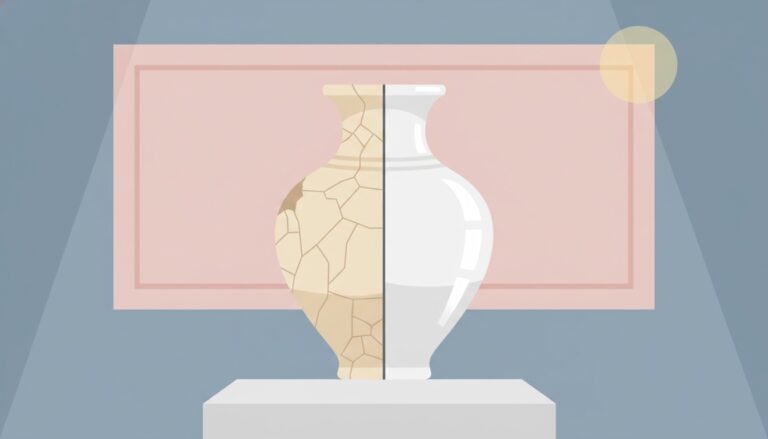
Have you ever watched a K-Drama involving art curators or museums, like Her Private Life? Sometimes, they face a big dilemma: “Should we fix this old artwork to look brand new, or keep it damaged to show its history?” 🤔
Today, we are diving into the world of Art & Criticism! But don’t worry, we will keep it simple and fun. You will learn how to discuss restoring art and expressing your opinion on whether we should change things or keep them as they are.
Let’s upgrade your Korean level so you can sound like a pro critic! Ready? Start! 🚀
🎨 Key Expressions
Here are 4 essential expressions to discuss art restoration.
1. 복원하다 (Bokwonhada)
- Pronunciation: [Bok-won-ha-da]
- English: To restore
- Explanation: This is the verb used when fixing cultural heritage or art pieces to bring them back to their original state. You might hear this in news about old Korean palaces too!
- 💡 Pronunciation Tip: The ‘ㄱ’ (k) in 복 (bok) meets the ‘ㅇ’ (w/placeholder) sound, but here it is pronounced clearly as separate blocks. Make sure to pronounce the ‘won’ smoothly.
2. 원래 모습 (Wollae moseup)
- Pronunciation: [Wol-lae mo-seup]
- English: Original appearance / Original form
- Explanation: 원래 (Wollae) means “originally” and 모습 (moseup) means “appearance” or “figure.” In an ethical debate, this is key! Do we want the current look or the original look?
- 💡 Pronunciation Tip: In 원래, the ‘ㄴ’ (n) and ‘ㄹ’ (r/l) meet. The ‘n’ sound changes to an ‘l’ sound for smoother flow. So it sounds like [Woll-lae], not [Won-lae].
3. 그대로 두다 (Geudaero duda)
- Pronunciation: [Geu-dae-ro du-da]
- English: To leave it as it is
- Explanation: If you think fixing the art destroys its history, you would say this! 그대로 (Geudaero) means “as it is” and 두다 (duda) means “to put/leave.”
4. 역사 (Yeoksa)
- Pronunciation: [Yeok-sa]
- English: History
- Explanation: The most important argument in art criticism! Sometimes, the damage on a painting is part of its history.
🗣️ Real Conversation
Minji and Daniel are at a museum looking at a damaged ancient pottery.
Minji: 이 도자기 좀 봐. 많이 깨졌네.
(I dojagi jom bwa. Mani kkaejyeonne.)
Look at this pottery. It’s broken a lot.
Daniel: 정말이네. 이걸 복원해야 할까?
(Jeongmarine. Igeol bokwonhaeya halkka?)
For real. Should they restore this?
Minji: 글쎄, 나는 원래 모습이 궁금하긴 해.
(Geulsse, naneun wollae moseup-i gunggeumhagin hae.)
Well, I am curious about its original appearance.
Daniel: 하지만 깨진 것도 역사야. 그냥 그대로 두는 게 좋아.
(Hajiman kkaejin geot-do yeoksa-ya. Geunyang geudaero duneun ge joa.)
But being broken is also history. It’s better to just leave it as it is.
Minji: 오, 다니엘! 진짜 예술가 같다! 😎
(Oh, Daniel! Jinjja yesulga gatda!)
Oh, Daniel! You sound like a real artist!
🇰🇷 Culture Tip: The Gate of History
Did you know that preservation (보존, bojon) is a hot topic in Korea?
A famous example is Sungnyemun Gate (Namdaemun), Korea’s National Treasure No. 1. After a tragic fire in 2008, there was a huge national debate on how to restore (복원하다) it. Some wanted to use modern technology to make it strong, while others insisted on traditional methods to keep the history (역사) alive.
Eventually, traditional methods were used as much as possible to respect the spirit of the ancestors! When you visit a palace in Seoul, remember that every stone has a story of preservation! 🏯
📝 Wrap-up & Quiz
Today we learned how to talk about fixing art and the ethics behind it!
Let’s check your memory:
- What is the Korean verb for “To restore”?
( ) - If you don’t want to change anything, you say: “Let’s leave it ( ).”
Great job today! Next time you see an old building or painting, try using these words! See you next time! Annyeong! 👋
Answers:
1. 복원하다 (Bokwonhada)
2. 그대로 (Geudaero)
Frequently Asked Questions (FAQ)
Q: What does "복원하다 (Bokwonhada)" mean in Korean and how do you pronounce it?
A: In Korean, "복원하다 (Bokwonhada)" is pronounced [Bok-won-ha-da] and means: a key conversational Korean expression covered in this lesson.
Q: What does "원래 모습 (Wollae moseup)" mean in Korean and how do you pronounce it?
A: In Korean, "원래 모습 (Wollae moseup)" is pronounced [Wol-lae mo-seup] and means: a key conversational Korean expression covered in this lesson.
Q: What does "그대로 두다 (Geudaero duda)" mean in Korean and how do you pronounce it?
A: In Korean, "그대로 두다 (Geudaero duda)" is pronounced [Geu-dae-ro du-da] and means: a key conversational Korean expression covered in this lesson.
Q: What does "역사 (Yeoksa)" mean in Korean and how do you pronounce it?
A: In Korean, "역사 (Yeoksa)" is pronounced [Yeok-sa] and means: a key conversational Korean expression covered in this lesson.







