

Introduction
Hello, everyone! It’s Daily Hangul, here to upgrade your Korean skills! 🚀
Have you ever visited a museum in Korea, like the National Museum of Korea or a beautiful palace like Gyeongbokgung? While enjoying the K-culture, it’s super important to understand the rules so you don’t accidentally break them! 🏛️
Today, we will learn how to understand prohibitions and commands (Imperatives). You often hear these in K-dramas when a strict manager scolds an employee or when a hero warns someone of danger! Let’s learn how to be a polite visitor in Korea. Let’s go! (Gogo! 고고!) 👇
Key Expressions
Here are 3 essential phrases you’ll see on signs or hear from staff at a museum.
1. 만지지 마세요
- Pronunciation: [Manjiji maseyo]
- English Meaning: Please do not touch.
- Explanation: This is the standard polite way to say “Don’t do X.” The grammar pattern is Verb Stem + -ji maseyo (-지 마세요). You will see this on signs near precious artifacts.
- 💡 Pronunciation Tip: The ‘j’ in manjiji is a soft ‘j’ sound. Try to flow the words together smoothly: Man-ji-ji-ma-se-yo.
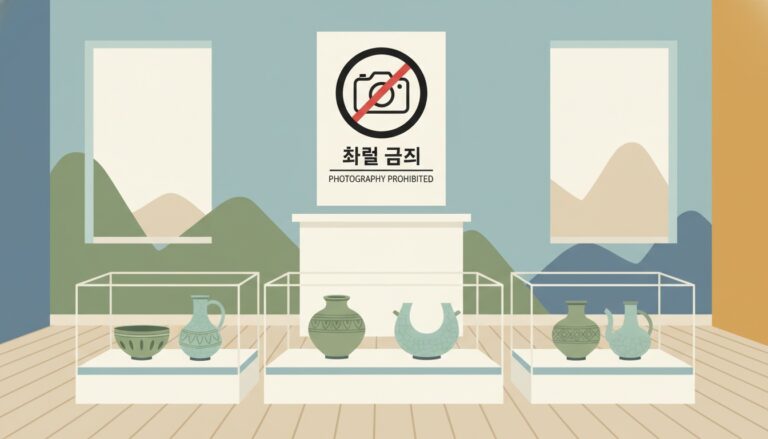
2. 사진 찍지 마세요
- Pronunciation: [Sajin jjikji maseyo]
- English Meaning: Please do not take photos.
- Explanation: Many museums have “No Photography” zones. Sajin means photo, and jjikda means to take (a photo).
- 💡 Pronunciation Tip: The double consonant ‘jj’ (ㅉ) in jjik requires more tension in your throat. It sounds sharper than a regular ‘j’. Also, the ‘k’ at the end of jjik stops abruptly before the ‘ji’ starts.
3. 조용히 하세요
- Pronunciation: [Joyonghi haseyo]
- English Meaning: Please be quiet.
- Explanation: You might hear this in a library or a quiet exhibition hall. Joyonghi means “quietly.”
- 💡 Pronunciation Tip: The ‘h’ in joyonghi is often pronounced very softly or almost dropped in fast speech, sounding like Joyong-i.
Real Conversation
Imagine you are at a museum with a guide. Let’s see how these phrases are used!
Situation: A tourist (A) is excited to see an ancient vase.
A: 와! 이거 진짜 예뻐요! (Wa! Igeo jinjja yeppeoyo!)
Wow! This is really pretty!
A: (Reaching out hand) 만져도 돼요? (Manjyeodo dwaeyo?)
Can I touch it?
B: 🙅♂️ 아니요! 만지지 마세요. (Aniyo! Manjiji maseyo.)
No! Please do not touch.
A: 아, 죄송합니다. 사진은요? (Ah, joesonghamnida. Sajineunyo?)
Ah, I’m sorry. What about photos?
B: 여기서는 사진 찍지 마세요. 눈으로만 보세요. (Yeogiseoneun sajin jjikji maseyo. Nuneuroman boseyo.)
Please do not take photos here. Please just watch with your eyes.
Culture Tip 🇰🇷
“No Kids Zones” and Public Etiquette
In Korea, public etiquette (called Etikhet 에티켓) is very important. You might see signs that say “Jeong-suk” (정숙) in museums or libraries, which means “Silence.”
Also, keep in mind that Korean staff often cross their arms in an ‘X’ shape while saying these phrases to communicate clearly to foreigners who might not speak Korean. It’s not meant to be rude, but to be visually clear! 🙅♀️
Conclusion & Quiz
Great job today! Now you can visit any Korean museum and be a respectful, awesome tourist. Remember, usually, we just watch with our eyes! 👀
📝 Mini Quiz
- Fill in the blank: To say “Please do not touch,” you say “_______ 마세요.”
- True or False: “Sajin jjikji maseyo” means “Please take many photos.”
(Scroll down for answers)
.
.
.
.
Answers:
1. 만지지 (Manjiji)
2. False (It means “Please do not take photos.”)
Frequently Asked Questions (FAQ)
Q: What does "만지지 마세요" mean in Korean and how do you pronounce it?
A: In Korean, "만지지 마세요" is pronounced [Manjiji maseyo] and means: Please do not touch.
Q: What does "사진 찍지 마세요" mean in Korean and how do you pronounce it?
A: In Korean, "사진 찍지 마세요" is pronounced [Sajin jjikji maseyo] and means: Please do not take photos.
Q: What does "조용히 하세요" mean in Korean and how do you pronounce it?
A: In Korean, "조용히 하세요" is pronounced [Joyonghi haseyo] and means: Please be quiet.







