

Introduction
Hello! This is Daily Hangul (DailyHangul.com), here to upgrade your Korean skills! 😊
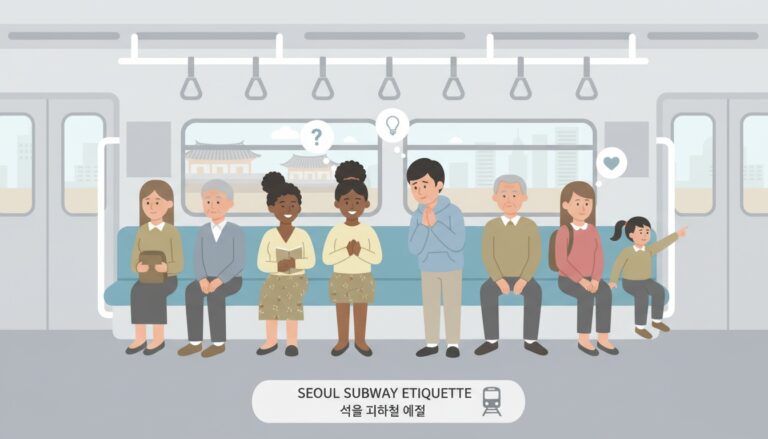
Imagine this: You are on a crowded subway in Seoul (just like in your favorite K-Drama scenes! 🚇). The train stops suddenly, you lose your balance, and… crunch! You accidentally step on someone’s foot! 😱
Don’t panic! Standing there silently makes it awkward. Today, we will learn the magic words to handle this situation politely and naturally. These expressions are essential for surviving rush hour in Korea! Let’s dive in! 💪
Core Expressions
Here are 3 key expressions you need when you make a small physical mistake.
1. 죄송합니다
- Pronunciation: [Joesonghamnida]
- English Meaning: I am sorry.
- Detail: This is the most standard and polite way to apologize to a stranger. Whether you step on a foot or bump into someone, this is your go-to phrase. You will hear this in almost every episode of any K-Drama!
- 💡 Pronunciation Tip: Notice how it is written as
hap-ni-dabut pronounced [ham-ni-da]? In Korean, when ‘ㅂ’ (b/p) is followed by ‘ㄴ’ (n), the sound changes to ‘m’ for smoother flow. So, say it softly: Joesong-ham-nida.
2. 괜찮으세요?
- Pronunciation: [Gwaenchaneuseyo?]
- English Meaning: Are you okay?
- Detail: After saying sorry, it is very kind to ask if the person is hurt. It shows you genuinely care. It is a polite version of the word “Gwaenchana” (which you might know from K-Pop songs! 🎵).
- 💡 Pronunciation Tip: The letter ‘ㅎ’ (h) in the bottom of ‘찮’ often becomes silent or very weak when followed by a vowel. So instead of Gwaen-chan-heu-se-yo, it sounds more like [Gwaen-cha-neu-se-yo].
3. 아!
- Pronunciation: [A!]
- English Meaning: Oh! / Oops!
- Detail: This isn’t a word, but a sound! In Korea, making a small sound of surprise lets the other person know it was an accident before you even speak. It sets the tone that you were surprised too.
Real-life Dialogue
Let’s see how this works on a bumpy bus in Seoul!
(Situation: The bus brakes hard, and Alex steps on a lady’s foot.)
Alex: 아! 죄송합니다! 괜찮으세요?
([A! Joesonghamnida! Gwaenchaneuseyo?])
(Oh! I am so sorry! Are you okay?)
Lady: 아, 네. 괜찮아요.
([A, ne. Gwaenchanayo.])
(Ah, yes. I’m okay.)
Alex: 정말 죄송합니다.
([Jeongmal joesonghamnida.])
(I am really sorry.)
Lady: 아니에요. 버스가 많이 흔들리네요.
([Anieyo. Beoseuga mani heundeullineyo.])
(It’s nothing. The bus is shaking a lot.)
Cultural Tip 🇰🇷
“The Sorry Bow”
In Korea, words are important, but body language is just as crucial! When you say “죄송합니다” (Joesonghamnida), you should slightly lower your head or bow your upper body a little bit. 🙇♂️🙇♀️
If you just say the words while looking straight ahead with a stiff neck, it might seem insincere. A small nod or bow shows true regret and respect. If you do this, most Koreans will smile and forgive you immediately!
Conclusion & Quiz
Great job! Now you don’t have to be afraid of the crowded Line 2 subway in Seoul. You know exactly how to be polite and cool. 😎
Let’s check what you remembered!
📝 Mini Quiz
- Fill in the blank: To apologize politely to a stranger, you say “_______ – hamnida.”
- True or False: When saying “Gwaenchaneuseyo” (Are you okay?), you must pronounce the ‘h’ sound very strongly.
- True or False: It is better to slightly bow your head when apologizing in Korea.
Answer Key
- Joesong (죄송)
- False (The ‘h’ becomes silent or weak!)
- True
Frequently Asked Questions (FAQ)
Q: What does "죄송합니다" mean in Korean and how do you pronounce it?
A: In Korean, "죄송합니다" is pronounced [Joesonghamnida] and means: I am sorry.
Q: What does "괜찮으세요?" mean in Korean and how do you pronounce it?
A: In Korean, "괜찮으세요?" is pronounced [Gwaenchaneuseyo?] and means: Are you okay?
Q: What does "아!" mean in Korean and how do you pronounce it?
A: In Korean, "아!" is pronounced [A!] and means: Oh! / Oops!






