

Introduction
Hello, everyone! 👋 It’s your friendly Korean tutor, Daily Hangul!
Have you ever watched a K-Drama where a team is working late to meet a deadline, and suddenly someone shouts a magic word, and everyone gets energized? ⚡ Today, we are going to learn how to be that energy booster!
Whether you are working on a group project or collaborating with Korean colleagues, knowing how to lift the team’s spirit is a superpower. Let’s learn the phrases that will make you the favorite team member! Ready? Let’s go! 🏃♂️💨
Key Expressions: Boosting Morale
1. 파이팅 / 화이팅 (Paiting / Hwaiting)
- Pronunciation: [Paiting] or [Hwaiting]
- Meaning: Let’s go! / Good luck! / Cheer up!
- Detail: This is the most famous Konglish (Korean + English) word! Originally from the English word “Fighting,” it doesn’t mean you want to fight someone. It means “Let’s fight through this challenge!” You use this to cheer someone on before a task or to boost energy during work.
- 💡 Pronunciation Tip: While it comes from “Fighting,” there is no ‘F’ sound in Korean. It is usually replaced with ‘P’ (ㅍ) or ‘H’ (ㅎ). Both are correct, but Paiting is the standard spelling!
2. 할 수 있어! (Hal su isseo!)
- Pronunciation: [Halsu-isseo]
- Meaning: You can do it! / We can do it!
- Detail: When your team feels like giving up, this is the perfect phrase. It literally translates to “(You/We) have the ability to do.” It’s a strong affirmation of potential.
- 💡 Pronunciation Tip: When saying 할 수 (Hal su), the ‘L’ sound in ‘Hal’ flows into the ‘S’ sound. It sounds smooth like “Halsu.”
3. 힘내세요 (Himnaeseyo)
- Pronunciation: [Him-nae-se-yo]
- Meaning: Cheer up / Have strength / Hang in there.
- Detail: 힘 (Him) means ‘strength’ or ‘power.’ So you are literally telling someone to “generate strength.” This is a polite way (ending in -yo) to encourage a coworker who looks tired or stressed.
4. 같이 하자 (Gachi haja)
- Pronunciation: [Gachi haja]
- Meaning: Let’s do it together.
- Detail: Koreans value “togetherness” (Uri culture). Reminding your team that they are not alone is a huge morale booster. This phrase emphasizes collaboration.
- 💡 Pronunciation Tip: Watch out for 같이 (Gachi)! Even though it is written as ‘gat-i’, the ‘t’ sound meets ‘i’ and changes to a ‘ch’ sound. So it is pronounced [Ga-chi], not [Gat-i]. This is a rule called Palatalization!
Real-life Dialogue 💬
Situation: Min-su and Lisa are working late on a team presentation. They are tired and losing focus.
Min-su: 아, 너무 힘들어요. 끝낼 수 있을까요? 😓
(Ah, neomu himdeureoyo. Kkeunnael su isseulkkayo?)
Ah, it’s so hard. Can we finish this?
Lisa: 걱정 마세요, 민수 씨! 우리 할 수 있어요! 💪
(Geokjeong maseyo, Min-su ssi! Uri hal su isseoyo!)
Don’t worry, Min-su! We can do it!
Min-su: 고마워요. 리사 씨도 힘내세요!
(Gomawoyo. Lisa ssi-do himnaeseyo!)
Thank you. You hang in there too, Lisa!
Lisa: 네! 빨리 끝내고 밥 먹어요. 파이팅! 🔥
(Ne! Ppalli kkeunnaego bap meogeoyo. Paiting!)
Yes! Let’s finish quick and eat. Fighting!
Culture Tip 🇰🇷
The Power of the Fist Pump! ✊
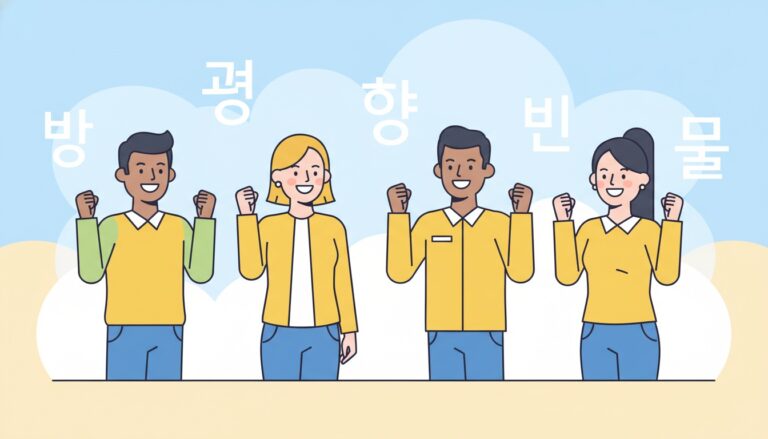
When Koreans say “Paiting!” or “Aja!” (another cheering sound), they almost always make a fist gesture, pulling it down towards their chest or raising it up. It’s a physical anchor for the energy!
Also, in Korean teamwork culture, the concept of “Uri” (Us/We) is vital. Success is rarely individual; it’s collective. Using phrases like “Let’s do it together” (Gachi haja) is sometimes more powerful than just saying “You can do it.”
Wrap-up & Quiz 📝
Great job today! You are now ready to be the energy source for your team. Remember, a simple “Paiting” can change the whole mood of a room! 😊
Let’s practice! (True or False)
- “Paiting” means you want to physically fight your coworker. (O / X)
- When pronouncing “Gachi” (Together), it sounds like [Ga-chi]. (O / X)
- “Himnaeseyo” means “Please go home.” (O / X)
Answers:
1. X (It means “Good luck” or “Cheer up”!)
2. O (Correct! The T becomes a CH sound.)
3. X (It means “Cheer up” or “Have strength”.)
See you next time! Annyeong! 👋
Frequently Asked Questions (FAQ)
Q: What does "파이팅 / 화이팅 (Paiting / Hwaiting)" mean in Korean and how do you pronounce it?
A: In Korean, "파이팅 / 화이팅 (Paiting / Hwaiting)" is pronounced [Paiting] and means: Let's go! / Good luck! / Cheer up!
Q: What does "할 수 있어! (Hal su isseo!)" mean in Korean and how do you pronounce it?
A: In Korean, "할 수 있어! (Hal su isseo!)" is pronounced [Halsu-isseo] and means: You can do it! / We can do it!
Q: What does "힘내세요 (Himnaeseyo)" mean in Korean and how do you pronounce it?
A: In Korean, "힘내세요 (Himnaeseyo)" is pronounced [Him-nae-se-yo] and means: Cheer up / Have strength / Hang in there.
Q: What does "같이 하자 (Gachi haja)" mean in Korean and how do you pronounce it?
A: In Korean, "같이 하자 (Gachi haja)" is pronounced [Gachi haja] and means: Let's do it together.







