

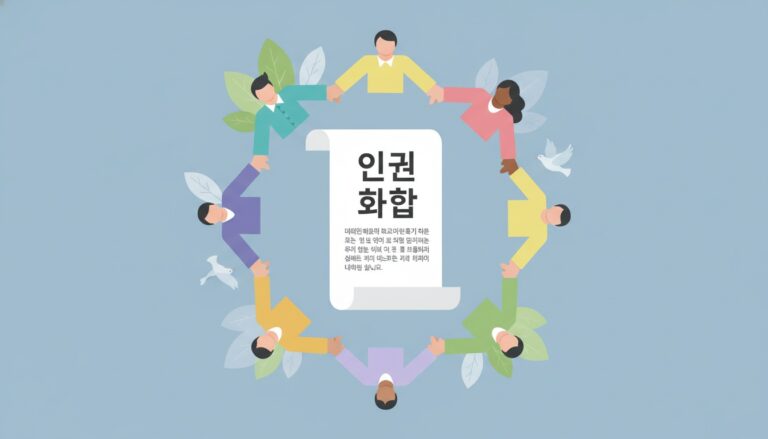
Stand Up for Rights! Writing About Indigenous Peoples in Korean 🇰🇷✊
👋 Hello, K-Learners!
안녕하세요! This is Daily Hangul, here to upgrade your Korean skills! 🚀
Today, we are diving into a slightly more serious but incredibly important topic: Human Rights and International Law. Have you ever watched legal K-dramas like Extraordinary Attorney Woo (이상한 변호사 우영우) or Law School? You often hear lawyers talking about “rights” and “protection” with a lot of passion! ⚖️
Specifically, we will learn how to write a simple statement regarding the Self-Determination of Indigenous Peoples. This might sound difficult, but don’t worry! We will learn the key words so you can express your opinions on global issues in Korean. Let’s get started! 🌏✨
🔑 Key Expressions
Here are 3 essential expressions to help you talk about human rights.
1. 선주민 (Seonjumin)
- Pronunciation: [Seonjumin]
- English Meaning: Indigenous Peoples
- Detail: This word is a combination of 선 (First) and 주민 (Resident/People). It refers to the original inhabitants of a land. In news or formal reports, using the correct terminology is very important!
- 💡 Pronunciation Tip: Pronounce each syllable clearly. Seon-ju-min.
2. 권리 (Gwonli)
- Pronunciation: [Gwolli]
- English Meaning: Right(s)
- Detail: You will hear this word all the time in K-dramas when someone shouts, “It’s my right!” (제 권리예요!). In our context, we use it to talk about the “Right to Self-Determination” (자결권 – Jagyeolgwon).
- 💡 Pronunciation Tip: This is a tricky one! Due to Korean sound rules (Liquidization), when ‘ㄴ’ (n) meets ‘ㄹ’ (l), the pronunciation changes to a double ‘L’ sound. So, say it like [Gwolli], not Gwon-ri.
3. 존중해야 합니다 (Jonjunghaeya hamnida)
- Pronunciation: [Jonjunghaeya hamnida]
- English Meaning: We must respect…
- Detail: 존중하다 means “to respect.” Adding ~해야 합니다 adds the meaning of “must” or “have to.” This is perfect for writing a formal statement or opinion.
- 💡 Pronunciation Tip: The ‘h’ in ‘hae’ is sometimes weak, but try to pronounce it softly. Jon-jung-hae-ya.
🗣️ Real Conversation
Let’s see how these words are used in a university setting. Mark is writing a report for his International Law class, and his Korean friend Sujin asks him about it.
Sujin: 마크 씨, 무엇을 쓰고 있어요?
(Mark, what are you writing?)
[Makeu ssi, mueoseul sseugo isseoyo?]
Mark: 선주민의 인권에 대한 글을 쓰고 있어요.
(I am writing a text about the human rights of Indigenous peoples.)
[Seonjumin-ui ingwon-e daehan geureul sseugo isseoyo.]
Sujin: 오, 정말 중요한 주제네요.
(Oh, that is a really important topic.)
[O, jeongmal jungyohan jujeneyo.]
Mark: 맞아요. 그들의 권리를 존중해야 합니다.
(That’s right. We must respect their rights.)
[Majayo. Geudeul-ui gwolli-reul jonjunghaeya hamnida.]
🇰🇷 Culture Tip: “In-gwon” (Human Rights)
In Korea, the word 인권 (In-gwon), meaning Human Rights, is a very powerful word. South Korea has a history of rapid democratization, so concepts of freedom and rights are deeply valued.
If you watch news debates or documentaries in Korea, you will often hear phrases like “Socially weak” (사회적 약자) or “Minority” (소수자). Using polite and formal endings like -습니다 (as we did in the lesson) is essential when discussing these serious topics to show respect and professionalism! 🎩
📝 Wrap-up & Quiz
Today we learned how to be an advocate for rights in Korean! You are now ready to sound like a smart law student in a K-drama. 🎓
Let’s test your knowledge! (Answers are at the bottom)
- How do you say “Indigenous Peoples” in Korean?
( ) -
True or False: The word 권리 (Rights) is pronounced as [Gwon-ri].
( O / X ) -
Fill in the blank: We must respect them = 그들을 ( ).
Great job today! See you next time! 안녕! 👋
Answers:
1. 선주민 (Seonjumin)
2. X (It is pronounced [Gwolli]!)
3. 존중해야 합니다 (Jonjunghaeya hamnida)
Frequently Asked Questions (FAQ)
Q: What does "선주민 (Seonjumin)" mean in Korean and how do you pronounce it?
A: In Korean, "선주민 (Seonjumin)" is pronounced [Seonjumin] and means: Indigenous Peoples
Q: What does "권리 (Gwonli)" mean in Korean and how do you pronounce it?
A: In Korean, "권리 (Gwonli)" is pronounced [Gwolli] and means: Right(s)
Q: What does "존중해야 합니다 (Jonjunghaeya hamnida)" mean in Korean and how do you pronounce it?
A: In Korean, "존중해야 합니다 (Jonjunghaeya hamnida)" is pronounced [Jonjunghaeya hamnida] and means: We must respect...







