

Introduction
Hello! This is Daily Hangul (DailyHangul.com), here to upgrade your Korean skills! 🌟
Have you ever watched a K-Drama and seen a scene where a mom asks her son or daughter to run to the convenience store? Or maybe a scene where the main character is separating trash with intense focus? Today, we are going to learn how to talk about Household Chores and Errands (Simbureum)!
Knowing these expressions will not only help you understand those domestic scenes in dramas but also make you a beloved guest or roommate if you ever live in Korea. Let’s learn how to be helpful in Korean! 💪
Key Expressions
1. 쓰레기 버리고 올게 (Sseuregi beorigo olge)
- English: I will go throw away the trash / I’ll be back after throwing away the trash.
- Explanation: This is a very common phrase. In Korea, taking out the trash is a frequent daily task.
- 쓰레기 (Sseuregi): Trash / Garbage
- 버리다 (Beorida): To throw away
- 💡 Pronunciation Tip: The ‘ㅆ’ (ss) in 쓰레기 is a ‘tense sound’. You need to push air through your teeth sharply, like the sound of a snake hissing! Also, thanks to the linking rule, 버리고 올게 often sounds like [Beori-go-olge] flowing together.
2. ~ 좀 사다 줄래? (~ jom sada jullae?)
- English: Can you buy some ~ for me?
- Explanation: This is the classic “errand” request! You can put any item in the blank.
- Example: 우유 좀 사다 줄래? (Can you buy some milk for me?)
- 좀 (Jom): Literally means “a little,” but here it softens the request, making it polite and gentle.
- 💡 Pronunciation Tip: 줄래 (Jullae) is pronounced with a clear ‘L’ sound because of the ㄹ (rieul). It sounds friendly and casual.
3. 설거지는 내가 할게 (Seolgeojineun naega halge)
- English: I will do the dishes.
- Explanation: Want to impress your Korean friends after a meal? Say this!
- 설거지 (Seolgeoji): Dishwashing
- 내가 할게 (Naega halge): I will do it (volunteering).
- 💡 Pronunciation Tip: 설거지 is pronounced like [Seol-geo-ji]. Make sure the ‘geo’ sound is open and relaxed.
4. 심부름 (Simbureum)
- English: Errand
- Explanation: This is the noun for any small task you do for someone else, like buying groceries or delivering a message.
Real-life Conversation
Situation: Min-su is relaxing at home, and his mom asks for help.
Mom: 민수야, 쓰레기 좀 버려 줄래?
(Minsu-ya, sseuregi jom beoryeo jullae?)
Minsu, can you throw away the trash?
Min-su: 네, 지금 나갈게요. 쓰레기 버리고 올게요!
(Ne, jigeum nagalgeyo. Sseuregi beorigo olgeyo!)
Okay, I’m going out now. I’ll go throw away the trash!
Mom: 아! 오는 길에 두부 좀 사다 줄래?
(Ah! Oneun gire dubu jom sada jullae?)
Ah! On your way back, can you buy some tofu?
Min-su: 알겠어요. 오늘의 심부름 끝?
(Algesseoyo. Oneurui simbureum kkeut?)
Got it. Is today’s errand finished?
Mom: 고마워! 저녁 먹고 설거지는 내가 할게.
(Gomawo! Jeonyeok meokgo seolgeojineun naega halge.)
Thanks! After dinner, I’ll do the dishes.
Cultural Tip 🇰🇷
“Jongnyangje” (Volume-based Waste Fee System)
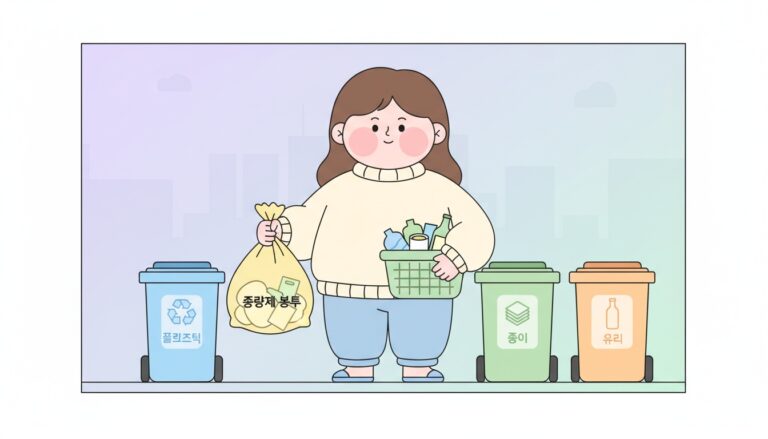
Did you know you can’t just use any plastic bag for trash in Korea? You must buy specific standard garbage bags (Jongnyangje bongtu) from a convenience store or supermarket. They are usually white, yellow, or pink depending on the district. Also, recycling (bunli-sugo) is taken very seriously! Food waste goes in a separate small bag. If you mix them up, the trash collector won’t take it! 😱
Conclusion & Quiz
Great job today! You are now ready to help out around the house in Korea. Whether it’s taking out the Sseuregi or running a Simbureum, these phrases are super useful!
📝 Mini Quiz
- How do you say “Dishwashing” in Korean?
(Hint: S_ _ g _ _ j _) -
Fill in the blank: “Can you buy some water?” = “물 좀 ____ 줄래?”
a) 사다 (sada)
b) 버리다 (beorida) -
True or False: In Korea, you can use any black plastic bag to throw away general household trash.
(True / False)
Answers:
1. Seolgeoji (설거지)
2. a) 사다 (sada)
3. False (You must use the official standard garbage bags!)
Frequently Asked Questions (FAQ)
Q: What does "쓰레기" mean in Korean and how do you pronounce it?
A: In Korean, "쓰레기" is pronounced [Sseuregi] and means: Trash / Garbage
Q: What does "버리다" mean in Korean and how do you pronounce it?
A: In Korean, "버리다" is pronounced [Beorida] and means: To throw away
Q: What does "좀" mean in Korean and how do you pronounce it?
A: In Korean, "좀" is pronounced [Jom] and means: Literally means "a little," but here it softens the request, making it polite and gentle.
Q: What does "줄래" mean in Korean and how do you pronounce it?
A: In Korean, "줄래" is pronounced [Jullae] and means: is pronounced with a clear 'L' sound because of the ㄹ (rieul). It sounds friendly and casual.






