

Introduction
Hello, K-Culture fans! 👋 Welcome back to Daily Hangul!
Today, we have a very special and slightly intellectual topic! 🧠 Have you ever used a translation app like Google Translate or Papago to watch a K-Drama? It gives you the answer, but does the app really know how you feel?
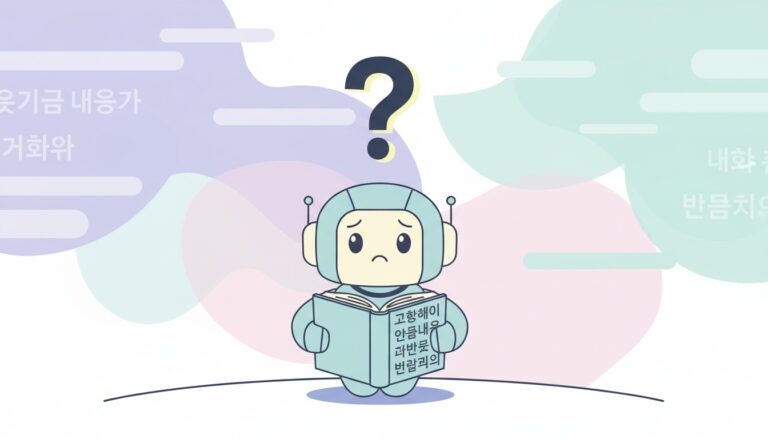
We are going to explore a famous philosophical idea called “The Chinese Room Argument” (John Searle) but in super easy Korean!
This argument asks: “Does a computer really understand language, or is it just processing symbols?”
Don’t worry, we won’t get a headache! We will learn key expressions to talk about understanding vs. just copying. Let’s upgrade your Korean brain! 🚀
Key Expressions (핵심 표현)
Here are 4 expressions to help you discuss “Real Understanding” vs. “Fake Simulation.”
1. 이해하다 (To understand)
- Pronunciation: [Ihaehada]
- English Meaning: To understand
- Detail: This is the most important word for today! In the Chinese Room argument, the person inside the room moves symbols but doesn’t understand the language. You can use this when you watch a K-Drama without subtitles!
- 💡 Pronunciation Tip: The ‘h’ (ㅎ) sound in the middle is very weak. It often sounds smoother, like [I-ae-ha-da] when spoken fast.
2. 뜻 (Meaning)
- Pronunciation: [Tteut]
- English Meaning: Meaning
- Detail: You use this to ask about the definition. John Searle says computers handle syntax (grammar/rules) but don’t know the semantics (meaning/뜻).
- 💡 Pronunciation Tip: The double consonant ‘ㄸ’ (tt) is a tense sound. Tense your throat and say a sharp ‘T’ without letting air escape! It sounds stronger than a normal ‘t’.
3. 따라 하다 (To copy / To mimic)
- Pronunciation: [Tpara hada]
- English Meaning: To follow / To copy / To mimic
- Detail: If an AI just gives an answer without thinking, it is just copying (따라 하다) the rules. K-Pop fans often use this: “춤을 따라 해요” (I copy/dance along to the dance).
- 💡 Pronunciation Tip: Like above, ‘따’ uses the tense ‘tt’ sound. Make it sharp!
4. 달라요 (It is different)
- Pronunciation: [Dallayo]
- English Meaning: It is different
- Detail: Used to say “A is different from B.” In our topic: “Human brains are different from computers.” (사람 뇌는 컴퓨터랑 달라요.)
- 💡 Pronunciation Tip: Notice the ‘ll’ sound? When ‘ㄹ’ is at the bottom of one block and the top of the next, it creates a flowing ‘L’ sound like in the English word “Lily.”
Real Conversation (실전 대화)
Let’s see how Minji and Paul talk about a new AI translator app.
Minji: 우와, 이 AI 한국어 진짜 잘해요!
(Uwa, i AI Hangugeo jinjja jalhaeyo!)
Wow, this AI speaks Korean really well!
Paul: 글쎄요. 그냥 말을 따라 하는 거 아니에요?
(Geulsseyo. Geunyang mareul ttara haneun geo anieyo?)
Well. Isn’t it just copying the words?
Minji: 무슨 말이에요?
(Museun marieyo?)
What do you mean?
Paul: AI는 뜻을 몰라요. 우리랑 달라요.
(Aineun tteuseul mollayo. Urirang dallayo.)
AI doesn’t know the meaning. It is different from us.
Minji: 아! 이해하는 게 아니군요!
(A! Ihaehaneun ge anigunyo!)
Ah! So it’s not understanding!
Culture Tip (문화 팁) 🇰🇷
“Nunchi” (눈치) vs. AI
In Korea, communication isn’t just about words; it’s about Nunchi (눈치)—the ability to gauge the atmosphere and understand unsaid feelings.
The Chinese Room argument fits perfectly here! Even if a robot speaks perfect Korean, Koreans might say it has “no Nunchi” (눈치가 없다) because it processes data but doesn’t feel the context. To speak natural Korean, you need to understand the heart (마음), not just the dictionary definitions! 😉
Wrap-up & Quiz (마무리 및 연습 문제)
Today we learned that speaking isn’t always understanding! Even if an AI looks smart, it might just be following rules without knowing the meaning (뜻).
Let’s test your knowledge! Fill in the blanks:
- “I don’t understand Korean well yet.”
-> 한국어를 잘 ( ) 못해요. - “Humans are different from robots.”
-> 사람은 로봇하고 ( ). - “Do you know the meaning?”
-> ( )을 알아요?
[Answers]
1. 이해하지 (from 이해하다)
2. 달라요
3. 뜻
Keep studying with your heart, not just your brain! See you next time! 안녕! 👋
Frequently Asked Questions (FAQ)
Q: What does "이해하다 (To understand)" mean in Korean and how do you pronounce it?
A: In Korean, "이해하다 (To understand)" is pronounced [Ihaehada] and means: To understand
Q: What does "뜻 (Meaning)" mean in Korean and how do you pronounce it?
A: In Korean, "뜻 (Meaning)" is pronounced [Tteut] and means: Meaning
Q: What does "따라 하다 (To copy / To mimic)" mean in Korean and how do you pronounce it?
A: In Korean, "따라 하다 (To copy / To mimic)" is pronounced [Tpara hada] and means: To follow / To copy / To mimic
Q: What does "달라요 (It is different)" mean in Korean and how do you pronounce it?
A: In Korean, "달라요 (It is different)" is pronounced [Dallayo] and means: It is different







