

Introduction
Hello, K-Culture lovers! It’s Daily Hangul! 👋✨
Have you ever watched a K-Drama like Kingdom or All of Us Are Dead? Zombies are scary, but today we are going to talk about a different kind of zombie: the Philosophical Zombie! 🧟♂️🧠
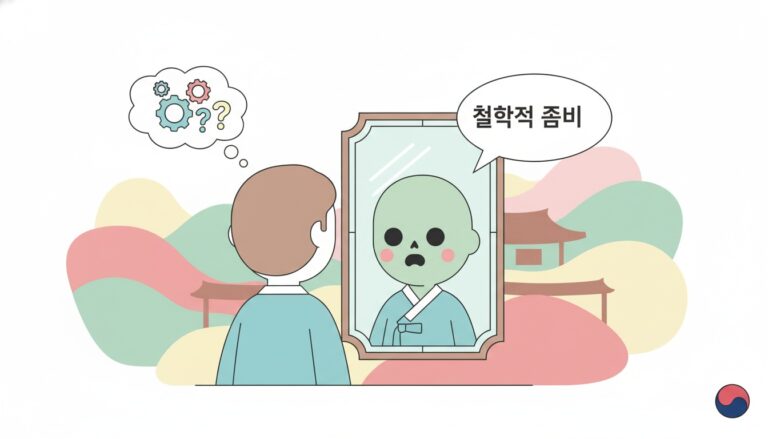
In Cognitive Science, a “Philosophical Zombie” is someone who looks and acts exactly like a human but has no inner thoughts or feelings. Imagine a K-Pop idol who dances perfectly but has zero emotion inside! 😱
Today, let’s learn essential Korean words related to the mind, soul, and feelings through this fascinating topic. These words are super useful when talking about emotions in daily life! Let’s dive in! 🚀
Key Expressions
1. 마음 (Maeum)
- Pronunciation: [Maeum]
- English Meaning: Mind / Heart
- Detail: This is one of the most important words in Korean. It represents your consciousness, your will, and your feelings. A philosophical zombie has a body, but no maeum.
- 💡 Pronunciation Tip: Connect the sounds smoothly. It sounds like “Ma-eum.”
2. 영혼 (Yeonghon)
- Pronunciation: [Yeonghon]
- English Meaning: Soul / Spirit
- Detail: In Korea, if someone speaks without sincerity, we say “You have no yeonghon!” (meaning: You are soulless). A zombie is a body without a yeonghon.
- 💡 Pronunciation Tip: The ‘h’ (ㅎ) sound is soft. Pronounce it gently, like breathing out.
3. 똑같다 (Ttokgatda)
- Pronunciation: [Ttok-kkat-ta]
- English Meaning: Exactly the same
- Detail: Use this when two things look identical. “A philosophical zombie looks ttokgatda (exactly the same) as a human.”
- 💡 Pronunciation Tip: The double consonants (ㄸ and ㄲ) make a strong, tense sound. It is pronounced like [똑깓따] because of sound rules!
4. 느끼다 (Neukkida)
- Pronunciation: [Neukkida]
- English Meaning: To feel
- Detail: Whether it’s pain, happiness, or the cold wind. Humans neukkida, but philosophical zombies just act like they feel it.
- 💡 Pronunciation Tip: Stress the ‘Kki’ part slightly. [Neu-KKI-da].
Real Dialogue
Situation: Minji and Jason are debating about a very advanced AI robot they saw on TV.
Minji: 저 로봇 좀 봐! 사람하고 똑같아. 😲
(Jeo robot jom bwa! Saramhago ttokgata.)
Look at that robot! It’s exactly the same as a human.
Jason: 응, 하지만 마음은 없잖아. 🤖
(Eung, hajiman maeum-eun eopjana.)
Yeah, but it doesn’t have a mind/heart.
Minji: 정말? 아픔을 느끼는 것처럼 보여. 🤔
(Jeongmal? Apeum-eul neukkineun geotcheoreom boyeo.)
Really? It looks like it feels pain.
Jason: 그건 그냥 연기야. 영혼이 없어! 🧟♂️
(Geugeon geunyang yeong-gi-ya. Yeonghon-i eopseo!)
That’s just acting. It has no soul!
Cultural Tip 🇰🇷
“Reaction with no Soul” (영혼 없는 리액션)
In Korea, “Soul” (영혼) is often used in slang! If your friend tells a boring story and you just say “Wow… really… cool…” in a monotone voice, your friend might say:
“너 왜 이렇게 영혼이 없어?”
(Why do you have no soul? / Why are you so insincere?)
To sound like a native Korean, put some energy (and soul!) into your reactions! “우와! 진짜?!” (Wow! Really?!) 🙌
Conclusion & Quiz
Today we explored the mysterious world of the mind using the “Philosophical Zombie” concept! Remember, speaking Korean well isn’t just about grammar; it’s about putting your Maeum (heart) into it! ❤️
📝 Mini Quiz
- Which word means “Soul”?
(A) 마음 (Maeum) (B) 영혼 (Yeonghon) -
Fill in the blank: “They look exactly the same!” = “우리는 _____!”
(A) 똑같아 (Ttokgata) (B) 느껴 (Neukkyeo) -
(True/False) A philosophical zombie has a “Maeum” (Mind).
See you next time! 안녕! 👋
Answers: 1. (B), 2. (A), 3. False
Frequently Asked Questions (FAQ)
Q: What does "마음 (Maeum)" mean in Korean and how do you pronounce it?
A: In Korean, "마음 (Maeum)" is pronounced [Maeum] and means: Mind / Heart
Q: What does "영혼 (Yeonghon)" mean in Korean and how do you pronounce it?
A: In Korean, "영혼 (Yeonghon)" is pronounced [Yeonghon] and means: Soul / Spirit
Q: What does "똑같다 (Ttokgatda)" mean in Korean and how do you pronounce it?
A: In Korean, "똑같다 (Ttokgatda)" is pronounced [Ttok-kkat-ta] and means: Exactly the same
Q: What does "느끼다 (Neukkida)" mean in Korean and how do you pronounce it?
A: In Korean, "느끼다 (Neukkida)" is pronounced [Neukkida] and means: To feel







