

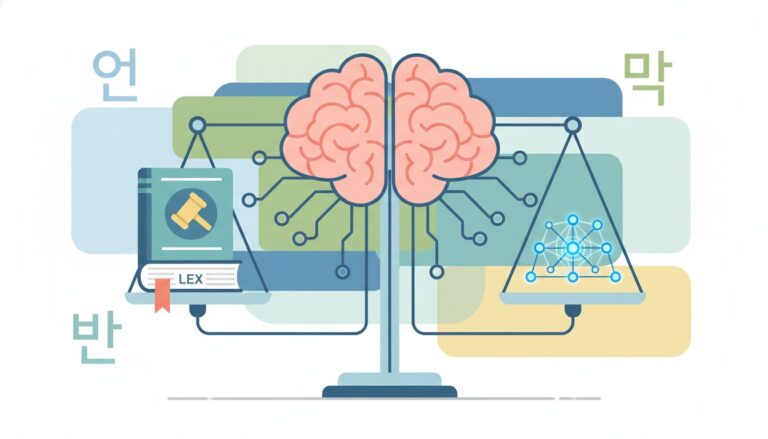
Is My Brain Safe? 🧠 Korean for BCI & Law
Introduction
Hello, everyone! It’s Daily Hangul here to upgrade your Korean skills! 😊
Have you watched the thrilling K-drama Dr. Brain (Dr. 브레인)? It explores the mysteries of connecting the human brain to computers. Today, we are going to dive into a very smart and futuristic topic: Cognitive Science and the Legal Ramifications of Brain-Computer Interfaces (BCI).
“Wait, that sounds too hard!” I hear you say. Don’t worry! We will learn the essential terms to discuss technology and law in Korean. These expressions will make you sound like a professional in any debate or serious conversation. Let’s get smart together! 🚀
Key Expressions
1. 뇌-컴퓨터 인터페이스 (Noe-keompyuteo Inteopeiseu)
- English: Brain-Computer Interface (BCI)
- Explanation: This is the direct translation. ‘뇌’ means Brain. Since ‘Computer’ and ‘Interface’ are loanwords, they sound very similar to English. You can also just say BCI in professional settings, but knowing ‘뇌’ (Brain) is essential!
2. 법적 책임 (Beopjeok chaegim)
- English: Legal responsibility
- Explanation: This is crucial when discussing who is at fault.
- 법 (Beop): Law
- 적 (Jeok): Suffix making it an adjective (Legal)
- 책임 (Chaegim): Responsibility
- 💡 Pronunciation Tip: When you say 법적, the ‘ㅂ’ (p) sound at the bottom of the first block meets the ‘ㅈ’ (j) of the next. This causes the ‘j’ to tense up into a ‘jj’ sound.
- Sound: [Beop-jjeok chaegim]
3. 부작용 (Bujagyong)
- English: Side effect / Negative ramification
- Explanation: In medical or technological contexts, this refers to unintended negative consequences. If a brain chip causes a headache or memory loss, that is a ‘부작용’.
4. 사생활 침해 (Sasaenghwal chimhae)
- English: Invasion of privacy
- Explanation: BCI deals with our thoughts, right? So privacy is a huge issue.
- 사생활 (Sasaenghwal): Private life/Privacy
- 침해 (Chimhae): Infringement/Invasion
Real Dialogue
Let’s see how two colleagues, Min-su and Ji-won, discuss a new BCI technology news report.
Min-su: 이번에 나온 뇌파 연결 기술 봤어? 정말 신기하더라.
(Ibeone naon noepa yeongyeol gisul bwasseo? Jeongmal singihadera.)
Did you see the brainwave connection technology released this time? It was really fascinating.
Ji-won: 응, 봤어. 그런데 해킹당하면 법적 책임은 누가 져?
(Eung, bwasseo. Geureonde haekingdanghamyeon beopjeok chaegim-eun nuga jyeo?)
Yeah, I saw it. But if it gets hacked, who takes legal responsibility?
Min-su: 제조사일까, 사용자일까? 사생활 침해 걱정도 좀 돼.
(Jejosailkka, sayongjailkka? Sasaenghwal chimhae geokjeongdo jom dwae.)
The manufacturer or the user? I’m also a bit worried about invasion of privacy.
Ji-won: 맞아. 아직 기술의 부작용을 우리가 다 모르니까.
(Maja. Ajik gisurui bujagyong-eul uriga da moreunikka.)
Right. Because we don’t know all the side effects of the technology yet.
Culture Tip 🇰🇷
“Ppalli-Ppalli” vs. Safety Ethics
Korea is famous for its Ppalli-Ppalli (Hurry, Hurry) culture, especially in adopting new technology. However, recently there has been a huge social movement focusing on Digital Ethics (디지털 윤리).
When discussing high-tech topics like AI or BCI with Koreans, mentioning the balance between “Technological Speed” and “Human Rights/Law” will make you look very knowledgeable and respectful of the current social climate in Seoul! 🏙️
Review & Quiz
Today we learned how to talk about the future of brains and law! Let’s check your memory.
Quiz:
1. How do you say “Legal Responsibility” in Korean?
( B__ __ __ __ C__ __ __ __ __ )
2. True or False: ‘부작용’ means ‘Good benefit’. ( O / X )
Answers:
1. 법적 책임 (Beopjeok chaegim)
2. X (It means Side effect/Negative ramification)
Keep studying, and see you next time! 안녕! 👋
Frequently Asked Questions (FAQ)
Q: What does "적" mean in Korean and how do you pronounce it?
A: In Korean, "적" is pronounced [Jeok] and means: Suffix making it an adjective (Legal)
Q: What does "책임" mean in Korean and how do you pronounce it?
A: In Korean, "책임" is pronounced [Chaegim] and means: Responsibility
Q: What does "사생활" mean in Korean and how do you pronounce it?
A: In Korean, "사생활" is pronounced [Sasaenghwal] and means: Private life/Privacy
Q: What does "침해" mean in Korean and how do you pronounce it?
A: In Korean, "침해" is pronounced [Chimhae] and means: Infringement/Invasion







