

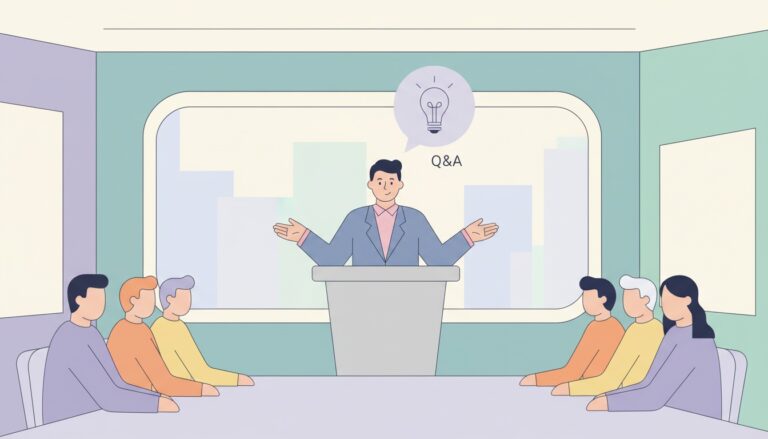
Dodge Like a Pro! 🎤 Handling Tricky Q&A in Korean
👋 Introduction
Hello, everyone! It’s your favorite Korean tutor, Daily Hangul (DailyHangul.com)! 🌟
Have you ever watched a K-Drama like Start-Up or Business Proposal? You see the main character giving a cool presentation, and suddenly… someone asks a totally random question! 😱
“What are we eating for lunch?” or “Is that rumor true?”
Don’t panic! Today, we will learn how to handle these off-topic questions politely and professionally. These expressions are super useful for business meetings, school presentations, or even serious conversations with friends. Let’s become a master of communication! 💼✨
🔑 Key Expressions
Here are 3 polite ways to steer the conversation back on track.
1. 그건 주제와 관련이 없습니다.
- Pronunciation: [Geugeon juje-wa gwallyeoni eopseumnida]
- English Meaning: That is not related to the topic.
- Detail: This is a firm but formal way to say the question is off-topic. Use this when you need to draw a clear line.
- 💡 Pronunciation Tip:
- 관련 (Gwallyeon): Notice the ‘L’ sound? When ‘ㄴ’ (n) meets ‘ㄹ’ (l), they often blend into a double ‘L’ sound. So it sounds like [Gwal-lyeon], not [Gwan-ryeon].
2. 나중에 따로 말씀드리겠습니다.
- Pronunciation: [Najunge ttaro malsseum-deurigetseumnida]
- English Meaning: I will tell you separately later.
- Detail: This is the magic phrase! Instead of saying “No,” you promise to answer later. It saves face for the asker and keeps your presentation moving. Highly recommended! 👍
- 💡 Pronunciation Tip:
- 따로 (Ttaro): The ‘ㄸ’ is a tense sound. Tense your throat and say a sharp ‘T’ without letting air escape!
3. 발표가 끝난 후에 질문해 주세요.
- Pronunciation: [Balpyoga kkeunnan hue jilmunhae juseyo]
- English Meaning: Please ask questions after the presentation is finished.
- Detail: Use this if someone keeps interrupting you with random questions. It’s polite but authoritative.
- 💡 Pronunciation Tip:
- 끝난 (Kkeunnan): The bottom ‘ㅌ’ in 끝 changes to an ‘n’ sound because of the following ‘ㄴ’. So it sounds like [Kkeun-nan].
🗣️ Real Conversation
Let’s see how Minji handles a random question from Mark during a meeting.
Minji: …그래서 이 프로젝트는 아주 중요합니다.
(…So, this project is very important.)
Mark: 저기요! 혹시 오늘 점심 메뉴는 뭐예요?
(Excuse me! By the way, what is today’s lunch menu?)
Minji: 아, 마크 씨. 그건 주제와 관련이 없습니다. 😅
(Ah, Mark. That is not related to the topic.)
Mark: 아, 죄송합니다. 너무 배가 고파서요.
(Ah, I’m sorry. I’m just so hungry.)
Minji: 점심 이야기는 나중에 따로 말씀드리겠습니다. 계속할까요?
(I will tell you about lunch separately later. Shall we continue?)
Mark: 네, 알겠습니다!
(Yes, understood!)
🇰🇷 Culture Tip
“Face” (Chemyeon, 체면) is important! 🎭
In Korea, directly rejecting someone’s question in front of others can make them lose “face” (feel embarrassed). Even if the question is silly, it is very polite to say, “I will answer you later” (나중에 말씀드릴게요) instead of just saying “I won’t answer.”
This shows that you respect the person, even if you don’t answer right now. It’s a sign of a true professional! 😎
📝 Wrap-up & Quiz
Great job today! Now you can defend your presentation from any random attacks! 🛡️ Remember, staying calm and polite is the key.
Let’s check what you learned!
- How do you say “later” in Korean?
( Hint: N_j_ng_ ) -
Which word means “separately”?
A) 같이 (Gachi)
B) 따로 (Ttaro) -
True or False: It is rude to tell someone you will answer later in Korea.
( O / X )
See you next time! 안녕! 👋
Answers:
1. 나중에 (Najunge)
2. B) 따로 (Ttaro)
3. X (False – It is actually very polite!)
Frequently Asked Questions (FAQ)
Q: What does "그건 주제와 관련이 없습니다." mean in Korean and how do you pronounce it?
A: In Korean, "그건 주제와 관련이 없습니다." is pronounced [Geugeon juje-wa gwallyeoni eopseumnida] and means: That is not related to the topic.
Q: What does "나중에 따로 말씀드리겠습니다." mean in Korean and how do you pronounce it?
A: In Korean, "나중에 따로 말씀드리겠습니다." is pronounced [Najunge ttaro malsseum-deurigetseumnida] and means: I will tell you separately later.
Q: What does "발표가 끝난 후에 질문해 주세요." mean in Korean and how do you pronounce it?
A: In Korean, "발표가 끝난 후에 질문해 주세요." is pronounced [Balpyoga kkeunnan hue jilmunhae juseyo] and means: Please ask questions after the presentation is finished.







