

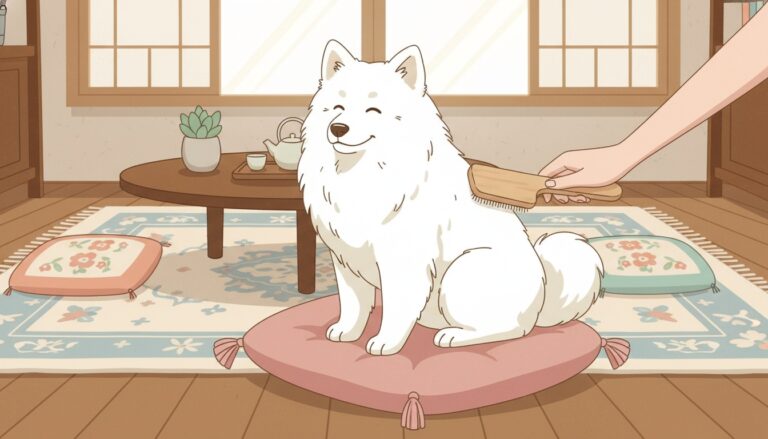
Introduction
Hello! It’s Daily Hangul, here to upgrade your Korean skills! 😊
Do you have a furry friend at home? 🐶🐱 In Korea, the number of pet owners is growing rapidly, and we even have a word for it: “Petfam” (Pet + Family). If you watch Korean reality shows like “I Live Alone” (나 혼자 산다), you often see celebrities taking care of their adorable pets.
Today, we are going to learn essential expressions for grooming your pet’s fur. Whether you are living in Korea with a pet or just want to understand what your favorite idol is saying to their dog on a live stream, this lesson is for you! Let’s make your pet shine! ✨
Core Expressions
Here are 4 useful phrases to use when brushing your pet!
1. 빗질하자! (Bitjilhaja!)
- English Meaning: Let’s brush (your) fur!
- Detailed Explanation: This is a friendly suggestion. ‘빗 (Bit)’ means ‘comb’ or ‘brush’, and ‘질 (jil)’ is a suffix meant to describe a repetitive action. Adding ‘-자 (-ja)’ makes it “Let’s do it.”
- 💡 Pronunciation Tip: When you say 빗질, the ‘ㅅ’ (t sound) meets ‘ㅈ’, making the ‘ㅈ’ sound stronger like a double ‘jj’. Pronounce it as [Bit-jjil-ha-ja].
2. 가만히 있어. (Gamanhi isseo.)
- English Meaning: Stay still.
- Detailed Explanation: Pets often wiggle around when they see a brush! Use this phrase to tell them to calm down. You will hear this a lot in K-dramas when someone is trying to fix another person’s hair or tie their tie too!
- 💡 Pronunciation Tip: The ‘ㅎ’ in 가만히 is often weak. It sounds like [Ga-ma-ni i-sseo].
3. 털이 엉켰어. (Teori eongkyeosseo.)
- English Meaning: The fur is tangled.
- Detailed Explanation: ‘털 (Teol)’ means fur or hair (for animals). ‘엉켰어 (Eongkyeosseo)’ is the past tense of “to be tangled.” Use this when you find a knot while brushing.
- 💡 Pronunciation Tip: Liaison rule! The final consonant ‘ㄹ’ in 털 moves to the next vowel slot. So 털이 sounds like [Teo-ri].
4. 아이 착해! (Ai chakhae!)
- English Meaning: Good boy/girl! (You are so good!)
- Detailed Explanation: This is the ultimate praise! ‘착해 (Chakhae)’ comes from the adjective meaning “nice” or “good-natured.” Say this with a high, happy tone to praise your pet for enduring the grooming session. 🥰
Real Conversation
Let’s see how Minji talks to her dog, Dubu, during grooming time.
Minji: 두부야, 이리 와! 빗질하자!
(Dubuya, iri wa! Bitjilhaja!)
(Dubu, come here! Let’s brush your fur!)
Dubu: (Wiggles and tries to run away)
Minji: 앗, 잠깐만. 가만히 있어.
(At, jamkkanman. Gamanhi isseo.)
(Ah, wait a second. Stay still.)
Minji: 귀 뒤에 털이 엉켰어. 아프지 않게 해 줄게.
(Gwi dwie teori eongkyeosseo. Apeuji anke hae julge.)
(The fur behind your ears is tangled. I’ll make sure it doesn’t hurt.)
Dubu: (Sits quietly)
Minji: 다 했다! 우와, 아이 착해! 간식 줄게.
(Da haetda! Uwa, ai chakhae! Gansik julge.)
(All done! Wow, good boy! I’ll give you a snack.)
Culture Tip 🇰🇷
“Pets are Maknae (The Youngest)!”
In Korea, pets are treated like actual family members. People often refer to their pets as the “Maknae” (막내), which means the youngest sibling in the family. It’s common to hear pet owners calling themselves “Mom” (엄마) or “Dad” (아빠) when talking to their pets. So, grooming isn’t just a chore; it’s a bonding time between a parent and their youngest child! 🛁
Conclusion & Quiz
Great job today! Now you can keep your pet’s fur smooth and silky while speaking Korean. Try using these phrases with your pet (or imaginary pet) today!
📝 Mini Quiz
- How do you say “Let’s brush fur” in Korean?
( ) -
True or False: “Gamanhi isseo” means “Run away quickly.”
( O / X ) -
Fill in the blank: To praise your pet, you say “Ai _______!”
a) Napo (Bad)
b) Chakhae (Good/Nice)
Answers:
1. 빗질하자 (Bitjilhaja)
2. X (It means “Stay still”)
3. b
Frequently Asked Questions (FAQ)
Q: What does "빗질하자! (Bitjilhaja!)" mean in Korean and how do you pronounce it?
A: In Korean, "빗질하자! (Bitjilhaja!)" is pronounced [Tip: When you say 빗질, the 'ㅅ' (t sound] and means: Let's brush (your) fur!
Q: What does "가만히 있어. (Gamanhi isseo.)" mean in Korean and how do you pronounce it?
A: In Korean, "가만히 있어. (Gamanhi isseo.)" is pronounced [Tip: The 'ㅎ' in 가만히 is often weak. It sounds like [Ga-ma-ni i-sseo] and means: Stay still.
Q: What does "털이 엉켰어. (Teori eongkyeosseo.)" mean in Korean and how do you pronounce it?
A: In Korean, "털이 엉켰어. (Teori eongkyeosseo.)" is pronounced [Tip: Liaison rule! The final consonant 'ㄹ' in 털 moves to the next vowel slot. So 털이 sounds like [Teo-ri] and means: The fur is tangled.
Q: What does "아이 착해! (Ai chakhae!)" mean in Korean and how do you pronounce it?
A: In Korean, "아이 착해! (Ai chakhae!)" is pronounced [see lesson guide] and means: Good boy/girl! (You are so good!)







