

🌍 Smart Korean: Talking About the Cold War & History!
👋 Introduction
Annyeonghaseyo! This is Daily Hangul, here to upgrade your Korean skills! 🎓
Today, we are going to learn something a bit different. Usually, we talk about food or travel, but today we are diving into History! 🏛️ Specifically, the Cold War (Truman Doctrine vs. Marshall Plan).
“Wait! Isn’t that too hard?” I hear you ask. Don’t worry! The words used to describe history are actually very common in daily life (like “Goal” or “Help”). Plus, understanding this era is crucial because it sets the background for many serious K-dramas and movies regarding modern Korean history (like Ode to My Father or Snowdrop).
Let’s become smart Korean speakers today! Sijak-haebolkkayo? (Shall we start?) 🚀
🔑 Key Expressions
Here are 4 key words to talk about history and goals!
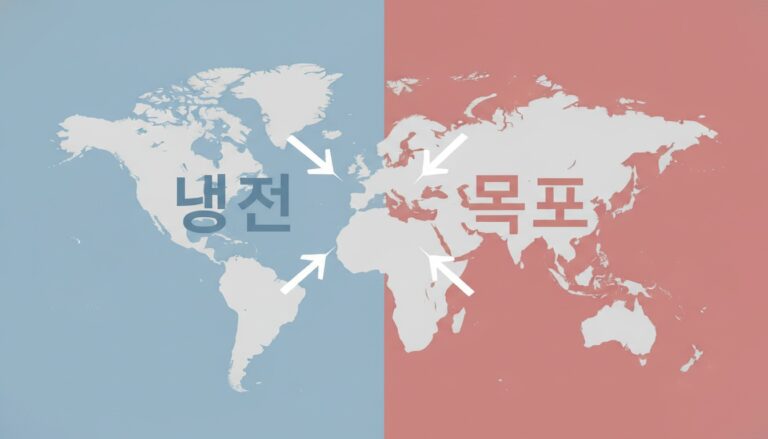
1. 냉전 (Naengjeon)
- Pronunciation: [Naeng-jeon]
- English Meaning: Cold War
- Detail: This is a combination of 냉 (Naeng) meaning ‘cold’ (like Naengmyeon noodles!) and 전 (Jeon) meaning ‘war’. It refers to the tension between the US and the USSR without direct fighting.
2. 목표 (Mokpyo)
- Pronunciation: [Mok-pyo]
- English Meaning: Goal / Objective
- Detail: You can use this word for history (“The goal of the plan…”) but also for your life! “My mokpyo is fluent Korean!”
3. 돕다 (Dopda)
- Pronunciation: [Dop-da]
- English Meaning: To help / To aid
- Detail: The Marshall Plan was all about economic aid. In Korean, we use 돕다 for helping friends or countries.
- Conjugation: Dowa-juseyo (Please help me).
4. 막다 (Makda)
- Pronunciation: [Mak-da]
- English Meaning: To block / To stop / To contain
- Detail: The Truman Doctrine‘s goal was to contain (block) the spread of communism. You can also use this when blocking a ball in soccer or blocking the wind!
💡 Pronunciation Tip (Batchim Rule):
Look at the word 막다 (Makda). The first syllable ends with a ‘k’ sound (ㄱ). When ‘k’ meets ‘d’ (ㄷ) in the next syllable, the ‘d’ sound becomes strong and tense, like ‘tt’.
* So, you pronounce it closer to [Mak-tta]! 🗣️
💬 Real Conversation
Let’s see how Minji explains history to her foreign friend Alex.
Alex: 한국 역사 숙제가 너무 어려워. ‘트루먼 독트린’이 뭐야?
(Hanguk yeoksa sukjega neomu eoryeowo. ‘Truman Doctrine’-i mwoya?)
* Korean history homework is too hard. What is the ‘Truman Doctrine’?
Minji: 공산주의가 퍼지는 것을 막는 거야.
(Gongsanjuuiga peojineun geoseul mangneun geoya.)
* It is to block communism from spreading.
Alex: 아하! 그럼 ‘마셜 플랜’의 목표는 뭐야?
(Aha! Geureom ‘Marshall Plan’-ui mokpyo-neun mwoya?)
* Aha! Then what was the goal of the ‘Marshall Plan’?
Minji: 유럽의 경제를 돕는 것이었어.
(Yureob-ui gyeongje-reul domneun geoshieosseo.)
* It was to help Europe’s economy.
🇰🇷 Cultural Tip
Why is the Cold War important to Korea?
Unlike Europe, where the Cold War ended, the Korean Peninsula is technically still the site of a “Cold War.” The division between South Korea and North Korea (DMZ) is a direct result of the Cold War era.
When you watch news in Korea, words like 냉전 (Cold War) or 동맹 (Alliance) appear often because this history is still alive here. Knowing these words shows you deeply understand Korea’s situation! 🇰🇷
📝 Wrap-up & Quiz
Today we learned how to sound intellectual by discussing the Cold War!
* Truman Doctrine = 막다 (To block/contain)
* Marshall Plan = 돕다 (To help/aid)
Let’s check your memory!
- How do you say “Cold War” in Korean? (Hint: Cold Noodles + War)
( ) - Which word means “Goal”?
a) Mokpyo (목표)
b) Hakgyo (학교)
See you next time! Annyeong! 👋
- Answers: 1. 냉전 (Naengjeon), 2. a
Frequently Asked Questions (FAQ)
Q: What does "냉전 (Naengjeon)" mean in Korean and how do you pronounce it?
A: In Korean, "냉전 (Naengjeon)" is pronounced [Naeng-jeon] and means: Cold War
Q: What does "목표 (Mokpyo)" mean in Korean and how do you pronounce it?
A: In Korean, "목표 (Mokpyo)" is pronounced [Mok-pyo] and means: Goal / Objective
Q: What does "돕다 (Dopda)" mean in Korean and how do you pronounce it?
A: In Korean, "돕다 (Dopda)" is pronounced [Dop-da] and means: To help / To aid
Q: What does "막다 (Makda)" mean in Korean and how do you pronounce it?
A: In Korean, "막다 (Makda)" is pronounced [Mak-da] and means: To block / To stop / To contain







