

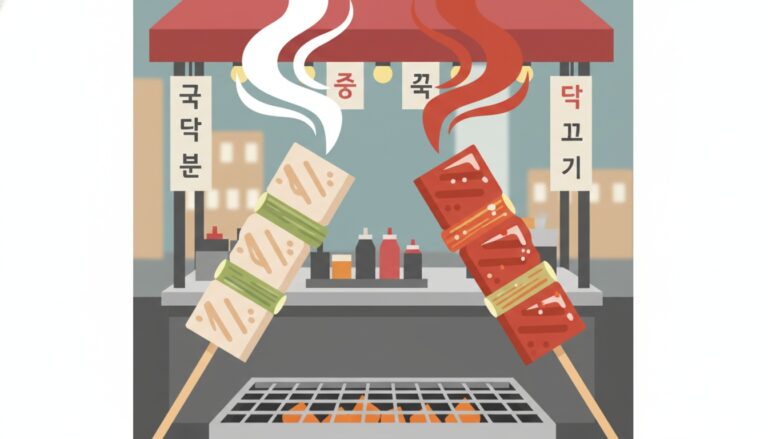
Introduction
Hello, K-Culture lovers! 👋 Welcome back to Daily Hangul, your best friend for learning Korean!
Have you ever watched a K-drama where the main characters stop by a street stall to eat delicious skewers? 🍢 That smell of grilled chicken is irresistible! Today, we are going to learn how to order Dak-kkochi (Chicken Skewers) like a pro.
The most important question when ordering is: “Salt or Sauce?” By the end of this post, you’ll be ready to grab your favorite flavor on the streets of Seoul! Let’s dive in! 😋
Key Expressions
1. 닭꼬치
- Pronunciation: [Dak-kkochi]
- English Meaning: Chicken Skewer
- Detail: This is the star of today’s lesson! ‘Dak’ means chicken, and ‘kkochi’ means skewer. It’s one of the most popular street foods in Korea.
- 💡 Pronunciation Tip: The double ‘kk’ (ㄲ) is a tense sound. Pronounce it stronger and sharper than a regular ‘k’. Imagine you are holding your breath for a split second before saying ‘kko’.
2. 소금구이
- Pronunciation: [Sogeum-gui]
- English Meaning: Salt-grilled (Salt flavor)
- Detail: If you prefer a savory, non-spicy taste where you can enjoy the natural flavor of the chicken, choose this! ‘Sogeum’ means salt.
- 💡 Pronunciation Tip: ‘Gui’ (grilled) sounds like ‘goo-ee’. Make sure to pronounce the ‘eu’ (으) in ‘Sogeum’ correctly—it sounds like the ‘u’ in ‘put’ but with your lips stretched horizontally.
3. 양념구이
- Pronunciation: [Yangnyeom-gui]
- English Meaning: Seasoned/Sauce-grilled
- Detail: This usually refers to the red, sweet, and spicy sauce. It’s the classic K-flavor! If you love a bit of a kick, this is for you.
- 💡 Pronunciation Tip: ‘Yang’ and ‘nyeom’ flow together. The ‘ny’ sound is similar to the ‘ni’ in ‘onion’.
4. … 주세요
- Pronunciation: [… juseyo]
- English Meaning: Please give me …
- Detail: This is the magic phrase for ordering anything in Korea. Just put the item name before ‘juseyo’.
Real Dialogue 🗣️
Imagine you are at a busy street food stall in Myeongdong!
A: Tourist (You)
B: Stall Owner (Sajangnim)
A: 안녕하세요! 닭꼬치 있어요?
(Annyeonghaseyo! Dak-kkochi isseoyo?)
Hello! Do you have chicken skewers?
B: 네! 소금이랑 양념 있어요.
(Ne! Sogeum-irang Yangnyeom isseoyo.)
Yes! We have salt and sauce flavors.
A: 소금 하나, 양념 하나 주세요.
(Sogeum hana, Yangnyeom hana juseyo.)
Please give me one salt and one sauce.
B: 네, 여기 있어요. 맛있게 드세요!
(Ne, yeogi isseoyo. Masitge deuseyo!)
Yes, here you go. Enjoy your meal!
Culture Tip 🇰🇷
“Mild, Medium, or Spicy?”
When you choose Yangnyeom (Sauce), sometimes the vendor might ask you about the spicy level!
Many stalls offer a range of sauces from “Sunhan-mat” (Mild) to “Nunmul-mat” (Tears flavor / Extremely spicy). 🔥 If you are not good with spicy food, stick to Sogeum-gui or ask for “Mild” sauce. Eating standing up right in front of the stall is part of the fun, and usually, there is a trash can or a cup nearby to put your empty stick (kkochi) in!
Wrap-up & Quiz 📝
Great job! Now you can confidently satisfy your hunger while traveling in Korea. Don’t be shy to speak up!
Let’s practice! (Answers are at the bottom)
- How do you say “Please give me” in Korean?
-> _______ -
If you don’t like spicy food, which flavor should you order? (Salt-grilled)
-> _______-gui -
True or False: ‘Dak’ means beef.
-> ( O / X )
See you next time! Annyeong! 👋
Answers:
1. Juseyo (주세요)
2. Sogeum (소금)
3. X (Dak means Chicken)
Frequently Asked Questions (FAQ)
Q: What does "닭꼬치" mean in Korean and how do you pronounce it?
A: In Korean, "닭꼬치" is pronounced [Dak-kkochi] and means: Chicken Skewer
Q: What does "소금구이" mean in Korean and how do you pronounce it?
A: In Korean, "소금구이" is pronounced [Sogeum-gui] and means: Salt-grilled (Salt flavor)
Q: What does "양념구이" mean in Korean and how do you pronounce it?
A: In Korean, "양념구이" is pronounced [Yangnyeom-gui] and means: Seasoned/Sauce-grilled
Q: What does "... 주세요" mean in Korean and how do you pronounce it?
A: In Korean, "... 주세요" is pronounced [... juseyo] and means: Please give me ...







