

Introduction
Annyeonghaseyo! (안녕하세요!) Hello, everyone! It’s your Korean study buddy, Daily Hangul! 🌟
Have you ever visited the National Museum of Korea in Seoul? It is a must-visit spot for K-culture fans! 🏛️ Today, we are going on a time travel adventure way back to the beginning of human history.
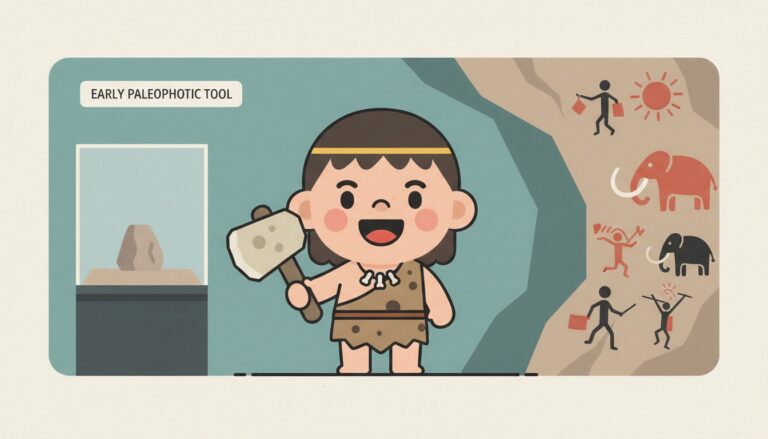
Even if you are a beginner, knowing how to talk about “history” makes you sound very smart! Today, we will learn how to describe the Paleolithic Age (Old Stone Age) and how humans started making tools. It’s like a real-life survival game, just like in the variety show Law of the Jungle! 🌴
Let’s dig into these rock-solid expressions! ⛏️
Core Expressions
Here are 4 key words to talk about ancient discoveries!
1. 구석기 (Guseokgi)
- Pronunciation: [Guseokgi]
- English Meaning: Paleolithic (Old Stone Age)
- Explanation: This word combines ‘Gu’ (Old), ‘Seok’ (Stone), and ‘Gi’ (Period). It refers to the time when early humans first used stones.
- 💡 Pronunciation Tip: The ㄱ (g) at the bottom of ‘석’ (seok) stops the sound abruptly before the next ‘기’ (gi). It sounds crisp, like Guseok-ki!
2. 돌 (Dol)
- Pronunciation: [Dol]
- English Meaning: Stone / Rock
- Explanation: A very basic and essential word! In the Stone Age, everything started with a ‘dol’.
- Fun Fact: If you watch K-dramas, you might hear about a baby’s first birthday party called Dol-janchi. But here, we are talking about actual rocks! 🪨
3. 주먹도끼 (Jumeok-dokki)
- Pronunciation: [Jumeok-dokki]
- English Meaning: Hand axe
- Explanation: This is a literal translation! 주먹 (Jumeok) means “fist” 👊 and 도끼 (Dokki) means “axe” 🪓. It is a stone tool held in the fist to cut things. It is the “smartphone” of the Stone Age—everyone needed one!
4. 만들다 (Mandeulda)
- Pronunciation: [Mandeulda]
- English Meaning: To make / To create
- Explanation: You will use this verb everywhere! In this context, humans used stones to make (mandeulda) tools.
Real-life Conversation
Imagine you are at a museum with a Korean friend, looking at a display case of ancient stones.
Minji: 와, 이 돌 좀 봐!
(Wa, i dol jom bwa!)
Wow, look at this stone!
Alex: 모양이 신기해. 칼 같아.
(Moyangi singihae. Kal gata.)
The shape is fascinating. It looks like a knife.
Minji: 맞아. 이건 구석기 시대 사람들이 썼어.
(Maja. Igeon guseokgi sidae saramdeuri sseosseo.)
Right. People from the Paleolithic era used this.
Alex: 이걸로 주먹도끼를 만들었어?
(Igeollo jumeok-dokki-reul mandeureosseo?)
Did they make a hand axe with this?
Minji: 응, 사냥할 때 썼어. 정말 똑똑하지?
(Eung, sanyanghal ttae sseosseo. Jeongmal ttokttokhaji?)
Yes, they used it when hunting. Aren’t they really smart?
Culture Tip: The Famous Korean Hand Axe 🇰🇷
Did you know Korea has a very famous archaeological site called Jeongok-ri?
In 1978, an American soldier was dating a Korean woman near the Hantan River. While walking, he found a strange stone. It turned out to be an Acheulean Hand Axe (주먹도끼)! 😲
Before this discovery, scholars thought East Asia didn’t have this advanced stone technology. This single stone found in Korea changed world history books! If you visit the Jeongok Prehistory Museum, you can see it yourself. It’s a great place to practice saying “Jumeok-dokki”!
Wrap-up & Quiz
Today we learned how to talk about the very beginning of human technology. Even complex history starts with simple words like Stone (Dol) and Make (Mandeulda)!
📝 Mini Quiz
- What is the Korean word for “Stone”?
( ______ ) -
How do you say “Hand Axe” (Fist + Axe) in Korean?
( ______ ______ ) -
True or False: 구석기 (Guseokgi) means the “Future Space Age”.
( O / X )
Good luck, and see you in the next lesson! Annyeong! 👋
Answers:
1. 돌 (Dol)
2. 주먹도끼 (Jumeok-dokki)
3. X (It means Paleolithic / Old Stone Age)
Frequently Asked Questions (FAQ)
Q: What does "구석기 (Guseokgi)" mean in Korean and how do you pronounce it?
A: In Korean, "구석기 (Guseokgi)" is pronounced [Guseokgi] and means: Paleolithic (Old Stone Age)
Q: What does "돌 (Dol)" mean in Korean and how do you pronounce it?
A: In Korean, "돌 (Dol)" is pronounced [Dol] and means: Stone / Rock
Q: What does "주먹도끼 (Jumeok-dokki)" mean in Korean and how do you pronounce it?
A: In Korean, "주먹도끼 (Jumeok-dokki)" is pronounced [Jumeok-dokki] and means: Hand axe
Q: What does "만들다 (Mandeulda)" mean in Korean and how do you pronounce it?
A: In Korean, "만들다 (Mandeulda)" is pronounced [Mandeulda] and means: To make / To create







