

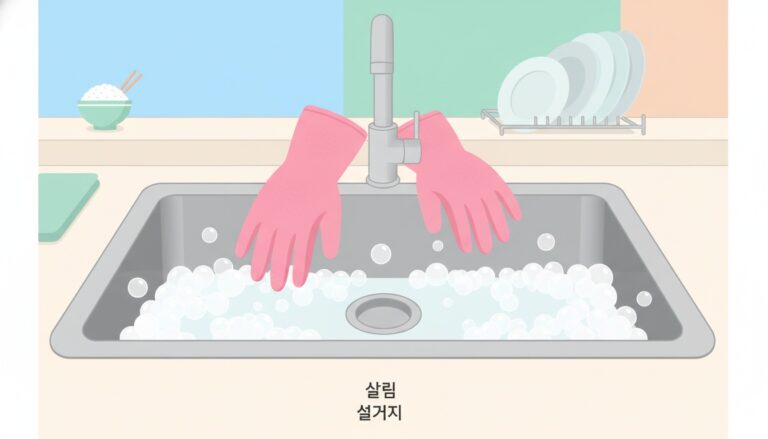
Winning Hearts: How to Offer Help with Dishes in Korea! 🍽️
Hello! It’s Daily Hangul, here to upgrade your Korean skills! 👋✨
Have you ever watched a K-Drama where the main character visits their partner’s parents? After a delicious meal, you often see them rushing to the kitchen saying, “I’ll do it!” This isn’t just about cleaning; it’s a super important way to show politeness and Jeong (affection) in Korean culture.
Today, we will learn how to offer help with the dishes after a family event or a dinner party. Mastering these phrases will make you the most loved guest in any Korean home! Let’s get started! 🚀
🔑 Key Expressions
Here are the 3 most useful phrases you need to know!
1. 제가 설거지할게요.
- Pronunciation: [Jega seolgeojihalkkeyo]
- Meaning: I will do the dishes.
- Explanation: This is the magic phrase!
- “Jega” means “I” (humble form).
- “Seolgeoji” means “dishwashing.”
- “-halkkeyo” is a grammar point used when you volunteer or promise to do something.
- 💡 Pronunciation Tip: In Seolgeoji, the ‘j’ sounds soft like ‘j’ in ‘juice’. For halkkeyo, notice the double ‘k’ sound (kk). It adds a firm, determined feeling to your offer!
2. 그냥 두세요.
- Pronunciation: [Geunyang duseyo]
- Meaning: Please just leave it.
- Explanation: You will hear this a lot from the host (or the Korean mother). They are saying, “Don’t worry about it, you are the guest!” It’s a polite refusal.
- 💡 Pronunciation Tip: Geunyang means “just.” Try to say it smoothly without stopping between syllables.
3. 같이 해요.
- Pronunciation: [Gachi haeyo]
- Meaning: Let’s do it together.
- Explanation: If the host insists on doing the dishes, you can suggest doing it together. It’s a sweet compromise!
- 💡 Pronunciation Tip: This is tricky! 같이 is written as ‘gati’ but pronounced as [gachi]. This is due to a rule called palatalization. So remember: Ga-chi!
💬 Real-life Dialogue
Let’s see how this works in a real situation. Mina is visiting her friend’s house and just finished dinner with the mother.
Mina: 어머니, 음식 너무 맛있었어요! 제가 설거지할게요.
(Mother, the food was delicious! I will do the dishes.)
Mother: 아이고, 아니에요. 손님인데 그냥 두세요.
(Oh my, no. You are a guest, please just leave it.)
Mina: 아니에요, 제가 하고 싶어서 그래요. 같이 해요!
(No, I really want to do it. Let’s do it together!)
Mother: 그래요? 그럼 그 접시만 좀 닦아 줄래요? 고마워요.
(Really? Then can you wipe just that plate? Thank you.)
🇰🇷 Culture Tip: The “Pink Gloves”!
Did you know? almost every Korean household has a pair of bright pink rubber gloves (Gomu-janggap) in the kitchen! 🧤🌸
Also, in Korea, even if the host says “No, sit down,” it is considered good manners (Nunchi) to offer at least one more time. It shows you care. If they refuse 3 times, then you can politely say “Thank you” and sit down. It’s like a polite dance!
📝 Wrap-up & Quiz
Today we learned how to be a polite guest by offering to do the dishes (Seolgeoji). Next time you are in Korea, try stealing the rubber gloves and winning the host’s heart! 😉
Let’s test your skills!
- Fill in the blank:
“I will do the dishes” = 제가 ______ 할게요. (Jega ______ halkkeyo) -
True or False:
If the host says “Just leave it” (Geunyang duseyo), you must immediately sit down and watch TV.
See you next time! 안녕! 👋
Answers:
1. 설거지 (Seolgeoji)
2. False! (It’s polite to offer once or twice more!)
Frequently Asked Questions (FAQ)
Q: What does "제가 설거지할게요." mean in Korean and how do you pronounce it?
A: In Korean, "제가 설거지할게요." is pronounced [Jega seolgeojihalkkeyo] and means: I will do the dishes.
Q: What does "그냥 두세요." mean in Korean and how do you pronounce it?
A: In Korean, "그냥 두세요." is pronounced [Geunyang duseyo] and means: Please just leave it.
Q: What does "같이 해요." mean in Korean and how do you pronounce it?
A: In Korean, "같이 해요." is pronounced [Gachi haeyo] and means: Let's do it together.






