

Introduction
Hello! It’s Daily Hangul (DailyHangul.com), here to upgrade your Korean skills! 🌟
Have you ever watched a K-drama where the main character finds an old cassette tape or a diary from the past? 📼 Today, we are going to mix Tradition and Modernity!
We will learn how to talk about recording old stories (oral history) using digital technology. It sounds difficult, but don’t worry! We will use simple expressions that you can use when you want to vlog, record a voice memo, or save a precious memory. Let’s become history keepers! 📝✨
Key Expressions
1. 녹음하다 (Nogeumhada)
- Meaning: To record (audio)
- Detail: This verb is used when you record voice or sound. If you are recording a video, you often use ‘촬영하다 (chwalyeonghada)’, but ‘녹음하다’ is perfect for capturing stories or interviews.
- 💡 Pronunciation Tip: When you say this, the bottom consonant ‘ㄱ’ (k/g) moves over to the next empty circle ‘ㅇ’. So it sounds like [No-geum-ha-da]. Smooth like butter! 🧈
2. 옛날이야기 (Yennal-iyagi)
- Meaning: Old story / Folktale
- Detail: Instead of the difficult word ‘oral history’ (구전 역사), Koreans often use this friendly word. It literally means “old days story.” It gives a cozy vibe, like listening to a grandmother.
- 💡 Pronunciation Tip: ‘옛’ (yet) + ‘날’ (nal). Because of nasalization, the ‘ㅅ’ (t sound) changes to an ‘n’ sound. It sounds like [Yen-nal-i-ya-gi].
3. 올리다 (Ollida)
- Meaning: To upload / To post
- Detail: In the digital age, we don’t just keep files; we share them! You use this word when uploading content to Instagram, YouTube, or a blog. “YouTube-e ollida” (Upload to YouTube).
- 💡 Pronunciation Tip: Pronounce the double ‘ㄹ’ clearly! [Ol-li-da].
4. 남기다 (Namgida)
- Meaning: To leave (behind) / To save
- Detail: This is used when you want to “leave a record” or “save a memory.” It’s very poetic and useful.
- 💡 Pronunciation Tip: [Nam-gi-da]. No tricky rules here, just say it as it looks!
Real-life Conversation
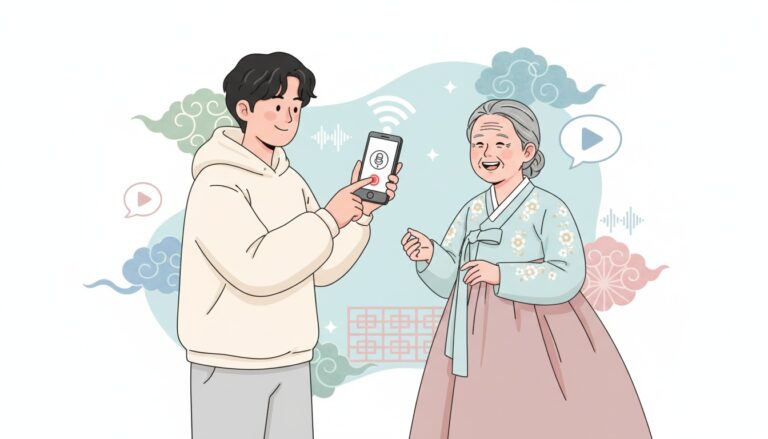
Situation: Min-ji is recording her grandmother telling a story about her childhood using her smartphone.
Min-ji: 할머니, 아까 그 옛날이야기 다시 해주세요.
(Halmeoni, akka geu yennal-iyagi dasi haejuseyo.)
Grandma, please tell me that old story again.
Grandma: 지금? 왜?
(Jigeum? Wae?)
Now? Why?
Min-ji: 핸드폰으로 녹음하고 싶어요.
(Haendeupon-euro nogeumhago sipeoyo.)
I want to record it with my phone.
Grandma: 아이고, 부끄러워라.
(Aigo, bukkeureowora.)
Oh my, I’m shy.
Min-ji: 인터넷에 올려서 기록을 남길 거예요!
(Inteonet-e ollyeoseo girogeul namgil geoyeyo!)
I will upload it to the internet and save the record!
Culture Tip 🇰🇷
“Halmeoni’s (Grandma’s) Wisdom”
In Korea, grandparents are often seen as the keepers of history. There is a strong culture of respecting elders and listening to their wisdom. Lately, many young Koreans are becoming “Digital Creators” who interview their grandparents to preserve dialects (Satoori) or traditional recipes that are disappearing! 🥘📱 Just like in the drama Navillera, bridging the gap between generations is a heartwarming trend in Korea.
Conclusion & Quiz
Today we learned how to save the past using modern tools! You can now say you are “recording” and “uploading.” Try using these words when you post your next Story! 📸
📝 Mini Quiz
- I want to _____ (record) this song.
( 노래를 [ ? ] 싶어요. ) -
Please tell me an _____ (old story).
( [ ? ] 좀 해주세요. ) -
I will _____ (upload) the video.
( 비디오를 [ ? ] 거예요. )
Answers:
1. 녹음하고 (Nogeumhago)
2. 옛날이야기 (Yennal-iyagi)
3. 올릴 (Ollil) / 올리다 (Ollida)
Frequently Asked Questions (FAQ)
Q: What does "녹음하다 (Nogeumhada)" mean in Korean and how do you pronounce it?
A: In Korean, "녹음하다 (Nogeumhada)" is pronounced [Tip: When you say this, the bottom consonant 'ㄱ' (k/g] and means: To record (audio)
Q: What does "옛날이야기 (Yennal-iyagi)" mean in Korean and how do you pronounce it?
A: In Korean, "옛날이야기 (Yennal-iyagi)" is pronounced [Tip: '옛' (yet] and means: Old story / Folktale
Q: What does "올리다 (Ollida)" mean in Korean and how do you pronounce it?
A: In Korean, "올리다 (Ollida)" is pronounced [Tip: Pronounce the double 'ㄹ' clearly! [Ol-li-da] and means: To upload / To post
Q: What does "남기다 (Namgida)" mean in Korean and how do you pronounce it?
A: In Korean, "남기다 (Namgida)" is pronounced [Tip: [Nam-gi-da] and means: To leave (behind) / To save







