

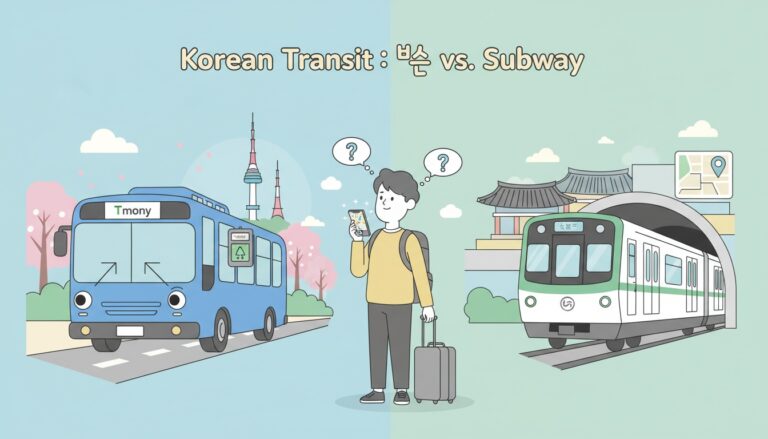
Introduction
Hello, everyone! It’s your favorite Korean tutor, Daily Hangul (DailyHangul.com)! 🌟 Ready to level up your Korean skills today?
Imagine you are in Seoul. You need to get to a K-pop concert or meet a friend at a famous cafe. Should you take the subway? Or the bus? Or maybe a taxi?
In K-Dramas, you often see characters running to catch a bus 🚌 or waiting romantically at a subway station 🚇. Today, we will learn how to compare transportation methods so you can travel like a pro! Let’s find out “Which one is more comfortable?”
Key Expressions
Here are 3 essential phrases to help you choose the best way to travel!
1. 어떤 게 더 편해요? (Eotteon ge deo pyeonhaeyo?)
- English: Which one is more comfortable?
- Detail:
- 어떤 게 (Eotteon ge): Which one (short for 어떤 것이).
- 더 (deo): More. This is the magic word for comparisons!
- 편해요 (pyeonhaeyo): Comfortable/Convenient.
- Usage: You can replace ‘편해요’ with ‘빨라요’ (ppallayo – fast) or ‘좋아요’ (joayo – good).
2. A보다 B가 더 빨라요. (A-boda B-ga deo ppallayo.)
- English: B is faster than A.
- Detail:
- ~보다 (~boda): This particle means “than.” It attaches to the noun being compared against.
- Example: “Bus-boda Subway-ga…” means “Compared to the bus, the subway is…”
3. 시간이 얼마나 걸려요? (Sigani eolmana geollyeoyo?)
- English: How long does it take?
- Detail: This is crucial when planning your trip! You will hear this in almost every travel variety show in Korea.
💡 Pronunciation Tip
Let’s look at 같이 (Together) and 편해요 (Comfortable).
- 편해요 [Pyeon-hae-yo]: Sometimes, the ‘h’ (ㅎ) sound is weak. When spoken fast, it sounds like [Pyeonaeyo].
- 지하철 [Ji-ha-cheol]: Make sure to pronounce the ‘ch’ strongly! It’s the subway!
Real Conversation
Let’s see how Minji and Jason decide on their transport to Gangnam! 🏙️
Jason: 강남까지 어떻게 가요?
(Gangnam-kkaji eotteoke gayo?)
How do we go to Gangnam?
Minji: 지하철하고 버스가 있어요. 어떤 게 더 편해요?
(Jihacheol-hago beoseu-ga isseoyo. Eotteon ge deo pyeonhaeyo?)
There is the subway and the bus. Which is more comfortable?
Jason: 버스보다 지하철이 더 빨라요.
(Beoseu-boda jihacheol-i deo ppallayo.)
The subway is faster than the bus.
Minji: 그래요? 그럼 지하철을 타요!
(Geuraeyo? Geureom jihacheol-eul tayo!)
Really? Then let’s take the subway!
Culture Tip 🇰🇷
Did you know about the “Transfer System” (Hwanseung – 환승)?
In Korea, if you use a transportation card (like the T-Money card seen in many dramas), you can transfer between the subway and bus for free within 30 minutes! 🤑 This is why many Koreans say public transport is the best. Don’t forget to tap your card when you get off (tag-out) to get this discount!
Conclusion & Quiz
Great job! Now you can compare transportation methods like a local. Whether you want speed or comfort, you know what to ask! 😉
📝 Mini Quiz
- Fill in the blank: “Bus is faster than walking.”
= 걷기 (Walking) [ ] 버스가 빨라요. - How do you say “More” in Korean?
(A) 덜 (Deol) (B) 더 (Deo) - True or False: You can transfer between bus and subway for free in Korea within 30 mins.
Answers:
1. 보다 (boda)
2. (B) 더 (Deo)
3. True (O)
Frequently Asked Questions (FAQ)
Q: What does "어떤 게" mean in Korean and how do you pronounce it?
A: In Korean, "어떤 게" is pronounced [Eotteon ge] and means: Which one (short for 어떤 것이).
Q: What does "더" mean in Korean and how do you pronounce it?
A: In Korean, "더" is pronounced [deo] and means: More. This is the magic word for comparisons!
Q: What does "편해요" mean in Korean and how do you pronounce it?
A: In Korean, "편해요" is pronounced [pyeonhaeyo] and means: Comfortable/Convenient.
Q: What does "~보다" mean in Korean and how do you pronounce it?
A: In Korean, "~보다" is pronounced [~boda] and means: This particle means "than." It attaches to the noun being compared against.







