

Introduction
Hello! It’s Daily Hangul (DailyHangul.com), here to upgrade your Korean skills! 🌟
Have you ever watched a Korean movie like Collectors (도굴) or a historical drama (Sageuk) and wondered what they are saying when they find a hidden treasure? Or maybe you dream of visiting Gyeongju, the ancient capital, and understanding the history beneath your feet! 🏺
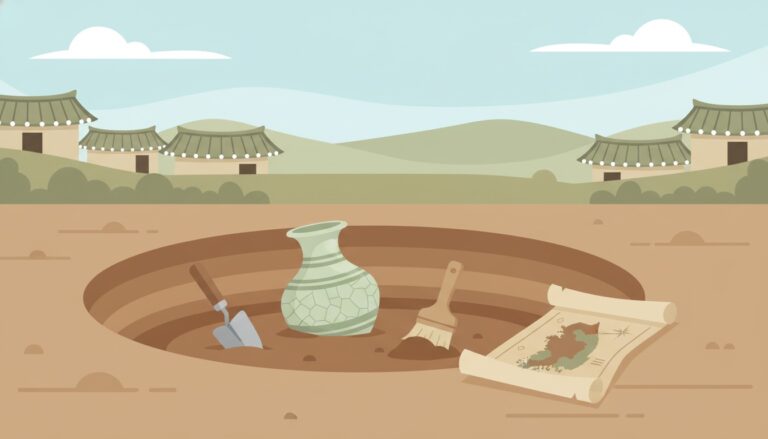
Today, we are going to channel our inner Indiana Jones! We will learn how to talk about Archaeological Discoveries and Reviewing Excavation Plans. While this sounds professional, these words are super useful when visiting museums or watching news about history! Let’s dig in! ⛏️
Key Expressions
Here are 4 key expressions to make you sound like a history expert!
1. 유물 (Yumul)
- Pronunciation: [Yumul]
- English Meaning: Artifact / Relic
- Detail: This is the most common word for items left behind by ancestors, like pottery or tools. You will hear this constantly in museums.
- 💡 Pronunciation Tip: Pronounce it smoothly. There is no pause between ‘Yu’ and ‘mul’.
2. 발굴하다 (Balgulhada)
- Pronunciation: [Balgulhada]
- English Meaning: To excavate / To dig up
- Detail: Used when digging the ground to find historical items. In a business context, it can also mean “discovering” new talent!
- 💡 Pronunciation Tip: The ‘L’ in Bal and ‘G’ in gul are distinct. Make sure to pronounce the ‘L’ (ㄹ) clearly at the bottom.
3. 검토하다 (Geomtohada)
- Pronunciation: [Geomtohada]
- English Meaning: To review / To examine
- Detail: This is a very common formal verb used in offices. Whether you are checking an excavation plan or a business report, you use this.
- 💡 Pronunciation Tip: The ‘H’ in hada is often soft. In fast speech, it sounds like [Geomtoda].
4. 가치 (Gachi)
- Pronunciation: [Gachi]
- English Meaning: Value / Worth
- Detail: You use this to say something is important.
Frequently Asked Questions (FAQ)
Q: What does "유물 (Yumul)" mean in Korean and how do you pronounce it?
A: In Korean, "유물 (Yumul)" is pronounced [Yumul] and means: Artifact / Relic
Q: What does "발굴하다 (Balgulhada)" mean in Korean and how do you pronounce it?
A: In Korean, "발굴하다 (Balgulhada)" is pronounced [Balgulhada] and means: To excavate / To dig up
Q: What does "검토하다 (Geomtohada)" mean in Korean and how do you pronounce it?
A: In Korean, "검토하다 (Geomtohada)" is pronounced [Geomtohada] and means: To review / To examine
Q: What does "가치 (Gachi)" mean in Korean and how do you pronounce it?
A: In Korean, "가치 (Gachi)" is pronounced [Gachi] and means: Value / Worth






