

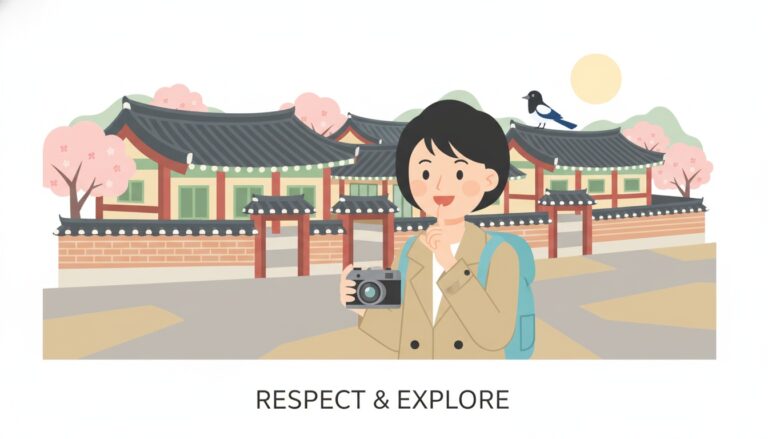
Introduction
Hello, everyone! 👋 It’s Daily Hangul, your friendly guide to mastering Korean!
Have you watched the K-drama Hometown Cha-Cha-Cha? 🌊 In the drama, people from the city visit the peaceful seaside village of Gongjin. While travel is fun, have you ever thought about how tourism affects the people actually living there?
Today, we are diving into a slightly deep but very important topic: Tourism Anthropology (관광 인류학)! Don’t worry, we will make it super easy. We’ll learn how to talk about respecting local culture and being a “Good Tourist” in Korea. Let’s level up your Korean and your travel etiquette! 🚀
Key Expressions
Here are 3 essential words to help you travel responsibly in Korea.
1. 현지인 (Hyeonjiin)
- Pronunciation: [Hyeon-ji-in]
- English Meaning: Local / Local people
- Detail: This word combines ‘Hyeonji’ (local site) and ‘In’ (person). When you travel, you aren’t just a tourist; you are interacting with hyeonjiin.
- 💡 Pronunciation Tip: Pronounce each syllable clearly. It flows like “Hyeon-jee-in”.
2. 피해를 주다 (Pihaereul juda)
- Pronunciation: [Pi-hae-reul ju-da]
- English Meaning: To cause damage / To inconvenience
- Detail: In Korea, not causing trouble to others is a huge cultural value. You often hear “Pihaereul jumyeon andwaeyo” (You shouldn’t cause inconvenience).
- 💡 Pronunciation Tip: The ‘H’ in ‘Hae’ is soft. ‘Ju-da’ sounds like ‘Chu-da’ sometimes depending on the sentence, but sticking to a soft ‘J’ is safe!
3. 지키다 (Jikida)
- Pronunciation: [Ji-ki-da]
- English Meaning: To protect / To keep (rules)
- Detail: You can use this for “keeping promises” (yaksogeul jikida) or “following rules” (gyuchigeul jikida). As a good tourist, we want to jikida the local environment!
- 💡 Pronunciation Tip: The ‘K’ in ‘Ki’ is an aspirated sound. A puff of air should come out when you say ‘Ki’.
Real Conversation
Imagine you are visiting the beautiful Bukchon Hanok Village in Seoul with a friend. 🏘️
A (Tourist): 우와, 여기 진짜 예쁘다! 사진 찍자!
(Uwa, yeogi jinjja yeppeuda! Sajin jjikja!)
(Wow, it’s really pretty here! Let’s take a picture!)
B (Friend): 쉿! 조용히 해야 해. 여기는 현지인들이 사는 곳이야.
(Shit! Joyonghi haeya hae. Yeogineun hyeonjiinderi saneun gosiya.)
(Shh! We have to be quiet. This is where locals live.)
A: 아, 맞다. 사람들에게 피해를 주면 안 되지.
(A, matda. Saramdeurege pihaereul jumyeon an doeji.)
(Ah, right. We shouldn’t cause inconvenience to people.)
B: 응, 우리의 매너를 잘 지키자!
(Eung, uriui maeneoreul jal jikija!)
(Yeah, let’s keep our manners well!)
Culture Tip: Sustainable Tourism in Korea 🇰🇷
Did you know that Bukchon Hanok Village (famous for traditional houses) actually has “Quiet Time” rules? 🤫
From a Tourism Anthropology perspective, this is about the balance between sharing culture and protecting the daily lives of residents. Because too many tourists made noise and left trash, the residents suffered (this is called ‘Overtourism’).
So, in Korea, if you visit residential tourist spots (like Mural Villages or Hanok Villages), you might see signs asking for silence. Being a traveler who respects the local vibe makes you a true pro! This is how we protect the Korean Wave (Hallyu) together. 🌏✨
Conclusion & Quiz
Today we learned how to be a respectful traveler in Korea! Remember, a great traveler respects the 현지인 (locals).
📝 Mini Quiz!
- What is the Korean word for “Local people”?
( Hint: H _ _ _ _ _ _ _ n ) -
Fill in the blank: “Rules” in Korean is ‘Gyuchik’. To say “Keep the rules”, you say “Gyuchigeul ______.”
a) Mokda (Eat)
b) Jikida (Keep) -
True or False: It is okay to be very loud in Hanok Villages because they are tourist sites.
( O / X )
Scroll down for answers!
.
.
.
.
Answers:
1. Hyunjiin (현지인)
2. b) Jikida (지키다)
3. X (False! People live there, so shh! 🤫)
Frequently Asked Questions (FAQ)
Q: What does "현지인 (Hyeonjiin)" mean in Korean and how do you pronounce it?
A: In Korean, "현지인 (Hyeonjiin)" is pronounced [Hyeon-ji-in] and means: Local / Local people
Q: What does "피해를 주다 (Pihaereul juda)" mean in Korean and how do you pronounce it?
A: In Korean, "피해를 주다 (Pihaereul juda)" is pronounced [Pi-hae-reul ju-da] and means: To cause damage / To inconvenience
Q: What does "지키다 (Jikida)" mean in Korean and how do you pronounce it?
A: In Korean, "지키다 (Jikida)" is pronounced [Ji-ki-da] and means: To protect / To keep (rules)







