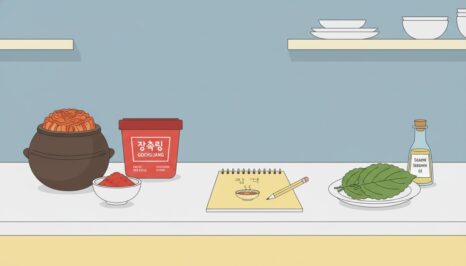
Cook Like a Chef! 🍳 Writing Simple Korean Recipes
Introduction
Hello! It’s your Korean learning buddy, Daily Hangul (DailyHangul.com)! 👋
Have you ever watched a K-Drama like Reply 1988 or Crash Landing on You and suddenly craved the Ramyeon or Bibimbap they were eating? 🍜 Today, we are going to learn how to write (and read) a simple recipe note in Korean!
Whether you want to jot down a quick recipe from a Korean friend or understand the instructions on a Ramyeon packet, these expressions are essential. Let’s become a K-Food master today! Let’s go! (Gaja! 가자!) 🚀
Key Expressions: Cooking Steps
Here are 4 essential phrases you will see in almost every simple Korean recipe note.
1. 물을 끓이세요
- Pronunciation: [Mureul kkeulhiseyo]
- English: Please boil the water.
- Explanation: This is usually the first step! ‘물’ (Mul) is water, and ‘끓이세요’ (Kkeulhiseyo) comes from the verb ‘끓이다’ (to boil). You can use this for tea, coffee, or Ramyeon.
- 💡 Pronunciation Tip: The double consonant ‘ㄹㅎ’ in 끓 looks scary, right? When followed by a vowel like ‘이’, the ‘ㅎ’ (h) sound becomes very weak or silent. It sounds more like [Kkeu-ri-se-yo] in natural speed!
2. 재료를 넣으세요
- Pronunciation: [Jaeryoreul neoeuseyo]
- English: Please put in the ingredients.
- Explanation: ‘재료’ (Jaeryo) means ingredients. ‘넣으세요’ (Neoeuseyo) means “please put in” or “add.” You can replace ‘ingredients’ with specific items like ‘김치’ (Kimchi) or ‘면’ (Noodles).
- 💡 Pronunciation Tip: Use the Liaison Rule! The final consonant ‘ㅎ’ in 넣 moves to the next vowel spot. So, it sounds like [Neo-eu-se-yo].
3. 잘 섞으세요
- Pronunciation: [Jal seokkeuseyo]
- English: Please mix well.
- Explanation: Essential for Bibimbap! ‘잘’ (Jal) means well, and ‘섞으세요’ (Seokkeuseyo) means mix.
- 💡 Pronunciation Tip: The double consonant ‘ㄲ’ (kk) moves over to the next syllable. Pronounce it sharply as [Seo-kkeu-se-yo].
4. 맛있게 드세요
- Pronunciation: [Masitge deuseyo]
- English: Please enjoy your meal (Eat deliciously).
- Explanation: This is the perfect way to end a recipe note! It’s the polite version of “Bon Appétit.”
Real-life Dialogue: The Ramyeon Note 📝
Minji wrote a quick sticky note for Jason on how to cook the special “Minji-style Ramyeon.”
Jason: (Reading the note) 민지야, 이 메모 뭐야? (Minji-ya, i memo mwoya?)
Minji: 아, 라면 레시피야! (Ah, Ramyeon recipe-ya!)
(The Note says:)
1. 물을 끓이세요. (Boil the water.)
2. 면과 스프를 넣으세요. (Put in noodles and soup.)
3. 계란을 넣고 섞으세요. (Add an egg and mix.)
4. 맛있게 드세요! (Enjoy!)
Jason: 오, 간단하네! 고마워. (Oh, gandanhane! Gomawo.)
Minji: 응, 꼭 계란 넣어야 해! (Eung, kkok gyeran neoeoya hae!)
- Jason: Minji, what is this note?
- Minji: Ah, it’s a Ramyeon recipe!
- Jason: Oh, it’s simple! Thanks.
- Minji: Yeah, you must add the egg!
Culture Tip: “Son-mat” (Hand Taste) 🖐️
In Korea, we often say that food tastes better because of “Son-mat” (손맛), which literally means “hand taste.” It refers to the unique flavor that comes from a person’s touch, care, and experience—like a mother’s cooking.
Even for a simple recipe note, adding a small drawing of a heart ❤️ or a smiley face 😊 at the end adds your own “warmth” to the message. Try adding “사랑을 담아서” (Sarangeul damaseo – With love) in your next note!
Wrap-up & Quiz ✍️
Today we learned how to write simple cooking instructions. You are now ready to share your secret recipes in Korean!
Let’s check your memory! (Fill in the blanks)
- To make tea, you need to
물을 OOOO. (Boil the water) - To make Bibimbap, you need to
잘 OOOO. (Mix well) - To add ingredients, you say
재료를 OOOO. (Put in)
[Answers]
1. 끓이세요 (Kkeulhiseyo)
2. 섞으세요 (Seokkeuseyo)
3. 넣으세요 (Neoeuseyo)
See you next time! 안녕! 👋
Frequently Asked Questions (FAQ)
Q: What does "물을 끓이세요" mean in Korean and how do you pronounce it?
A: In Korean, "물을 끓이세요" is pronounced [Mureul kkeulhiseyo] and means: a key conversational Korean expression covered in this lesson.
Q: What does "재료를 넣으세요" mean in Korean and how do you pronounce it?
A: In Korean, "재료를 넣으세요" is pronounced [Jaeryoreul neoeuseyo] and means: a key conversational Korean expression covered in this lesson.
Q: What does "잘 섞으세요" mean in Korean and how do you pronounce it?
A: In Korean, "잘 섞으세요" is pronounced [Jal seokkeuseyo] and means: a key conversational Korean expression covered in this lesson.
Q: What does "맛있게 드세요" mean in Korean and how do you pronounce it?
A: In Korean, "맛있게 드세요" is pronounced [Masitge deuseyo] and means: a key conversational Korean expression covered in this lesson.