👋 Hello! Welcome to Daily Hangul! (DailyHangul.com)
Hello, K-Culture lovers! I’m your friendly Korean tutor, Daily Hangul! 🍎✨
Have you ever watched a K-Drama where the main character wants to succeed but hits a wall? 🤔 Then, they go to a cool Sunbae (senior) or a wise mentor and say, “Please teach me!” That is the moment their life changes!
Today, we are going to learn how to ask for guidance or advice in Korean. Whether you want to improve your Korean, learn a new skill, or adjust to life in Korea, knowing how to ask for help politely is a superpower! 🦸♀️🦸♂️
Ready to find your mentor? Let’s go! (Gogo! 고고!)
📚 Key Expressions: Asking for Help
Here are the 4 most useful expressions to win your mentor’s heart!
1. 시간 괜찮으세요? (Sigan gwaenchaneuseyo?)
- Meaning: Do you have time? / Is this a good time?
- Explanation: Before asking a big favor, politeness is key! This is the magic phrase to open a conversation without being rude. In K-Dramas, you often see a junior employee knocking on a door and saying this.
- 💡 Pronunciation Tip:
- The ‘S’ in Si sounds like ‘Sh’ in ‘She’. So it sounds like [Shigan].
- Gwaenchaneuseyo is a bit long! Try breaking it: Gwaen-chan-eu-se-yo.
2. 조언 좀 부탁드려요. (Jo-eon jom butakdeuryeoyo.)
- Meaning: I’d like to ask for some advice.
- Explanation:
- Jo-eon (조언) = Advice
- Butakdeuryeoyo (부탁드려요) = I request/ask of you (very polite).
- This is a formal and respectful way to ask a superior for their wisdom.
- 💡 Pronunciation Tip:
- The j in jom sounds soft.
- Link the sounds naturally: Jo-eon-jom.
3. 배우고 싶어요. (Baeugo sipeoyo.)
- Meaning: I want to learn.
- Explanation: Mentors love passion! ❤️🔥 Instead of just asking for an answer, showing that you want to learn makes a great impression.
- Baeu-da (배우다) = To learn.
- ~go sipeoyo (~고 싶어요) = I want to…
- 💡 Pronunciation Tip:
- Sipeoyo sounds like [Shi-peo-yo].
4. 도와주셔서 감사합니다. (Dowajusyeoseo gamsahamnida.)
- Meaning: Thank you for helping me.
- Explanation: Always finish with gratitude! This phrase is specific for when someone has given you help.
- 💡 Pronunciation Tip:
- Gamsahamnida often sounds like [Gamsamnida] in fast speech because the ‘h’ gets weak.
🗣️ Real-Life Conversation: At the Office/School
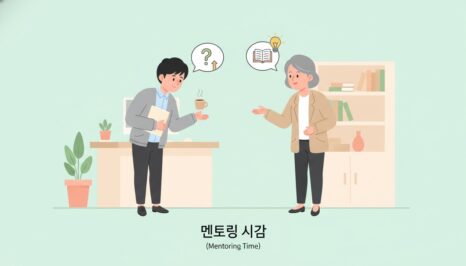
Imagine you are a Hoobae (Junior) asking a Sunbae (Senior) for help with a project.
👩🦰 Minji (Hoobae): 선배님, 혹시 시간 괜찮으세요?
(Sunbaenim, hoksi sigan gwaenchaneuseyo?)
[Sunbae, by any chance, do you have time?]
🧑💼 Jun-u (Sunbae): 응, 민지야. 무슨 일이야?
(Eung, Minji-ya. Museun iriya?)
[Yeah, Minji. What’s up?]
👩🦰 Minji: 이 프로젝트를 잘하고 싶은데 어려워요. 조언 좀 부탁드려요.
(I peurojekteureul jalhago sipeunde eoryeowoyo. Jo-eon jom butakdeuryeoyo.)
[I want to do this project well, but it’s hard. I’d like to ask for some advice.]
🧑💼 Jun-u: 그래? 열정이 대단하네! 내가 도와줄게.
(Geurae? Yeoljeong-i daedanhane! Naega dowajulge.)
[Really? Your passion is amazing! I will help you.]
👩🦰 Minji: 와! 정말 배우고 싶어요. 감사합니다!
(Wa! Jeongmal baeugo sipeoyo. Gamsahamnida!)
[Wow! I really want to learn. Thank you!]
🎭 Culture Tip & Drama Scene
☕ The “Coffee Tribute”
In Korea, when you ask a mentor or a Sunbae for advice, it is very common to bring a small canned coffee or a vitamin drink! 🥤 It shows “Jeong” (affection/connection) and respect.
Drama Scene: Think of the drama “Start-Up” or “Misaeng”. Whenever the main characters feel lost, they approach their mentor humbly, often bowing slightly. The attitude (politeness) is just as important as the words! If you use the expressions above with a polite smile, no Korean will refuse to help you! 😉
📝 Wrap-up & Practice Quiz
Today we learned how to approach a mentor and ask for guidance. Don’t be afraid to ask!
Let’s check your understanding! (Fill in the blanks)
- When you want to check if someone is busy:
“________ 괜찮으세요?” (Is the time okay?) -
When you want to show your passion to learn:
“________ 싶어요.” (I want to learn.) -
When asking for advice politely:
“________ 좀 부탁드려요.” (Please give me advice.)
▼ Answers (Drag to see!)
1. 시간 (Sigan)
2. 배우고 (Baeugo)
3. 조언 (Jo-eon)
Great job today! Keep practicing, and I’ll see you in the next lesson! Annyeong! 👋💙
Frequently Asked Questions (FAQ)
Q: What does "시간 괜찮으세요? (Sigan gwaenchaneuseyo?)" mean in Korean and how do you pronounce it?
A: In Korean, "시간 괜찮으세요? (Sigan gwaenchaneuseyo?)" is pronounced [Tip:] and means: Do you have time? / Is this a good time?
Q: What does "조언 좀 부탁드려요. (Jo-eon jom butakdeuryeoyo.)" mean in Korean and how do you pronounce it?
A: In Korean, "조언 좀 부탁드려요. (Jo-eon jom butakdeuryeoyo.)" is pronounced [see lesson guide] and means: I’d like to ask for some advice.
Q: What does "배우고 싶어요. (Baeugo sipeoyo.)" mean in Korean and how do you pronounce it?
A: In Korean, "배우고 싶어요. (Baeugo sipeoyo.)" is pronounced [see lesson guide] and means: I want to learn.
Q: What does "도와주셔서 감사합니다. (Dowajusyeoseo gamsahamnida.)" mean in Korean and how do you pronounce it?
A: In Korean, "도와주셔서 감사합니다. (Dowajusyeoseo gamsahamnida.)" is pronounced [Tip:] and means: Thank you for helping me.