
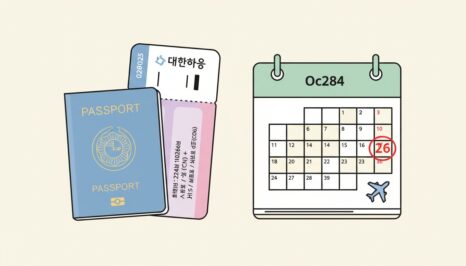
Introduction
Annyeonghaseyo! Hello, everyone! It’s your favorite Korean tutor, Daily Hangul! 👋✨
Are you planning a trip to Korea? Or maybe you are watching a K-Drama where the main characters are planning a romantic getaway to Jeju Island? 🏝️
One of the most important things when traveling is getting the date right! Imagine booking your flight for the wrong day… oh no! 😱 Today, we will learn how to talk about your departure date so you can tell your friends exactly when you are jetting off to Seoul!
Let’s master the calendar in Korean! Go go! 🚀
Key Expressions 🔑
Here are the 3 essential phrases you need to talk about travel dates.
1. 언제 가요? (When are you going?)
- Korean: 언제 가요?
- Pronunciation: [Eonje gayo?]
- English Meaning: When are you going?
- Detail: This is the most common question you will hear. ‘언제’ (Eonje) means ‘when’, and ‘가요’ (gayo) comes from the verb ‘to go’. It’s polite but friendly!
2. [Number]월 [Number]일 (Month & Day)
- Korean: [Number]월 [Number]일
- Pronunciation: [~wol ~il]
- English Meaning: [Number] Month [Number] Day
- Detail: In Korean, we use Sino-Korean numbers (il, i, sam, sa…) for dates. The order is always Month (월) first, then Day (일).
- Example: May 5th = 5월 5일 (O-wol O-il).
3. 출발해요 (I am departing/leaving)
- Korean: 출발해요.
- Pronunciation: [Chulbalhaeyo]
- English Meaning: I am departing / I am leaving.
- Detail: If you want to sound more specific than just “going,” use this! You often hear this in variety shows like Running Man when the race starts!
💡 Pronunciation Tip (Honey Tip! 🍯)
When you say the date, the sound often links together!
For example, 12일 (12th) is written as sip-i-il, but it is pronounced like [sibi-il] because the bottom consonant moves over to the empty vowel spot. Smooth like butter! 🧈
Real Conversation 🗣️
Let’s see how Min-ji and Jason talk about Jason’s upcoming trip to Korea!
Min-ji: 제이슨, 한국 여행 언제 가요?
(Jason, when are you going on your Korea trip?)
[Jeiseun, hanguk yeohaeng eonje gayo?]
Jason: 3월 10일에 가요.
(I go on March 10th.)
[Sam-wol sip-il-e gayo.]
Min-ji: 와, 다음 주네요! 몇 시 비행기예요?
(Wow, that’s next week! What time is the flight?)
[Wa, daeum ju-neyo! Myeot si bihaenggi-yeyo?]
Jason: 오후 2시에 출발해요.
(I depart at 2 PM.)
[Ohu dusi-e chulbalhaeyo.]
Culture Tip & K-Drama Moment 🎬
🇰🇷 The “Big to Small” Rule
In Western countries, you might write dates as Day/Month/Year. But in Korea, we always go from Big to Small!
Year (년) ➡️ Month (월) ➡️ Day (일)
So, if you look at a plane ticket in a K-Drama (like in Crash Landing on You when Se-ri is trying to return home), the date will be written like 2024.05.20. Keep this in mind when filling out your arrival card at Incheon Airport! ✈️
Conclusion & Quiz 📝
Great job today! Now you can tell anyone when your adventure begins. Don’t forget, use Sino-Korean numbers for dates!
Let’s check your understanding! (Answers at the bottom)
- How do you say “Month” in Korean?
(A) 일 (Il) (B) 월 (Wol) -
Fill in the blank:
“I depart on May 1st.”
= 5월 1일에 ______. -
(True/False) In Korea, you write the Day before the Month. (e.g., 20th May)
See you next time! Annyeong! 👋❤️
Answers:
1. (B) 월 (Wol)
2. 출발해요 (Chulbalhaeyo) – “Gayo” is also okay!
3. False (Korea uses Year-Month-Day order!)
Frequently Asked Questions (FAQ)
Q: What does "언제 가요? (When are you going?)" mean in Korean and how do you pronounce it?
A: In Korean, "언제 가요? (When are you going?)" is pronounced [Eonje gayo?] and means: When are you going?
Q: What does "[Number]월 [Number]일 (Month & Day)" mean in Korean and how do you pronounce it?
A: In Korean, "[Number]월 [Number]일 (Month & Day)" is pronounced [~wol ~il] and means: [Number] Month [Number] Day
Q: What does "출발해요 (I am departing/leaving)" mean in Korean and how do you pronounce it?
A: In Korean, "출발해요 (I am departing/leaving)" is pronounced [Chulbalhaeyo] and means: I am departing / I am leaving.


