

Introduction
Hello, everyone! 👋 It’s Daily Hangul, your best friend for learning Korean!
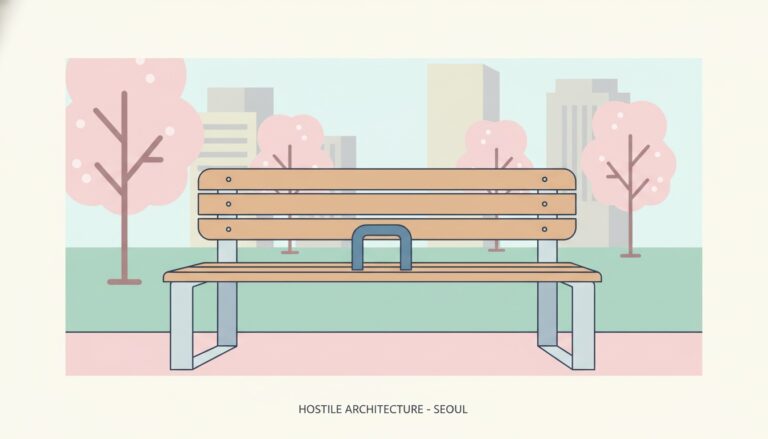
Have you ever walked through the beautiful streets of Seoul, seen a bench, and thought, “Wait, why is this bench so uncomfortable?” or “Why is there a weird handle in the middle?” 🤔
Today, we are diving into a slightly deeper but very interesting topic: Hostile Architecture (적대적 건축). It sounds serious, but don’t worry! We will learn easy and useful expressions to describe spaces and feelings. This will help you understand the hidden meanings behind the designs you see in K-Dramas or on your next trip to Korea! Let’s get started! 🚀
Key Expressions
Here are 4 key words to help you talk about spaces and design in Korean!
1. 건축 (Geonchuk)
- Pronunciation: [Geon-chuk]
- English Meaning: Architecture
- Detail: This is the general word for architecture. You can see many unique geonchuk styles in neighborhoods like Gangnam or Dongdaemun!
- 💡 Pronunciation Tip: The ‘ch’ in chuk is an aspirated sound. Imagine spitting a little air out when you say it! 💨
2. 불편하다 (Bulpyeonhada)
- Pronunciation: [Bul-pyeon-ha-da]
- English Meaning: To be uncomfortable / inconvenient
- Detail: This is a MUST-KNOW word. You use it when a chair is hard, a situation is awkward, or a design isn’t user-friendly. Hostile architecture is designed to be intentionally bulpyeonhada.
- 💡 Pronunciation Tip: In spoken Korean, the ‘h’ sound in ‘ha’ often becomes very soft or disappears, sounding like [Bul-pyeon-a-da].
3. 공공장소 (Gonggongjangso)
- Pronunciation: [Gong-gong-jang-so]
- English Meaning: Public space
- Detail: Places like parks (공원), subways (지하철), and plazas (광장). These are spaces for everyone.
- 💡 Pronunciation Tip: The double ‘g’ (ㄱ) in Gong is soft, but the double ‘ss’ (ㅆ) in so is strong and sharp!
4. 배려 (Baeryeo)
- Pronunciation: [Bae-ryeo]
- English Meaning: Consideration / Care for others
- Detail: This is a beautiful Korean value. Critics say hostile architecture lacks baeryeo for vulnerable people (like the homeless or elderly).
- 💡 Pronunciation Tip: ‘Ryeo’ (려) can be tricky! Try saying “Ree-yuh” quickly together.
Real-life Conversation
Let’s see how two friends, Minji and Alex, talk about a bench in a park in Seoul.
Minji: 알렉스, 여기 앉아서 좀 쉬자.
(Alex, yeogi anjaseo jom swija.)
Alex, let’s sit here and rest a bit.
Alex: 음… 이 벤치 너무 불편해 보여.
(Eum… i benchi neomu bulpyeonhae boyeo.)
Hmm… This bench looks too uncomfortable.
Minji: 맞아. 중간에 팔걸이가 있어서 누울 수가 없어.
(Maja. Junggane palgeoriga isseoseo nuul suga eopseo.)
Right. There is an armrest in the middle, so you can’t lie down.
Alex: 아, 이게 바로 ‘적대적 건축‘이구나?
(Ah, ige baro ‘jeokdaejeok geonchuk‘iguna?)
Ah, is this exactly what ‘hostile architecture‘ is?
Minji: 응. 공공장소인데 배려가 좀 부족한 것 같아.
(Eung. Gonggongjangsoinde baeryeoga jom bujokan geot gata.)
Yeah. It’s a public space, but it seems to lack a bit of consideration.
Cultural Tips & Drama Scenes 🎬
📺 The “Drunken Bench Scene” in K-Dramas
Have you seen K-Dramas where the main character gets drunk on Soju and sleeps on a park bench? 🍾😴 In older dramas, this was common! However, in modern Seoul, you might notice more benches with dividers (armrests) in the middle.
🇰🇷 The Debate in Korea
Just like in many other countries, Korea is debating “Inclusive Design” (포용적 디자인) vs. “Hostile Architecture”. While the city wants to keep streets clean and orderly, many Koreans feel that Gonggongjangso (public spaces) should be welcoming to everyone, including the elderly and the homeless. Using the word 배려 (Baeryeo) is very important when discussing this topic socially!
Wrap-up & Quiz
Today we learned how to look at city spaces through Korean words! Even architecture tells a story about society. Next time you visit Korea, look at the benches and think about today’s lesson! 😉
📝 Mini Quiz
Fill in the blanks with the words we learned today!
- This chair is too hard. It is so __________. (불편해요 / 편해요)
- A park is a __________, so everyone should be able to use it. (건축 / 공공장소)
- We need more __________ for others in our society. (배려 / 벤치)
[Answers]
1. 불편해요 (Bulpyeonhaeyo – Uncomfortable)
2. 공공장소 (Gonggongjangso – Public space)
3. 배려 (Baeryeo – Consideration)
See you next time! 안녕! 👋
Frequently Asked Questions (FAQ)
Q: What does "건축 (Geonchuk)" mean in Korean and how do you pronounce it?
A: In Korean, "건축 (Geonchuk)" is pronounced [Geon-chuk] and means: Architecture
Q: What does "불편하다 (Bulpyeonhada)" mean in Korean and how do you pronounce it?
A: In Korean, "불편하다 (Bulpyeonhada)" is pronounced [Bul-pyeon-ha-da] and means: To be uncomfortable / inconvenient
Q: What does "공공장소 (Gonggongjangso)" mean in Korean and how do you pronounce it?
A: In Korean, "공공장소 (Gonggongjangso)" is pronounced [Gong-gong-jang-so] and means: Public space
Q: What does "배려 (Baeryeo)" mean in Korean and how do you pronounce it?
A: In Korean, "배려 (Baeryeo)" is pronounced [Bae-ryeo] and means: Consideration / Care for others






