

Hello! It’s Daily Hangul (DailyHangul.com), here to upgrade your Korean skills! 👋✨
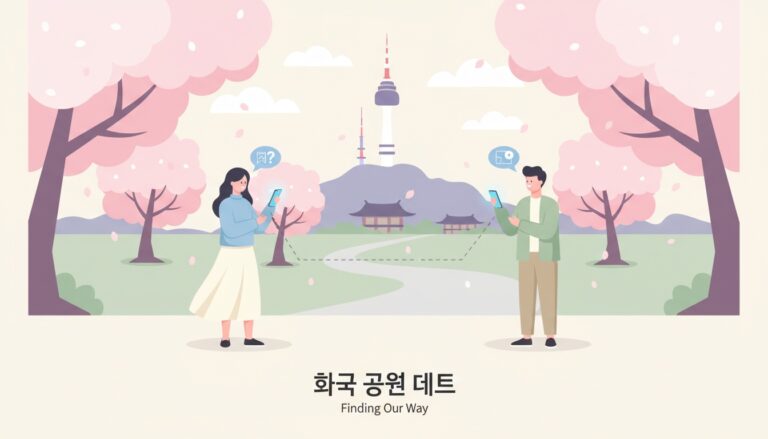
Have you ever agreed to meet a friend at a park in Korea, only to realize the park is huge? 😱 In K-Dramas, the main characters always seem to find each other romantically by the fountain, but in reality, finding a meeting spot can be tricky!
Today, we will learn essential expressions to find your friends in a large public space like the Han River Park (Hangang Park). These phrases are super useful for your next trip to Korea! Let’s get started! 🚀
🔑 Key Expressions
1. 어디예요? (Where are you?)
- Pronunciation: [Eodi-yeyo?]
- English Meaning: Where are you?
- Explanation: This is the most basic and essential phrase. You use this when you call or text your friend to ask their location. It is polite but friendly.
- 💡 Pronunciation Tip: Connect the sounds smoothly! Instead of saying “Eodi” and “yeyo” separately, say it like [Eo-di-ye-yo] in one breath.
2. [Place] 앞에 있어요. (I am in front of [Place].)
- Pronunciation: [[Place] ape isseoyo.]
- English Meaning: I am in front of [Place].
- Explanation: In large parks, landmarks are important. You can replace [Place] with words like 편의점 (pyeoneuijeom – convenience store) or 화장실 (hwajangsil – restroom).
- 💡 Pronunciation Tip: When saying 앞에 (ape), the ‘ㅍ’ (p) sound moves to the next syllable because ‘에’ starts with a vowel. So, it sounds like [A-pe], not [Ap-e]!
3. 보여요? (Can you see it? / Do you see me?)
- Pronunciation: [Boyeoyo?]
- English Meaning: Can you see it?
- Explanation: Use this to check if your friend can see the landmark you are describing or if they can see you waving your hand! 👋
- 💡 Pronunciation Tip: The ‘yo’ at the end should go up in pitch to indicate a question. ↗️
4. 이쪽으로 오세요. (Please come this way.)
- Pronunciation: [Ijjogeuro oseyo.]
- English Meaning: Please come this way.
- Explanation: Once you spot each other, use this phrase to guide them toward you. It’s a polite request often heard in dramas when a lead character guides someone.
- 💡 Pronunciation Tip: 쪽 (jjok) has a strong, tense sound. Pronounce the ‘jj’ strongly, almost like a sharp ‘ch’ but with more tension in your throat.
🗣️ Real-life Dialogue
Situation: Jason and Minji are trying to meet at the crowded Han River Park for a picnic.
Jason: 민지 씨, 어디예요? (Minji, where are you?)
Minji: 저는 편의점 앞에 있어요. (I am in front of the convenience store.)
Jason: 편의점이 많아요. 큰 나무 보여요? (There are many convenience stores. Can you see the big tree?)
Minji: 네, 보여요! (Yes, I see it!)
Jason: 아! 저도 민지 씨 보여요. 이쪽으로 오세요! (Ah! I see you too, Minji. Come this way!)
🇰🇷 Culture Tip & K-Drama Scene
“Delivery Zones” (배달존) 🍗🍕
If you watch Korean dramas, you’ve definitely seen people eating Chimaek (Chicken + Beer) at the park. But how does the delivery driver find them in such a huge park?
Korean parks have specific “Delivery Zones” (배달존)! When you order food, you tell the driver which “Delivery Zone” you are at (e.g., Delivery Zone 2). It is a very unique Korean culture! If you are lost, meeting at a “Delivery Zone” is also a great strategy because they are easy to find on maps! 🗺️
📝 Wrap-up & Quiz
Today we learned how to find locations and guide friends in Korean. Now you won’t get lost in Han River Park! 😉
Let’s practice! (Fill in the blanks)
- A: Minji, _________? (Where are you?)
B: I’m at the park. -
I am in front of the subway station.
= 지하철역 ______ 있어요. -
Can you see the fountain?
= 분수 ______?
[Answers]
1. 어디예요? (Eodi-yeyo?)
2. 앞에 (ape)
3. 보여요? (boyeoyo?)
Frequently Asked Questions (FAQ)
Q: What does "어디예요? (Where are you?)" mean in Korean and how do you pronounce it?
A: In Korean, "어디예요? (Where are you?)" is pronounced [Eodi-yeyo?] and means: Where are you?
Q: What does "[Place] 앞에 있어요. (I am in front of [Place].)" mean in Korean and how do you pronounce it?
A: In Korean, "[Place] 앞에 있어요. (I am in front of [Place].)" is pronounced [Place] and means: I am in front of [Place].
Q: What does "보여요? (Can you see it? / Do you see me?)" mean in Korean and how do you pronounce it?
A: In Korean, "보여요? (Can you see it? / Do you see me?)" is pronounced [Boyeoyo?] and means: Can you see it?
Q: What does "이쪽으로 오세요. (Please come this way.)" mean in Korean and how do you pronounce it?
A: In Korean, "이쪽으로 오세요. (Please come this way.)" is pronounced [Ijjogeuro oseyo.] and means: Please come this way.







