

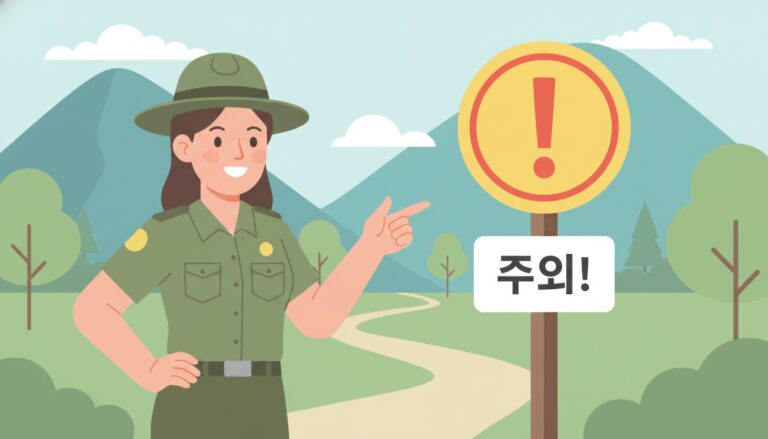
Stay Safe! Essential Korean Phrases for Your Trip 🛡️
Introduction
Hello! It’s Daily Hangul (DailyHangul.com), here to upgrade your Korean skills! 🌟
Are you planning to visit the beautiful mountains of Korea or walk along the Han River? While Korea is a very safe country, knowing how to understand warnings or give safety advice is crucial! Whether you are hiking in Seoraksan or visiting a construction-heavy city area, these phrases will keep you safe.
Plus, you’ve definitely heard these in K-Dramas when the main character protects their love interest from a speeding car! 🚗💨 Let’s learn how to stay safe in Korean!
Core Expressions
1. 조심하세요 (Jo-sim-ha-se-yo)
- English Meaning: Be careful / Watch out
- Detail: This is the most common polite way to tell someone to be cautious. You will hear this from hiking guides, subway announcements, or friendly locals.
- 💡 Pronunciation Tip: The ‘h’ in ‘ha’ is often pronounced very softly. It sounds a bit like Jo-sim-a-se-yo when spoken fast!
2. 위험해요 (Wi-heom-hae-yo)
- English Meaning: It is dangerous
- Detail: Used to describe a situation or place. If you see a sign with ‘위험’ (Wi-heom) written in red, it means DANGER!
- 💡 Pronunciation Tip: When ‘h’ (ㅎ) comes between vowels, it often becomes silent. So, it sounds more like Wi-eo-mae-yo.
3. 들어가지 마세요 (Deu-reo-ga-ji ma-se-yo)
- English Meaning: Do not enter
- Detail: This is a negative command. ‘~ji maseyo’ means “Please do not ~”. You might see this near cliffs, construction sites, or staff-only areas at tourist attractions.
- 💡 Pronunciation Tip: 들 (Deul) + 어 (eo) links together to sound like Deu-reo. This is called Liaison!
Real Conversation
Situation: You and your Korean friend, Min-su, are hiking up a mountain trail.
Min-su: 여기 경치 진짜 좋다! 그런데 바닥이 좀 미끄러워요.
(Yeogi gyeongchi jinjja jota! Geureonde badagi jom mikkeureowoyo.)
The view here is really good! But the ground is a bit slippery.
You: 아, 그래요? 조심하세요!
(A, geuraeyo? Jo-sim-ha-se-yo!)
Oh, really? Be careful!
Min-su: 저쪽은 위험해요. 절벽이에요.
(Jeojjogeun wi-heom-hae-yo. Jeolbyeogieyo.)
Over there is dangerous. It’s a cliff.
You: 네, 저기로 들어가지 마세요.
(Ne, jeogiro deu-reo-ga-ji ma-se-yo.)
Okay, do not enter there.
Culture Tip & K-Drama Scene 🎬
1. The “Wrist Grab” Scene:
In almost every romance K-Drama, there is a scene where a car or motorcycle almost hits the female lead. The male lead grabs her wrist, pulls her into a hug, and yells “위험해!” (Wi-heom-hae! – Informal). Now you know exactly what he is screaming! 😲💕
2. Hiking Culture:
Koreans LOVE hiking (Deungsan). If you go to a mountain on the weekend, you will see many people wearing professional hiking gear. Safety is taken seriously, so you will often hear people saying “조심하세요” to each other on steep paths.
Conclusion & Quiz 📝
Great job! Now you can spot danger signs and warn your friends like a pro. Safety first implies a happy trip! ✈️
Let’s test your knowledge:
- How do you say “Be careful” politely in Korean?
(Answer: ______________) -
True or False: 위험해요 (Wi-heom-hae-yo) means “It is safe.”
(Answer: ______) -
Fill in the blank to say “Do not enter”:
들어가지 ______ (Deu-reo-ga-ji ______)
[Answers]
1. 조심하세요 (Jo-sim-ha-se-yo)
2. False (It means “It is dangerous”)
3. 마세요 (ma-se-yo)
Frequently Asked Questions (FAQ)
Q: What does "조심하세요 (Jo-sim-ha-se-yo)" mean in Korean and how do you pronounce it?
A: In Korean, "조심하세요 (Jo-sim-ha-se-yo)" is pronounced [Tip: The 'h' in 'ha' is often pronounced very softly. It sounds a bit like Jo-sim-a-se-yo when spoken fast!] and means: Be careful / Watch out
Q: What does "위험해요 (Wi-heom-hae-yo)" mean in Korean and how do you pronounce it?
A: In Korean, "위험해요 (Wi-heom-hae-yo)" is pronounced [Tip: When 'h' (ㅎ] and means: It is dangerous
Q: What does "들어가지 마세요 (Deu-reo-ga-ji ma-se-yo)" mean in Korean and how do you pronounce it?
A: In Korean, "들어가지 마세요 (Deu-reo-ga-ji ma-se-yo)" is pronounced [Tip: 들 (Deul] and means: Do not enter







