

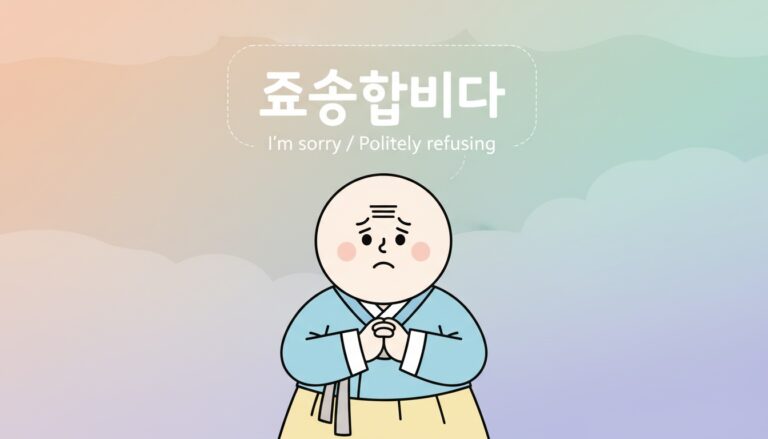
Saying “No” Politely in Korean! 😭💔
Hello, K-culture lovers! Welcome back to Daily Hangul, your best friend for learning Korean! 🍎👋
Have you ever been in a situation where someone asks for a favor, but you really can’t help? In K-Dramas, you often see the main character looking troubled, hesitating, and saying something soft instead of a cold “No!”
Today, we are going to learn how to express regret when you can’t help someone. In Korea, refusing politely is an art form! You need to protect the other person’s feelings while saying no. Let’s learn how to do it like a polite local! 🚀
🎓 Key Expressions: How to say “Sorry, I can’t”
Here are the top 3 expressions you need to know to refuse a request softly.
1. 어떡하죠?
- Pronunciation: [Eotteokajo?]
- Meaning: What should I do? / Oh no…
- Explanation: This is the magic phrase! Before saying “no,” Koreans often say this to show they are genuinely worried or sad that they can’t help. It softens the blow immediately.
- 💡 Pronunciation Tip: When ‘ㄱ’ meets ‘ㅎ’, they blend into a strong ‘K’ sound. So, say it like [Eotteo-Kajo]!
2. 미안하지만 안 될 것 같아요.
- Pronunciation: [Mianhajiman an doel geot gatayo.]
- Meaning: I’m sorry, but I don’t think I can.
- Explanation: This is a standard polite refusal. Instead of saying “I can’t” (which is too direct), we say “It seems like I can’t.”
- 미안하지만 (Mianhajiman) = I’m sorry, but…
- 안 될 것 같아요 (An doel geot gatayo) = It seems it won’t work out.
3. 도와주고 싶은데…
- Pronunciation: [Dowajugo sipeunde…]
- Meaning: I want to help you, but…
- Explanation: This is a very kind way to refuse. You are emphasizing your intent to help, even though the reality prevents you. Usually, you trail off at the end (…), implying the reason follows.
🗣️ Real-Life Conversation
Let’s see how these expressions work in a real situation! Min-ji asks Jason for help with moving boxes.
Min-ji: 제이슨 씨, 오늘 이사하는 것 좀 도와줄 수 있어요?
(Jason, can you help me move today?)
[Jeiseun ssi, oneul isahaneun geot jom dowajul su isseoyo?]
Jason: 아, 어떡하죠? 오늘 약속이 있어요.
(Ah, oh no… I have plans today.)
[Ah, eotteokajo? Oneul yaksogi isseoyo.]
Min-ji: 정말요? 1시간만 도와주면 안 돼요?
(Really? Can’t you help for just 1 hour?)
[Jeongmal-yo? Hansiganman dowajumyeon an dwaeyo?]
Jason: 도와주고 싶은데, 시간이 없어요. 미안하지만 안 될 것 같아요.
(I want to help, but I don’t have time. I’m sorry, but I don’t think I can.)
[Dowajugo sipeunde, sigani eopseoyo. Mianhajiman an doel geot gatayo.]
🎭 Culture Tip & K-Drama Moment
🇰🇷 The Culture of “Indirect Refusal”
In Western cultures, a clear “No” is often appreciated for its honesty. However, in Korea, a direct “No” (아니요 / Aniyo) to a request can feel hurtful or cold! 🥶
Koreans prefer “Cushion Language.”
If you watch K-Dramas, notice how characters rarely say “No, I won’t go.” Instead, they say, “It might be difficult” (어렵네요 / eoryeomneyo) or “I’ll think about it” (생각해 볼게요 / saeng-gak-hae bolgeyo).
Using “어떡하죠? (Oh no…)” shows you care about the relationship more than the task!
📝 Wrap-up & Quiz
Today we learned how to be a polite refuser! Remember, it’s not about saying no; it’s about showing you care even when you can’t help.
Test your knowledge! (Fill in the blanks)
- “Oh no… (What should I do?)” = _________?
- “I’m sorry, but…” = 미안하_____
Try to answer in the comments below! 👇
See you next time! 안녕! (Bye!) 👋❤️
Answer Key:
1. 어떡하죠 (Eotteokajo)
2. 지만 (jiman) -> 미안하지만 (Mianhajiman)
Frequently Asked Questions (FAQ)
Q: What does "어떡하죠?" mean in Korean and how do you pronounce it?
A: In Korean, "어떡하죠?" is pronounced [Eotteokajo?] and means: What should I do? / Oh no...
Q: What does "미안하지만 안 될 것 같아요." mean in Korean and how do you pronounce it?
A: In Korean, "미안하지만 안 될 것 같아요." is pronounced [Mianhajiman an doel geot gatayo.] and means: I'm sorry, but I don't think I can.
Q: What does "도와주고 싶은데..." mean in Korean and how do you pronounce it?
A: In Korean, "도와주고 싶은데..." is pronounced [Dowajugo sipeunde...] and means: I want to help you, but...







