

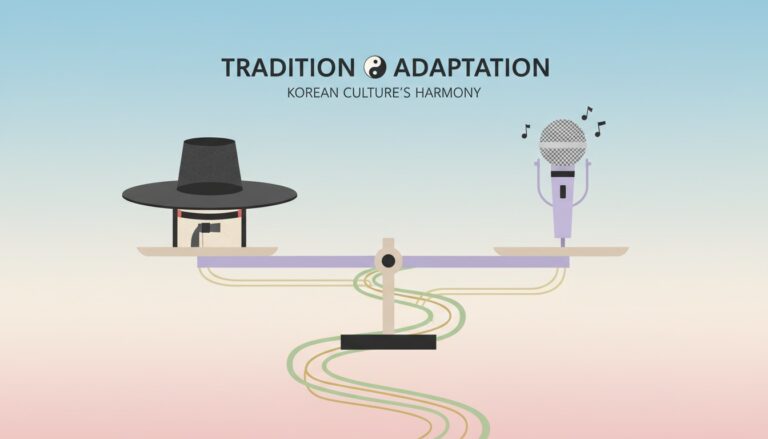
Is it Respect or Copying? Let’s Talk K-Culture! 🇰🇷
1. Introduction
Hello, K-Culture lovers! 👋 It’s your favorite Korean tutor, Daily Hangul!
Have you ever seen non-Korean celebrities wearing Hanbok (traditional Korean clothes) in music videos? Or perhaps you’ve seen debates online about “Cultural Appropriation” vs. “Cultural Appreciation”? 🤔
Today, we are going to dive into a slightly deeper but very important topic: Justice in Culture. How do we distinguish between simply copying a style and truly respecting a culture?
Don’t worry, we will learn easy expressions to discuss this heavy topic! If you want to share your opinion on K-dramas or K-pop fashion like a pro, this lesson is for you! Let’s go! 🚀
2. Key Expressions (핵심 표현)
Here are 4 essential expressions to discuss cultural respect and differences.
1️⃣ 문화 (Culture)
- Korean: 문화
- Pronunciation: [Mun-hwa]
- English Meaning: Culture
- Detail: This is the base word for everything we love! K-Pop is “Daejung Munhwa” (Pop culture).
- 💡 Pronunciation Tip: The ‘h’ sound is soft. It sounds almost like ‘Mun-wa’ when spoken fast, but try to keep a slight ‘h’ sound!
2️⃣ 존중해요 (I respect)
- Korean: 존중해요
- Pronunciation: [Jon-jung-hae-yo]
- English Meaning: I respect / To respect
- Detail: This is the magic word! When you appreciate Korean culture, you say “문화를 존중해요.” It is very polite.
- 💡 Pronunciation Tip: ‘Jon’ and ‘Jung’ both have soft ‘J’ sounds (like Jam).
3️⃣ 따라해요 (Copy / Imitate)
- Korean: 따라해요
- Pronunciation: [Tta-ra-hae-yo]
- English Meaning: To copy / To follow / To imitate
- Detail: Used when someone copies a style without understanding it. It can be neutral (following a dance) or negative (stealing a style), depending on context.
- 💡 Pronunciation Tip: The ‘Tt’ (ㄸ) is a tensed sound. You must tense your tongue and say it sharply, like the ‘t’ in stop!
4️⃣ 차이가 있어요 (There is a difference)
- Korean: 차이가 있어요
- Pronunciation: [Cha-i-ga i-sseo-yo]
- English Meaning: There is a difference
- Detail: Use this when you want to explain that “Appreciation” and “Appropriation” are not the same.
3. Real Conversation (실전 대화)
Let’s see how two friends discuss a K-Pop idol’s outfit that looks traditional but modified.
Situation: Minji and Alex are watching a music video.
Alex: 이 가수 의상 좀 보세요. 한복이에요?
(Look at this singer’s outfit. Is it Hanbok?)
[I gasu uisang jom boseyo. Hanbogieyo?]
Minji: 비슷해요. 그런데 그냥 따라한 것 같아요.
(It’s similar. But I think they just copied it.)
[Biseutaeyo. Geureonde geunyang ttarahan geot gatayo.]
Alex: 진짜 의미를 아는 게 중요해요.
(Knowing the real meaning is important.)
[Jinjja uimireul aneun ge jungyohaeyo.]
Minji: 맞아요. 그게 바로 문화 존중이에요.
(That’s right. That is exactly cultural respect.)
[Majayo. Geuge baro munhwa jonjungieyo.]
4. Culture Tip & Drama Context 🎬
“Is wearing Hanbok cultural appropriation?”
In Korea, people generally love it when foreigners wear Hanbok! 😍 If you visit Gyeongbokgung Palace in Seoul, wearing Hanbok gives you free entry. Koreans see this as “Cultural Appreciation” (존중) because you are experiencing the tradition properly.
However, it becomes “Appropriation” (or disrespectful) if the traditional clothes are sexualized or used as a funny costume without caring about the history.
Drama Scene: In historical dramas (Sageuk), you see how important clothes are to social status. Wearing them correctly shows Ye-ui (Etiquette/Manners). Just like in the drama Mr. Queen, respecting the dress code is respecting the history!
5. Wrap-up & Quiz (마무리 및 연습 문제)
Today we learned how to talk about Justice in Culture! Remember, the key is knowing the difference between simply copying and truly respecting.
Let’s test your knowledge!
- How do you say “Culture” in Korean?
( ) -
If you want to say “I respect Korean culture,” you say:
“한국 문화를 ( )해요.” -
(True/False) The word “따라해요” means “to create”.
( )
Answers:
1. 문화 (Munhwa)
2. 존중 (Jonjunghada/Jonjunghaeyo)
3. False (It means “to copy/follow”)
See you next time! 안녕! 👋







