

🤒 “Since Yesterday?” Describing Symptoms in Korean!
1. Introduction
Hello, K-Culture fans! Welcome back to [Daily Hangul], your best friend for learning Korean! 👋✨
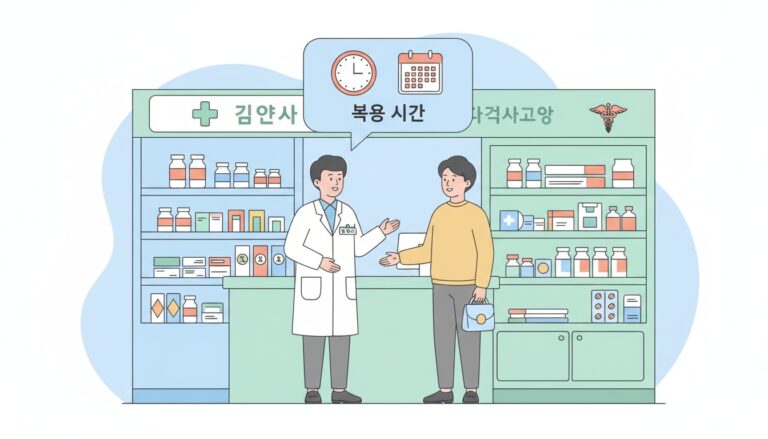
Getting sick while traveling or living abroad can be scary. Imagine you are at a pharmacy (Yakguk) in Seoul, and the pharmacist asks, “When did it start?” 😱
Don’t panic! Today, we will learn how to say “since when” you have been feeling sick. This is a super useful phrase that appears in almost every medical K-drama scene (like Hospital Playlist!). Let’s become experts at describing symptoms so you can get the right medicine and feel better fast! 💊💪
2. Key Expressions
Here are 3 essential expressions to tell time and symptoms!
1. 언제부터? (Since when?)
- Pronunciation: [Eonjebuteo?]
- Meaning: Since when?
- Explanation: This is the most common question a doctor or pharmacist will ask you. “Eonje” means “when,” and “-buteo” is a particle that means “from” or “since.”
- 💡 Pronunciation Tip: Pronounce it smoothly as one block. The ‘j’ in ‘Eonje’ is soft, like ‘j’ in ‘juice’.
2. 어제부터 (Since yesterday)
- Pronunciation: [Eojebuteo]
- Meaning: Since yesterday
- Explanation: To answer “Since when,” just add “-buteo” after the time word.
- Eoje (Yesterday) + buteo (since) = Eojebuteo.
- 💡 Pronunciation Tip: Make sure to pronounce ‘Eo’ clearly (like the ‘u’ in ‘run’), not like ‘o’ in ‘go’.
3. 아파요 (It hurts / I’m sick)
- Pronunciation: [Apayo]
- Meaning: It hurts / I feel sick
- Explanation: You can put a body part in front of this word.
- Meori (Head) + Apayo = I have a headache.
- Bae (Stomach) + Apayo = I have a stomachache.
- 💡 Pronunciation Tip: The ‘p’ in ‘Apayo’ is aspirated, meaning a small puff of air should come out. It sounds energetic!
3. Real Conversation
Let’s see how this works in a real situation at a Korean Pharmacy (Yakguk)! 🏥
Pharmacist (A) vs. Patient (B)
A: 어디가 아파요?
[Eodiga apayo?]
(Where does it hurt?)
B: 목이 아파요.
[Mogi apayo.]
(My throat hurts.)
A: 언제부터 아파요?
[Eonjebuteo apayo?]
(Since when has it hurt?)
B: 오늘 아침부터요.
[Oneul achimbuteoyo.]
(Since this morning.)
Note: Adding “-yo” at the end makes it polite! 😉
4. Culture Tip & Drama Moment 🎬
🍵 The Magic of “Juk” (Porridge)
In K-dramas, when a character says “Apayo” (I’m sick), have you noticed what their boyfriend, girlfriend, or best friend brings them? It’s usually “Juk” (Rice Porridge)!
In Korea, it is a warm culture to buy or cook Juk for someone who is sick because it is easy to digest. If you tell your Korean friend “Eojebuteo apayo” (I’ve been sick since yesterday), don’t be surprised if they send you a gift coupon for Bonjuk (a famous porridge chain)! 🥣💖
5. Wrap-up & Quiz
Today we learned how to use “-buteo” (since) to tell people when our pain started. Now you can confidently visit a pharmacy in Korea!
📝 Mini Quiz
Let’s check your understanding! (Answers are at the bottom)
- How do you say “Since yesterday” in Korean?
( Hint: E_ _ _ b_ _ _ _ ) -
True or False: “Apayo” means “I am hungry.”
( O / X ) -
Fill in the blank: To sound polite, you should add “____” at the end of your sentence.
( Hint: -yo )
Great job today! Stay healthy and see you next time! 안녕! (Bye!) 👋🥰
[Answers]
1. Eojebuteo (어제부터)
2. X (It means “It hurts/I’m sick”)
3. yo (요)
Frequently Asked Questions (FAQ)
Q: What does "어제부터 (Since yesterday)" mean in Korean and how do you pronounce it?
A: In Korean, "어제부터 (Since yesterday)" is pronounced [Eojebuteo] and means: Since yesterday
Q: What does "아파요 (It hurts / I'm sick)" mean in Korean and how do you pronounce it?
A: In Korean, "아파요 (It hurts / I'm sick)" is pronounced [Apayo] and means: It hurts / I feel sick







