

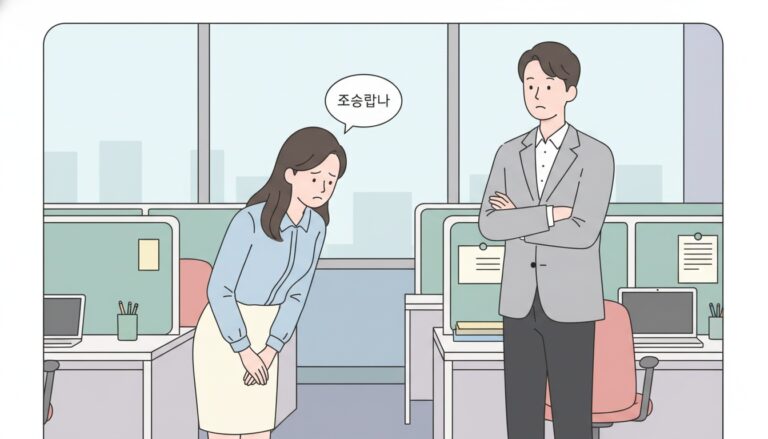
😭 Oops! How to Apologize & Win Trust in Korean
1. Introduction
Hello, everyone! It’s your favorite Korean tutor, Daily Hangul! 👋✨
We all make mistakes sometimes, right? Whether you forgot an appointment or spilled coffee on a friend’s shirt, the way you handle the mistake is key! In Korea, admitting a mistake sincerely can actually turn a crisis into an opportunity to build trust (신뢰, Sin-lwe).
Have you seen K-dramas where the main character bows their head and apologizes sincerely? That honesty makes people love them even more! 🥰 Today, let’s learn how to admit mistakes coolly and politely to win people’s hearts. Let’s start! 🚀
2. Key Expressions
Here are 3 essential expressions to handle mistakes like a pro!
1️⃣ 죄송합니다 (I am sorry)
- Pronunciation: [Joesonghamnida]
- English Meaning: I am sorry / I apologize.
- Detail: This is the most standard and polite way to apologize. You use this with strangers, at work, or to older people. It shows you respect the other person and feel bad about the situation.
- 💡 Pronunciation Tip: Notice the spelling is
hap-ni-dabut we sayham-ni-da. When the letter ㅂ (b/p) meets ㄴ (n), the sound changes to m for smoother flow! It’s not “Joesong-hap-nida”, it’s “Joesong-ham-nida”!
2️⃣ 제 실수예요 (It is my mistake)
- Pronunciation: [Je silsuyeyo]
- English Meaning: It is my mistake.
- Detail: Admitting fault is very important. 제 (Je) means “my” (polite), and 실수 (silsu) means “mistake”. Saying this shows you are taking responsibility, which Koreans appreciate very much.
- 💡 Pronunciation Tip: In 실수 (silsu), the ‘s’ is a soft ‘s’ sound. But in 예요 (yeyo), try to slide the sounds together smoothly. Je sil-su-ye-yo.
3️⃣ 앞으로 더 신경 쓸게요 (I will pay more attention in the future)
- Pronunciation: [Apeuro deo singyeong sseulgeyo]
- English Meaning: I will pay more attention / take better care in the future.
- Detail: An apology isn’t complete without a promise to improve! This phrase is perfect for work or serious situations. It tells the listener, “I won’t let this happen again.”
- 💡 Pronunciation Tip: 신경 (singyeong) means “nerve” or “care”. The ㅆ (ss) in 쓸게요 (sseulgeyo) is a tense sound. Press your tongue harder against the roof of your mouth to make a strong ‘SS’ sound!
3. Real-life Conversation
Let’s see how to use these in a workplace situation. Minji forgot to send an important file to her boss, Mr. Kim.
(Situation: In the office)
🤵 Mr. Kim: 민지 씨, 이메일 보냈어요?
[Minji ssi, imeil bonaesseoyo?]
(Minji, did you send the email?)
👩💼 Minji: 아! 깜빡했어요. 제 실수예요.
[A! Kkamppakhaesseoyo. Je silsuyeyo.]
(Ah! I forgot. It’s my mistake.)
👩💼 Minji: 정말 죄송합니다. 지금 바로 보낼게요.
[Jeongmal joesonghamnida. Jigeum baro bonaelgeyo.]
(I am really sorry. I will send it right now.)
🤵 Mr. Kim: 네, 알겠어요. 다음부터는 잊지 마세요.
[Ne, algesseoyo. Daeumbuteoneun itji maseyo.]
(Okay, I understand. Don’t forget next time.)
👩💼 Minji: 네! 앞으로 더 신경 쓸게요.
[Ne! Apeuro deo singyeong sseulgeyo.]
(Yes! I will pay more attention in the future.)
4. Culture Tip & K-Drama Vibes 🎭
🙇 The 90-Degree Bow
Did you know that in Korea, your body language speaks as loudly as your words? When you say “죄송합니다”, it is customary to bow your head slightly. If the mistake is big, a deeper bow (bending from the waist) shows deeper regret. In dramas, you might see a “90-degree bow” (polite folder bow) when a character is extremely sorry!
🍎 The “Apple” Apology
Fun Fact: The Korean word for “Apology” is 사과 (Sagwa). But 사과 also means Apple! 🍎
Sometimes, close friends or couples in Korea will give a shiny red apple to someone as a cute way of saying “I apologize.” If you see a character in a rom-com handing over an apple after a fight, now you know why! 😉
5. Wrap-up & Quiz
Admitting a mistake isn’t easy, but in Korean culture, honesty and a polite attitude are the best ways to fix a problem. Don’t be afraid to say “제 실수예요” (It’s my mistake)! It makes you look professional and trustworthy. ✨
📝 Mini Quiz
Let’s check what you learned!
Q1. Fill in the blank:
To say “It is my mistake” politely, you say: “_____ 실수예요.”
Q2. True or False:
When apologizing in Korea, it is better to maintain stiff eye contact and not move your head.
Q3. Which fruit shares the same name as “Apology” in Korean?
A) Banana B) Apple C) Grape
Answers:
1. 제 (Je)
2. False (You should bow your head slightly to show respect!)
3. B) Apple (Sagwa)
Good job today! See you next time! 안녕! 👋❤️
Frequently Asked Questions (FAQ)
Q: What does "제" mean in Korean and how do you pronounce it?
A: In Korean, "제" is pronounced [Je] and means: means "my" (polite), and
Q: What does "실수" mean in Korean and how do you pronounce it?
A: In Korean, "실수" is pronounced [silsu] and means: means "mistake". Saying this shows you are taking responsibility, which Koreans appreciate very much.
Q: What does "실수" mean in Korean and how do you pronounce it?
A: In Korean, "실수" is pronounced [silsu] and means: , the 's' is a soft 's' sound. But in
Q: What does "예요" mean in Korean and how do you pronounce it?
A: In Korean, "예요" is pronounced [yeyo] and means: , try to slide the sounds together smoothly.







