

🎭 Korean Sarcasm 101: Understanding Irony in K-Dramas!
2. Intro
Hello, everyone! It’s your favorite Korean tutor, Daily Hangul! 👋😊
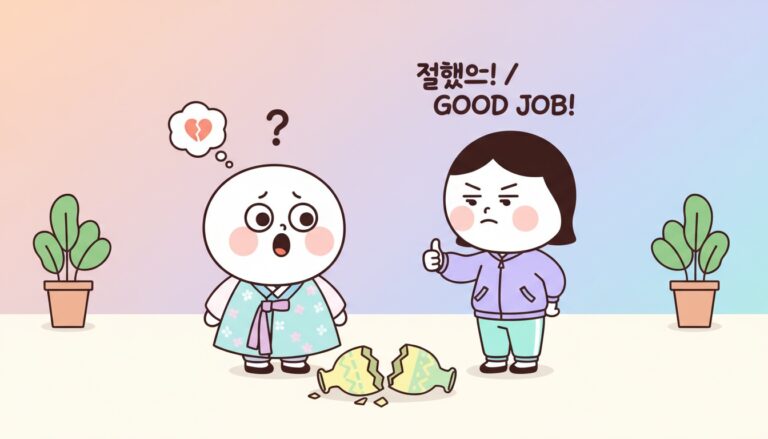
Have you ever watched a K-Drama where a character says “Well done!” but their face looks absolutely furious? 😡 Or someone says “You are so smart” to a person who just made a mistake?
That, my friends, is the art of Irony and Sarcasm! Today, we are going to learn how to use these rhetorical techniques to sound like a native speaker. These expressions are super useful when you want to playfully tease your friends or understand the intense arguments in dramas! Let’s dive in! 🚀
3. Key Expressions
1️⃣ 잘한다 (Jal-han-da)
- Pronunciation: [Jal-han-da]
- English Meaning: Good job / Well done
- Detailed Explanation: Literally, this means “You are doing well.” However, in a sarcastic context, it means “Wow, look at the mess you made!” or “Great, you ruined it.” You will hear this often when a parent scolds a child or when a friend makes a silly mistake.
- 💡 Pronunciation Tip: When saying this sarcastically, you elongate the middle syllable: “Jal~ han-da!” The ‘h’ sound is soft.
2️⃣ 참나 (Cham-na)
- Pronunciation: [Cham-na]
- English Meaning: Ha! / Unbelievable / Are you kidding me?
- Detailed Explanation: This is an exclamation used to express disbelief or absurdity. It’s a rhetorical device used to show that the other person’s action or logic is so ridiculous that you are speechless. It’s the Korean equivalent of a sarcastic “Wow.”
- 💡 Pronunciation Tip: Pronounce it sharply and quickly. It often starts with a scoffing sound.
3️⃣ 잘났어 정말 (Jal-nas-seo jeong-mal)
- Pronunciation: [Jal-lat-seo jeong-mal]
- English Meaning: You’re really something / You think you’re so great
- Detailed Explanation: “잘났다” literally means “to be distinct/great.” But 99% of the time, this phrase is used ironically to tell someone they are being arrogant or acting like a know-it-all. It’s a classic phrase in arguments!
- 💡 Pronunciation Tip: Due to sound rules, the ‘s’ (ㅅ) at the bottom of ‘nas’ meets the ‘s’ (ㅆ) in ‘seo’, creating a strong ‘ss’ sound. Also, ‘Jal-nas’ sounds like [Jal-lat] because of assimilation.
4. Real Conversation
(Situation: Min-su accidentally spills coffee on his own shirt just before a meeting.)
- Min-su: 아, 뜨거워! 커피 쏟았어. (Ah, hot! I spilled the coffee.)
- [Ah, tteugeowo! Keopi ssod-asseo.]
- Ji-min: 참나, 조심 좀 하지 그랬어. (Ha! You should have been more careful.)
- [Cham-na, josim jom haji geuraesseo.]
- Min-su: 셔츠가 다 젖었네. 어떡하지? (My shirt is all wet. What do I do?)
- [Syeocheu-ga da jeojeonne. Eotteokhaji?]
- Ji-min: 잘한다, 잘해. 회의 5분 전인데! (Great job, really. The meeting is in 5 minutes!)
- [Jalhanda, jalhae. Hoe-ui obun jeoninde!]
5. Culture Tip & Drama Vibes 🎬
Did you know? Tone is Everything! 😲
In Korea, “Nunchi” (눈치)—the ability to read the room—is crucial. Because Korean is a high-context language, the meaning of a word often changes completely based on your tone and facial expression.
In dramas, when a villain says “참~ 대단하시네요” (You are truly amazing), they are usually using irony to mock the hero. If you use these expressions with a smile and a gentle tone, they might be taken literally, so remember to act a little dramatic when practicing sarcasm! 🎭
6. Wrap-up & Quiz
Today we learned how to use Irony and Sarcasm to spice up your Korean! Don’t be afraid to use these playfully with close friends. 😉
📝 Mini Quiz
- True or False: If you drop a plate and your mom says “잘한다!” (Jalhanda), she is genuinely happy.
- ( )
- Fill in the blank: When you hear something absolutely ridiculous, you can say “_____!”
- A) 사랑해 (Saranghae)
- B) 참나 (Chamna)
See you next time! 안녕! 👋
Answers:
1. False (It is sarcasm!)
2. B) 참나 (Chamna)
Frequently Asked Questions (FAQ)
Q: What does ""참~ 대단하시네요"" mean in Korean and how do you pronounce it?
A: In Korean, ""참~ 대단하시네요"" is pronounced [You are truly amazing] and means: , they are usually using







