

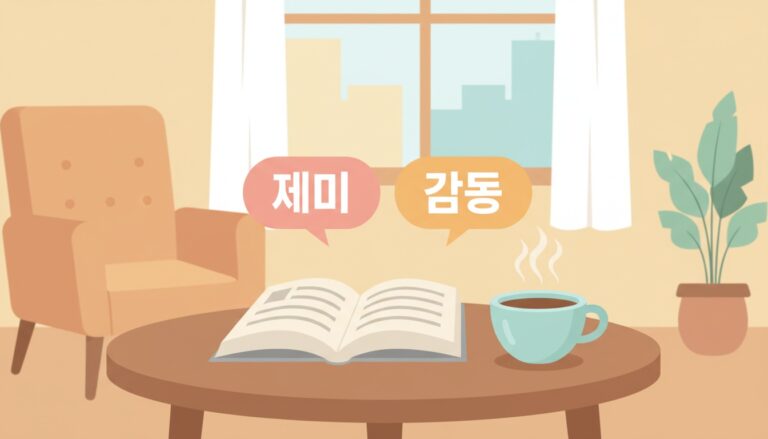
📚 Book Talk: Sharing Opinions Like a Local!
2. Intro
Annyeonghaseyo! Hello, everyone! It’s your Korean study buddy, Daily Hangul (매일한글)! 👋✨
Have you recently finished a great book or a popular Korean Webtoon? When we read something amazing, we just have to talk about it, right? Whether you are discussing the original webtoon of a K-Drama or just chatting with friends at a book club, sharing your feelings is key to bonding!
Today, we will learn how to say “It was fun,” “It was touching,” and how to agree with your friend’s opinion. If you master these, you can talk about K-Dramas too! Let’s level up your Korean! 🚀
3. Key Expressions
Here are 3 essential expressions to share your thoughts!
1. 재미있었어요 (It was interesting/fun)
- Korean: 재미있었어요
- Pronunciation: [Jaemiisseosseoyo]
- English Meaning: It was interesting / It was fun.
- Detail: This is the most common way to express a positive reaction. You can use this for books, movies, dramas, or even a trip! It covers both “funny” and “entertaining.”
- 💡 Pronunciation Tip: The bottom consonant ㅆ (ss) in
있carries over to the next empty consonant ㅇ. So instead of saying “It-eoss-eo-yo,” it flows smoothly like [Jaemi-sseo-sseo-yo]. Link the sounds together!
2. 감동적이었어요 (It was touching)
- Korean: 감동적이었어요
- Pronunciation: [Gamdongjeogieosseoyo]
- English Meaning: It was touching / moving.
- Detail: Did the story make you cry? 😭 Use this word! In K-Dramas, when a character sacrifices themselves for love, we say this. It comes from the word 감동 (Gamdong) which means ‘emotion’ or ‘deep impression’.
- 💡 Pronunciation Tip: The ㅈ (j) in
적sounds soft, like the ‘j’ in ‘juice’. Also, link the final ㄱ to the next vowel: [Gam-dong-jeo-gi-eo-sseo-yo].
3. 맞아요 (That’s right / I agree)
- Korean: 맞아요
- Pronunciation: [Majayo]
- English Meaning: That’s right! / Exactly!
- Detail: This is the magic word for conversation! When you want to show you are listening and agreeing, just say this. It’s the “Yes!” button of Korean conversation.
- 💡 Pronunciation Tip: Even though it is spelled with ㅈ at the bottom (mat-a-yo), when followed by a vowel, the ㅈ moves up and sounds like a ‘j’. So pronounce it clearly as [Ma-ja-yo]!
4. Real Conversation
Let’s see how Minji and Alex talk about a book in a cafe! ☕️
Minji: 알렉스 씨, 그 책 어때요? (Alex, how is that book?)
[Allekeuseu ssi, geu chaek eottaeyo?]
Alex: 정말 재미있었어요! (It was really interesting!)
[Jeongmal jaemiisseosseoyo!]
Minji: 그쵸? 저는 엔딩이 감동적이었어요. (Right? For me, the ending was touching.)
[Geuchyo? Jeoneun ending-i gamdongjeogieosseoyo.]
Alex: 맞아요! 저도 울었어요. (Exactly! I cried too.)
[Majayo! Jeodo ureosseoyo.]
5. Culture Tip & Drama Scene 🎬
🇰🇷 The “Reaction” Culture (Ri-aek-shyeon)
In Korea, being a good listener means giving good reactions! If you stay silent, Koreans might think you are bored. The word 맞아요 (Majayo) is the perfect tool for this. In Korean variety shows, you will often see subtitles repeating
Frequently Asked Questions (FAQ)
Q: What does "감동적이었어요 (It was touching)" mean in Korean and how do you pronounce it?
A: In Korean, "감동적이었어요 (It was touching)" is pronounced [Gamdongjeogieosseoyo] and means: It was touching / moving.
Q: What does "맞아요 (That's right / I agree)" mean in Korean and how do you pronounce it?
A: In Korean, "맞아요 (That's right / I agree)" is pronounced [Majayo] and means: That's right! / Exactly!







