

Lost? How to Politely Say “I Don’t Know” 🤷♀️
1. Intro
Hello! It’s Daily Hangul, here to upgrade your Korean skills! 🌟
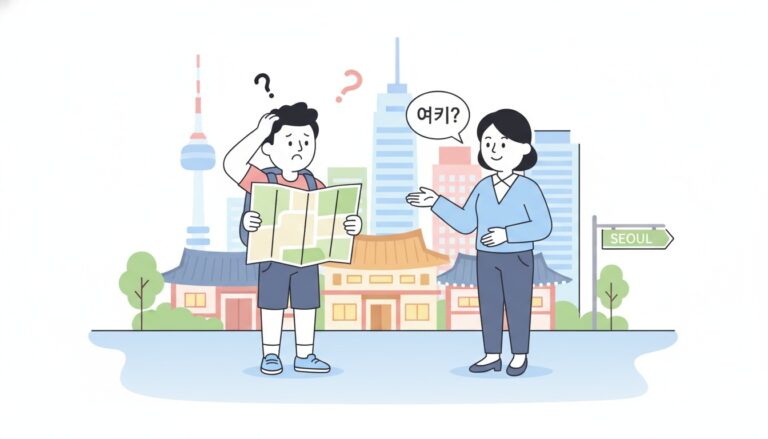
Have you ever been walking on the streets of Seoul, and suddenly someone asks you for directions? It happens more often than you think! Or maybe someone asks you a question in Korean that you just don’t understand.
In these moments, you don’t want to be rude by just walking away, right? Today, we will learn how to politely say “I don’t know” or explain that you are a tourist too.
If you watch K-Dramas, you’ve probably seen a character scratch their head and look confused while saying this phrase. Let’s master it so you can handle any surprise questions like a pro! 😎
2. Key Expressions
Here are the 3 most useful expressions when you are unsure about something.
1. 잘 모르겠어요 (I don’t know well)
- Pronunciation: [Jal moreugesseoyo]
- English Meaning: I don’t know well / I’m not sure.
- Detail: This is the most standard and polite way to say you don’t know.
- 잘 (Jal) means “well.”
- 모르겠어요 (Moreugesseoyo) comes from the verb ‘to not know.’
- 💡 Pronunciation Tip:
Pay attention to 겠 (get). When followed by 어 (eo), the ‘ss’ sound flows into the next vowel. So it sounds a bit like [Mo-reu-ge-sseo-yo].
2. 죄송합니다 (I’m sorry)
- Pronunciation: [Joesonghamnida]
- English Meaning: I am sorry / I apologize.
- Detail: In Korea, it is polite to apologize first if you cannot help someone. Use this before saying “I don’t know.”
- 💡 Pronunciation Tip:
Standard Korean pronunciation rule! When ㅂ (b/p) is followed by ㄴ (n), the ㅂ sound changes to an ㅁ (m) sound.- So, write it as hap-ni-da, but say it as [ham-ni-da].
3. 저도 여기 처음이에요 (It’s my first time here too)
- Pronunciation: [Jeodo yeogi cheoeumieyo]
- English Meaning: It’s my first time here too.
- Detail: This is a perfect phrase for tourists! It explains why you don’t know the way.
- 저도 (Jeodo): Me too.
- 여기 (Yeogi): Here.
- 처음 (Cheoeum): First time.
- 💡 Pronunciation Tip:
Link the sounds together! 처음 (Cheoeum) + 이에요 (ieyo) sounds like [Cheo-eu-mi-e-yo] because the ‘m’ sound carries over.
3. Real-life Dialogue
Imagine you are standing near a subway station in Hongdae, looking at your phone. A Korean grandmother approaches you.
(Situation: Asking for directions)
👵 Grandma: 저기요, 시청이 어디예요?
(Jeogiyo, sicheong-i eodiyeyo?)
Excuse me, where is City Hall?
🧑 You: 아… 죄송합니다.
(Ah… Joesonghamnida.)
Ah… I’m sorry.
🧑 You: 제가 잘 모르겠어요.
(Jega jal moreugesseoyo.)
I don’t know well.
🧑 You: 저도 여기 처음이에요.
(Jeodo yeogi cheoeumieyo.)
It’s my first time here too.
👵 Grandma: 아, 알겠어요. 고마워요!
(Ah, algesseoyo. Gomawoyo!)
Ah, I understand. Thank you!
4. Culture Tip & K-Drama Scene 🎬
The “Hand Wave” of Confusion 👋
In Korea, body language is just as important as words! When you say “잘 모르겠어요” (I don’t know), it is very common to wave your hand slightly in front of your face (like you are fanning yourself, but with your palm facing out sideways).
This gesture means “No,” “I’m not sure,” or “No thank you.” You will see this in almost every K-Drama when a character is denying a rumor or doesn’t know the answer! Try adding this hand wave, and you will look 100% more natural! 🇰🇷
5. Wrap-up & Quiz
Today we learned how to politely decline giving directions or admit we don’t know something. Remember, saying you don’t know is better than giving wrong directions!
Let’s practice! (Quiz)
- Fill in the blank: “I don’t know well.”
= 잘
______. (Jal moreugesseoyo) -
True or False?
When pronouncing 죄송합니다 (Joesonghamnida), the ‘hap’ sounds like ‘ham’. ( O / X ) -
How do you say “It’s my first time here too”?
= 저도 여기 ______이에요. (Jeodo yeogi ______ieyo.)
[Answers]
1. 모르겠어요 (moreugesseoyo)
2. O (True! It sounds like ham-ni-da)
3. 처음 (cheoeum)
See you next time! 안녕! 👋
Frequently Asked Questions (FAQ)
Q: What does "죄송합니다 (I'm sorry)" mean in Korean and how do you pronounce it?
A: In Korean, "죄송합니다 (I'm sorry)" is pronounced [Joesonghamnida] and means: I am sorry / I apologize.
Q: What does "저도 여기 처음이에요 (It's my first time here too)" mean in Korean and how do you pronounce it?
A: In Korean, "저도 여기 처음이에요 (It's my first time here too)" is pronounced [Jeodo yeogi cheoeumieyo] and means: It's my first time here too.







