

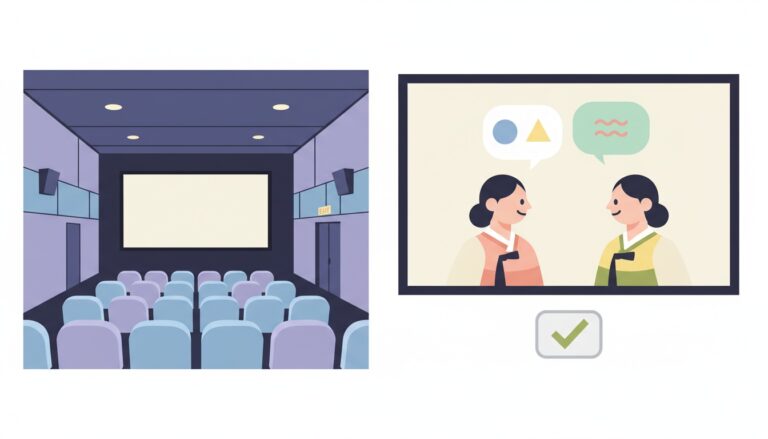
🎬 Does Your Fav K-Movie Pass? The Bechdel Test in Korean!
Annyeonghaseyo! 👋 It’s your energetic Korean tutor, Daily Hangul!
Are you a fan of K-Movies or K-Dramas? 🇰🇷🍿 Today, we are going to dive into a slightly smarter topic but in a super easy way! Have you heard of the Bechdel Test? It’s a fun way to check gender representation in movies.
Today, we will learn how to discuss movies, female characters, and social topics in Korean. Don’t worry, we will keep it simple and fun! Let’s level up your Korean skills so you can debate movies like a pro! 🚀
📚 Key Expressions: Discussing Movies & Gender
Here are 4 essential expressions to talk about the Bechdel Test and movies in Korean!
1. 여자 주인공 (Female Protagonist)
- Pronunciation: [Yeoja juingong]
- English Meaning: Female protagonist / Female lead
- Detail: In casual conversation, Koreans often shorten this to 여주 (Yeoju). The male lead is 남주 (Namju).
- 💡 Pronunciation Tip: When saying ‘Yeo-ja’, open your mouth vertically! For ‘ju-in-gong’, flow the sounds together smoothly.
2. 대화하다 (To converse / To talk)
- Pronunciation: [Daehwahada]
- English Meaning: To have a conversation
- Detail: The core of the Bechdel Test! Do the characters talk to each other? You can also just use the noun 대화 (Daehwa).
- 💡 Pronunciation Tip: The ‘h’ (ㅎ) sound in the middle is often very soft or almost silent in fast speech. It sounds like [Dae-wa-ha-da].
3. 통과하다 (To pass)
- Pronunciation: [Tonggwahada]
- English Meaning: To pass (a test or a place)
- Detail: Used when a movie passes the test! “This movie passed!” = “이 영화 통과했어! (I yeonghwa tonggwahaesseo!)”
- 💡 Pronunciation Tip: The ‘ng’ (ㅇ) in ‘Tong’ is a nasal sound like the ending of ‘Sing’.
4. 한계 (Limitation)
- Pronunciation: [Han-gye]
- English Meaning: Limitation / Limit
- Detail: The Bechdel Test is useful, but it has limits (it doesn’t measure quality). This is a great word to show you have an intermediate vocabulary!
- 💡 Pronunciation Tip: pronounce ‘Gye’ (계) clearly. It sounds like ‘Geh’ with a ‘y’ inside.
🗣️ Real Conversation: Did it pass?
Let’s see two friends, Mina and Suji, talking about a new movie at a cafe ☕.
Mina: 어제 그 영화 봤어? 여자 주인공이 멋있더라!
(Eoje geu yeonghwa bwasseo? Yeoja juingong-i meositdeora!)
Did you see that movie yesterday? The female lead was so cool!
Suji: 응, 나도 봤어. 그런데 그 영화 벡델 테스트 통과했을까?
(Eung, nado bwasseo. Geureonde geu yeonghwa bekdel teseuteu tonggwahaesseulkka?)
Yeah, I saw it too. But do you think it passed the Bechdel Test?
Mina: 글쎄… 여자들이 대화는 했는데, 다 남자 이야기였어.
(Geulsse… Yeojadeuri daehwaneun haenneunde, da namja iyagiyeosseo.)
Well… The women did talk, but it was all about men.
Suji: 아, 그럼 실패네. 그게 좀 한계야.
(Ah, geureom silpaene. Geuge jom han-gyeya.)
Ah, then it failed. That is a bit of a limitation.
🇰🇷 Culture Tip & Drama Vibes
Did you know?
In recent years, Korean content has seen a huge rise in strong female narratives! 👩🎤 Dramas like “The Glory” (더 글로리) or “Extraordinary Attorney Woo” (이상한 변호사 우영우) focus heavily on the female lead’s journey and career, easily passing the Bechdel Test.
However, traditional Korean cinema was often male-dominated. Discussing the “limitations (한계)” of older movies is a hot topic among young Koreans these days. If you use the word “여주 (Yeoju)” when talking about your favorite actress, your Korean friends will be surprised by your natural slang! 😎
📝 Wrap-up & Quiz
Today we learned how to look at movies through a new lens using Korean!
Let’s check your memory:
- What is the short slang for “Female Protagonist”?
(Answer:
[ ? ] ) - How do you say “To pass” in Korean?
(Answer:
[ ? ] )
Answers:
1. 여주 (Yeoju)
2. 통과하다 (Tonggwahada)
Keep practicing, and next time you watch a K-Drama, check if it passes the test! See you next time! 안녕! 👋
Frequently Asked Questions (FAQ)
Q: What does "여자 주인공 (Female Protagonist)" mean in Korean and how do you pronounce it?
A: In Korean, "여자 주인공 (Female Protagonist)" is pronounced [Yeoja juingong] and means: Female protagonist / Female lead
Q: What does "대화하다 (To converse / To talk)" mean in Korean and how do you pronounce it?
A: In Korean, "대화하다 (To converse / To talk)" is pronounced [Daehwahada] and means: To have a conversation
Q: What does "통과하다 (To pass)" mean in Korean and how do you pronounce it?
A: In Korean, "통과하다 (To pass)" is pronounced [Tonggwahada] and means: To pass (a test or a place)
Q: What does "한계 (Limitation)" mean in Korean and how do you pronounce it?
A: In Korean, "한계 (Limitation)" is pronounced [Han-gye] and means: Limitation / Limit







