

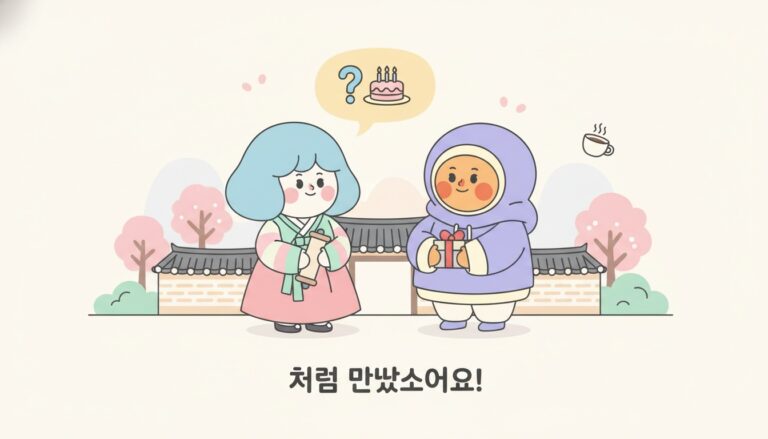
Are You Oppa or Unnie? Asking Age in Korean! 🎂
1. Introduction
Hello, K-Culture fans! 👋 Welcome back to Daily Hangul, your best friend for learning Korean!
Have you ever watched a K-Drama and noticed that characters ask “How old are you?” almost immediately after meeting? 😲 In many Western cultures, asking for someone’s age might be rude, but in Korea, it is essential!
Why? Because age determines how you speak to someone (Polite vs. Casual) and what you call them (Oppa, Unnie, Hyung, Noona). Knowing someone’s age helps you become close friends faster! Let’s learn how to ask and answer this important question like a native! 🚀
2. Key Expressions
Here are the 3 most important phrases you need to know about age.
1️⃣ 몇 살이에요? (Casual Polite)
- Pronunciation: [Myeot sar-ieyo?]
- Meaning: How old are you?
- Explanation: This is the most common way to ask age to someone who looks similar in age to you or is younger. It’s polite but friendly.
- 💡 Pronunciation Tip: The ‘t’ in Myeot moves over to sal, so it sounds more like Myeos-sar-ieyo. It flows smoothly!
2️⃣ 나이가 어떻게 되세요? (Formal / Honorific)
- Pronunciation: [Naiga eotteoke doeseyo?]
- Meaning: May I ask how old you are?
- Explanation: If you are talking to someone older, a business partner, or a complete stranger, use this phrase! It shows high respect. You will hear this a lot in interview scenes in dramas!
3️⃣ 저는 [Number]살이에요. (Answering)
- Pronunciation: [Jeoneun [Number] sar-ieyo.]
- Meaning: I am [Number] years old.
- Explanation: To answer, you use Native Korean Numbers (Hana, Dul, Set…) + sal (counter for age).
- 20 years old: Seumul sal
- 25 years old: Seumul-daseot sal
- 30 years old: Seoreun sal
3. Real Conversation Practice 🗣️
Imagine meeting a new friend at a fan meeting!
A: 안녕하세요! 만나서 반가워요.
(Annyeonghaseyo! Mannaseo bangawoyo.)
Hello! Nice to meet you.
B: 저도 반가워요! 혹시… 나이가 어떻게 되세요?
(Jeodo bangawoyo! Hoksi… naiga eotteoke doeseyo?)
Nice to meet you too! By chance… may I ask how old you are?
A: 저는 스물다섯 살이에요.
(Jeoneun seumul-daseot sar-ieyo.)
I am 25 years old.
B: 정말요? 저도 25살이에요! 우리 친구 해요!
(Jeongmaryo? Jeodo seumul-daseot sar-ieyo! Uri chingu haeyo!)
Really? I am 25 too! Let’s be friends!
4. Culture Tip & K-Drama Moment 🎬
Why is age so important?
In Korea, if you are the same age, you are “Chingu” (Friend) and can drop the polite language (speak casually). If one person is even 1 year older, they are the “Unnie/Oppa/Noona/Hyung”!
📺 Drama Scene:
You often see a scene where two characters realize they are the same age (Donggap). Their eyes widen, and one says, “Mal noja!” (Let’s speak casually/drop the honorifics!). This is the moment their friendship truly begins! So, asking for age is actually an invitation to get closer. 🥰
5. Wrap-up & Quiz 📝
Today we learned how to ask for someone’s age to establish a relationship. Don’t be shy to ask this in Korea—it’s a sign you want to connect!
Let’s check your understanding:
- Which phrase is better for asking an older person’s age?
- A) Myeot sar-ieyo?
- B) Naiga eotteoke doeseyo?
- When counting age (years old), which number system do we use?
- A) Native Korean (Hana, Dul…)
- B) Sino-Korean (Il, I, Sam…)
Answers:
1. B
2. A (We use Native numbers for age!)
See you in the next lesson! Annyeong! 👋







