

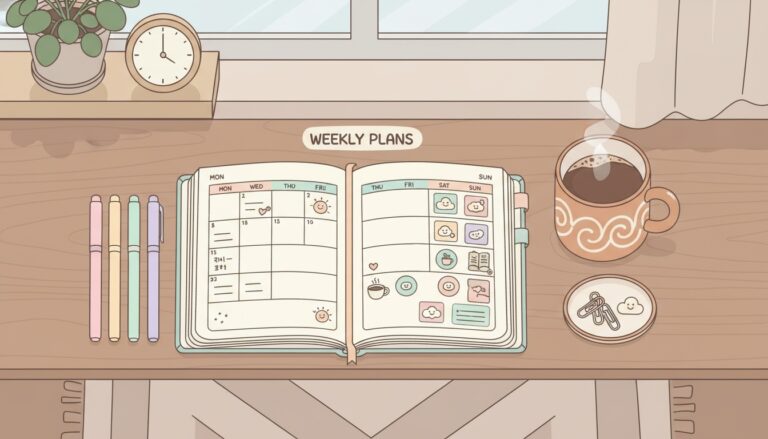
📝 Planning Next Week? Essential Korean To-Do List Phrases!
👋 Introduction
Annyeonghaseyo! (Hello!) It’s your friendly Korean tutor, Daily Hangul! 🍎
Do you want to be productive like the passionate characters in K-dramas like Start-Up or Itaewon Class? To achieve your dreams, you need a plan! Today, we are going to learn how to talk about your goals and plans for next week.
Whether you are writing a diary or telling a friend about your schedule, these expressions are super useful. Let’s get organized Korean style! 📅✨
📚 Key Expressions
Here are 3 essential expressions to help you plan your week.
1. 다음 주 (Daeum ju)
- Pronunciation: [Daeum ju]
- English Meaning: Next week
- Detail: This is the starting point for your planning. You can put time words at the beginning of a sentence.
- 💡 Pronunciation Tip: Pronounce each syllable clearly. Dae-um sounds a bit like “Day-um” without the ‘y’ sound.
2. 할 일 (Hal il)
- Pronunciation: [Haril]
- English Meaning: Things to do / To-do list
- Detail: Literally, it means “work to do.” You will see this often as a header in Korean planners!
- 💡 Pronunciation Tip: Watch out for the Liaison rule! The final consonant ‘ㄹ’ (l) in 할 moves over to the empty ‘ㅇ’ in 일. So, it sounds like [Ha-ril], not [Hal-il].
3. ~할 거예요 (~hal geoyeyo)
- Pronunciation: [~hal geoyeyo]
- English Meaning: I will do… / I am going to do…
- Detail: This is the future tense. You add this after a verb stem to show your plan.
- Example: 청소하다 (to clean) → 청소할 거예요 (I will clean).
- 💡 Pronunciation Tip: The ‘거’ sounds like ‘geo’ (like in geography), not ‘go’.
🗣️ Real Conversation
Let’s see how Minji and Jason talk about their plans for next week at a cafe. ☕
Minji: 제이슨 씨, 다음 주에 바빠요?
(Jason, are you busy next week?)
Jason: 네, 할 일이 많아요.
(Yes, I have a lot of things to do.)
Minji: 그래요? 뭐 할 거예요?
(Really? What will you do?)
Jason: 한국어를 공부하고, 친구를 만날 거예요.
(I will study Korean and meet a friend.)
Minji: 와, 화이팅!
(Wow, fighting! / Good luck!)
🇰🇷 Culture Tip & Drama Scene
🎨 Have you heard of “Dakku” (다꾸)?
In Korea, organizing your schedule isn’t just a chore; it’s art! “Dakku” (다꾸) is short for Daieori Kkumigi (Decorating a Diary).
Many Koreans love to use colorful stickers, masking tape, and cute memos to write their 할 일 (To-do list). If you watch high school K-dramas, you might see the main character carefully decorating their planner before an exam. Why not buy a cute Korean planner and start your own “Dakku” journey? It makes studying Korean much more fun! 🎀🖊️
📝 Wrap-up & Quiz
Today we learned how to say “Next week,” “Things to do,” and how to express future plans. You are now ready to plan a successful week!
Let’s check your understanding! (Answers are at the bottom)
- How do you say “Things to do” in Korean? (Hint: Ha-ril)
- True or False: “~할 거예요” is used to talk about the past.
- Complete the sentence: “I will exercise.” = 운동______. (Base verb: 운동하다)
Happy studying, and see you next time! Annyeong! 👋😊
Answers:
1. 할 일 (Hal il)
2. False (It is used for the Future tense)
3. 운동할 거예요 (Undonghal geoyeyo)
Frequently Asked Questions (FAQ)
Q: What does "다음 주 (Daeum ju)" mean in Korean and how do you pronounce it?
A: In Korean, "다음 주 (Daeum ju)" is pronounced [Daeum ju] and means: Next week
Q: What does "할 일 (Hal il)" mean in Korean and how do you pronounce it?
A: In Korean, "할 일 (Hal il)" is pronounced [Haril] and means: Things to do / To-do list
Q: What does "~할 거예요 (~hal geoyeyo)" mean in Korean and how do you pronounce it?
A: In Korean, "~할 거예요 (~hal geoyeyo)" is pronounced [~hal geoyeyo] and means: I will do... / I am going to do...







