

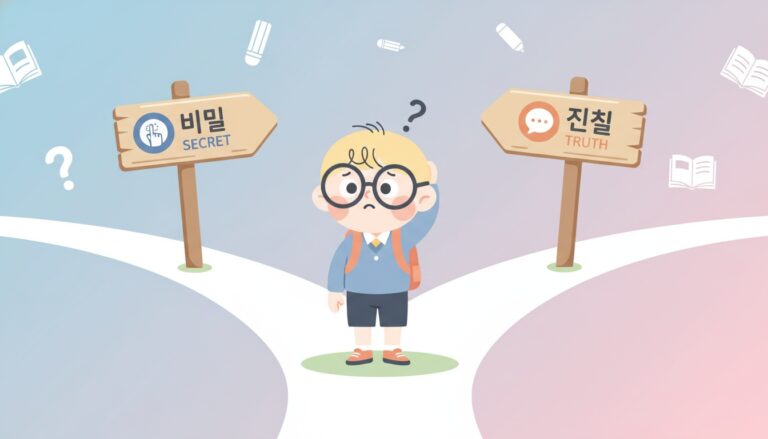
Omo! What Should I Do? 😱 Handling Dilemmas & Secrets in Korean
1. Introduction
Hello, everyone! It’s your friendly Korean tutor, Daily Hangul! 👋✨
Today, we have a slightly serious but super interesting topic: “What do I do when I have two difficult choices?” 🤔
In philosophy, this is called the “Problem of Conflicting Duties” (like when you promised to keep a secret, but you also need to tell the truth to save someone!). In K-Dramas, this is that classic scene where the main character holds their head and sighs, not knowing which path to take! 🎬
Let’s learn the perfect Korean expressions to use when you are stuck in a dilemma or have a heavy secret to tell. Ready to become the protagonist of your own drama? Let’s go! 🚀
2. Core Expressions
Here are 4 phrases you will hear all the time when Koreans face a difficult situation!
1️⃣ 어떡해? (Eotteokhae?)
- Pronunciation: [Eotteokhae]
- English Meaning: What should I do? / Oh no!
- Details: This is the #1 phrase for panic or dilemmas! You use this when something goes wrong, or you are stuck between two choices. You will hear this in every single episode of a K-Drama.
- 💡 Pronunciation Tip: Even though it is written with a
ㄱ(k) at the bottom, followed byㅎ(h), they combine to make a strong ‘K’ sound! So it sounds like [Eotteokae].
2️⃣ 솔직히 말해서 (Soljikhi malhaeseo)
- Pronunciation: [Soljikhi malhaeseo]
- English Meaning: To be honest… / Honestly speaking…
- Details: This is the phrase you use right before you drop a “truth bomb” or confess something difficult. It signals that you are choosing the duty of honesty.
- 💡 Pronunciation Tip: In
솔직히, theㄱandㅎmeet again to make a hard ‘K’ sound. Pronounce it like [Soljik-ki].
3️⃣ 비밀이야 (Bimiriya)
- Pronunciation: [Bimiriya]
- English Meaning: It’s a secret.
- Details: Use this when you are choosing the duty of loyalty or privacy. It is a casual way to say, “Shh, don’t tell anyone!” 🤫
4️⃣ 고민이야 (Gominiya)
- Pronunciation: [Gominiya]
- English Meaning: I’m worried / I have a dilemma.
- Details:
고민(Gomin) isn’t just “worry”; it specifically means thinking deeply about a problem or a choice. If you can’t decide between A and B, you say “Ah, gominiya…”
3. Real-life Conversation 🗣️
Situation: Min-ji is struggling because she knows a secret about Cheol-su’s surprise birthday party, but Cheol-su keeps asking why everyone is acting weird.
(Min-ji and her friend Yeong-hee are at a cafe)
Min-ji: 아, 진짜 고민이야.
(Ah, jinjja gominiya.)
[Ah, I really have a dilemma.]
Yeong-hee: 왜? 무슨 일 있어?
(Wae? Museun il isseo?)
[Why? Is something wrong?]
Min-ji: 철수가 계속 물어봐. 어떡해?
(Cheol-su-ga gyesok mureobwa. Eotteokhae?)
[Cheol-su keeps asking me. What should I do?]
Yeong-hee: 음… 솔직히 말해서, 그냥 모른 척해.
(Eum… Soljikhi malhaeseo, geunyang moreun cheokhae.)
[Hmm… To be honest, just pretend you don’t know.]
Min-ji: 그래, 파티 전까지는 비밀이야!
(Geurae, pati jeonkkajineun bimiriya!)
[Okay, until the party, it’s a secret!]
4. Culture Tip & K-Drama Vibes 🎭
🇰🇷 The “White Lie” (선의의 거짓말)
In Korea, maintaining harmony in a group (Kibun – 기분) is very important. Sometimes, telling a “White Lie” (Seonui-ui geojinmal) is considered socially acceptable if it protects someone’s feelings or the group atmosphere. This is a classic example of conflicting duties!
📺 Drama Scene Alert!
Have you seen the drama “Start-Up”? The characters constantly struggle with the dilemma: “Should I tell him I’m the one who wrote the letters?” 💌 whenever you see a character pacing around a room sighing, listen for “Eotteokhae…” or “Gomin-ida” (formal of Gominiya)!
5. Wrap-up & Quiz 📝
Today we learned how to express our struggles when duties conflict! Don’t worry too much (고민하지 마세요), practicing Korean is always the right choice! 😉
🧠 Mini Quiz
- How do you say “What should I do?” when you are in a panic?
( Hint: E _ _ _ _ _ _ _ _ ) -
True or False: “Bimiriya” means “I promise.”
( True / False ) -
Fill in the blank: To introduce a hard truth, you start with “Soljikhi _______.”
Answers:
1. Eotteokhae (어떡해)
2. False (It means “It’s a secret”)
3. malhaeseo (말해서)







