

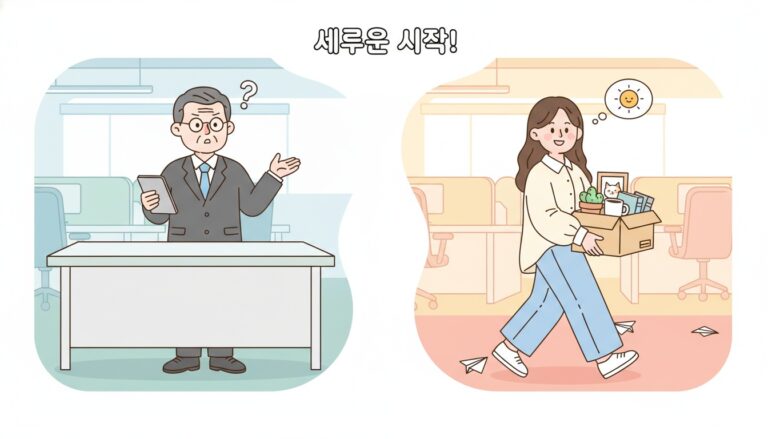
Is Job Hopping Bad? 🏢 Korean Workplace Realities!
👋 Introduction
Annyeonghaseyo! It’s your favorite Korean tutor, Daily Hangul! 🍎✨
Have you ever watched a K-Drama where a character dramatically hands in their resignation letter? 📄 In shows like Start-Up or Misaeng, the workplace is a battlefield! Today, we are going to talk about a very hot topic in Korea: Job Hopping (Changing jobs frequently).
In the past, staying at one company forever was the norm. But nowadays, the younger generation (Gen MZ) thinks differently! Let’s learn expressions to discuss career moves and understand the generation gap in the Korean office. Let’s level up! 🚀
🔑 Key Expressions
1. 이직하다 (To change jobs)
- Pronunciation: [Ijikada]
- English: To change jobs / To move to another company
- Detail: This is the standard verb for moving from one company to another. While older generations valued loyalty, young Koreans often do this to find better opportunities.
- 💡 Pronunciation Tip: The ‘h’ in ‘ha’ is weak. When spoken fast, it sounds smoother, almost like “Ijikkada”.
2. 경력 (Career / Work Experience)
- Pronunciation: [Gyeongnyeok]
- English: Career / Experience
- Detail: This is the most important word in a resume! Young people change jobs to build their ‘Gyeongnyeok’.
- 💡 Pronunciation Tip: Watch out! This is a nasalization rule.
Gi-yeok(ㄱ) meetsRieul(ㄹ), so it changes sound. It is NOT [Gyeong-ryeok], it is [Gyeong-nyeok].
3. 끈기 (Patience / Perseverance)
- Pronunciation: [Kkeungi]
- English: Patience / Perseverance / Tenacity
- Detail: This is a word often used by the older generation. If someone quits too soon, a boss might say, “You have no Kkeungi!” (meaning you give up too easily).
- 💡 Pronunciation Tip: The ‘Kk’ (ㄲ) is a tense sound. Tense your throat and say it sharply!
4. 월급 (Monthly Salary)
- Pronunciation: [Wolgeup]
- English: Monthly Salary / Paycheck
- Detail: The main reason for job hopping? A higher Wolgeup! 💸
💬 Real-Life Conversation
Here is a chat between two friends, Minsu (Young generation) and Joon (Slightly conservative view).
Minsu: 나 다음 달에 이직해.
[Na da-eum dare ijikhae.]
(I am changing jobs next month.)
Joon: 진짜? 벌써 세 번째 아니야?
[Jinjja? Beolsseo se beonjjae aniya?]
(Really? Isn’t that the third time already?)
Minsu: 더 좋은 경력을 만들고 싶어서 그래.
[Deo joeun gyeongnyeogeul mandeulgo sipeoseo geurae.]
(It’s because I want to build a better career.)
Joon: 너는 끈기가 좀 부족한 것 같아.
[Neoneun kkeungiga jom bujokhan geot gata.]
(I think you lack a bit of patience.)
Minsu: 아니야, 월급이 두 배라고!
[Aniya, wolgeubi du baerago!]
(No way, the salary is double!)
🇰🇷 Culture Tip & Drama Vibes
☕ “Latte is Horse” (Latte-neun Mariya)
In Korean dramas, have you seen an angry boss scolding a young employee? They often think, “Back in my day…” In Korean, this sounds like “Na-tte-neun mariya” (나 때는 말이야). Young people make fun of this by calling it “Latte is horse” (because ‘mariya’ sounds like ‘horse’ and ‘Na-tte’ sounds like ‘Latte’).
- Older View: “Stay in one company! That is loyalty and Kkeungi!”
- Younger View: “I need better Wolgeup and Gyeongnyeok! I will Ijik (change jobs)!”
Understanding this gap will help you understand office conflicts in dramas like Kkondae Intern! 😉
📝 Wrap-up & Quiz
Today we learned how to talk about changing jobs and the different views on it! Are you Team Loyalty or Team Career Growth?
Let’s check your understanding!
- Which word means “To change jobs”?
A) 이직하다 (Ijikada)
B) 공부하다 (Gongbuhada) -
How do you pronounce 경력 (Career)?
A) [Gyeong-ryeok]
B) [Gyeong-nyeok] -
(True/False) “Latte is horse” is a phrase young people use to joke about older generations saying “Back in my day.”
Answers:
1. A
2. B
3. True
See you next time! Annyeong! 👋
Frequently Asked Questions (FAQ)
Q: What does "이직하다 (To change jobs)" mean in Korean and how do you pronounce it?
A: In Korean, "이직하다 (To change jobs)" is pronounced [Ijikada] and means: a key conversational Korean expression covered in this lesson.
Q: What does "경력 (Career / Work Experience)" mean in Korean and how do you pronounce it?
A: In Korean, "경력 (Career / Work Experience)" is pronounced [Gyeongnyeok] and means: a key conversational Korean expression covered in this lesson.
Q: What does "끈기 (Patience / Perseverance)" mean in Korean and how do you pronounce it?
A: In Korean, "끈기 (Patience / Perseverance)" is pronounced [Kkeungi] and means: a key conversational Korean expression covered in this lesson.
Q: What does "월급 (Monthly Salary)" mean in Korean and how do you pronounce it?
A: In Korean, "월급 (Monthly Salary)" is pronounced [Wolgeup] and means: a key conversational Korean expression covered in this lesson.







