

Hello, K-culture fans! It’s Daily Hangul! 😊
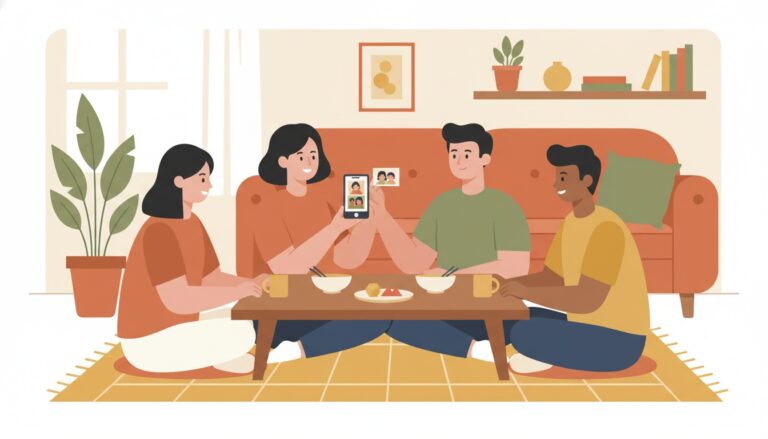
Welcome back! Imagine you are at a fun chicken & beer (Chimaek) party in Seoul. Someone points to a photo on your phone and asks, “Who is that?” Is it your boyfriend? No, it’s just your brother! 😅
In K-Dramas, family relationships can be super dramatic, but in real life, talking about family is a great way to make friends. Today, let’s learn how to introduce your family members without any confusion!
🔑 Core Expressions
Here are the 3 key phrases you need to survive a family introduction!
1. 가족이 몇 명이에요? (How many people are in your family?)
- Pronunciation: [Gajogi myeon myeong-ieyo?]
- Meaning: How many people are in your family?
- Detail: This is the most common question to start a topic about family.
- 💡 Pronunciation Tip: Did you notice we write ‘Gajok’ but say ‘Gajogi’? When the bottom consonant ㄱ (k/g) meets the vowel 이 (i), the sound travels over! It becomes smoother: Ga-jo-gi.
2. 우리 오빠예요. (He is my older brother.)
- Pronunciation: [Uri oppa-yeyo.]
- Meaning: He is my older brother. (Used by females)
- Detail: If you are a K-Drama fan, you know Oppa! It means “older brother” for a female speaker.
- Wait! Does it mean boyfriend? Sometimes! But when introducing family, it strictly means brother.
- If you are a male, you call your older brother 형 (Hyeong).
3. 언니가 있어요. (I have an older sister.)
- Pronunciation: [Eonniga isseoyo.]
- Meaning: I have an older sister. (Used by females)
- Detail: Use ~이/가 있어요 to say “I have ~.”
- If you are a male, you call your older sister 누나 (Noona).
🗣️ Real Conversation
Let’s see how Minji and Jason talk at a party!
Minji: 제이슨 씨, 가족이 몇 명이에요?
(Jason, how many people are in your family?)
Jason: 세 명이에요. 아버지, 어머니, 그리고 저예요. 민지 씨는요?
(Three people. Father, mother, and me. How about you, Minji?)
Minji: 저는 네 명이에요. 언니가 있어요.
(I am four. I have an older sister.)
Jason: 아, 언니랑 같이 살아요?
(Ah, do you live with your sister?)
Minji: 네, 같이 살아요!
(Yes, we live together!)
🎭 Culture Tip & K-Drama Vibes
Why do Koreans say “OUR” Mom? 🤔
Did you notice in Expression #2, I used 우리 (Uri) which means “Our”?
Koreans value community and “oneness.” Instead of saying “My mom” (which sounds a bit detached to Koreans), we say “Our mom” (우리 엄마) or “Our house” (우리 집), even if you are the only child!
So next time, try saying “Uri Oppa” instead of “My Oppa” to sound like a native Seoulite! 😉
📝 Wrap-up & Quiz
Today we learned how to count family members and use the correct titles! Let’s check your memory.
Quiz Time!
1. How do you say “How many people in your family?”
-> ________ 몇 명이에요?
2. If you are a girl, what do you call your older brother?
-> ______
Keep practicing, and see you next time! Annyeong! 👋
[Answers]
1. 가족이 (Gajogi)
2. 오빠 (Oppa)
Frequently Asked Questions (FAQ)
Q: What does "가족이 몇 명이에요? (How many people are in your family?)" mean in Korean and how do you pronounce it?
A: In Korean, "가족이 몇 명이에요? (How many people are in your family?)" is pronounced [Gajogi myeon myeong-ieyo?] and means: How many people are in your family?
Q: What does "우리 오빠예요. (He is my older brother.)" mean in Korean and how do you pronounce it?
A: In Korean, "우리 오빠예요. (He is my older brother.)" is pronounced [Uri oppa-yeyo.] and means: He is my older brother. (Used by females)
Q: What does "언니가 있어요. (I have an older sister.)" mean in Korean and how do you pronounce it?
A: In Korean, "언니가 있어요. (I have an older sister.)" is pronounced [Eonniga isseoyo.] and means: I have an older sister. (Used by females)







