

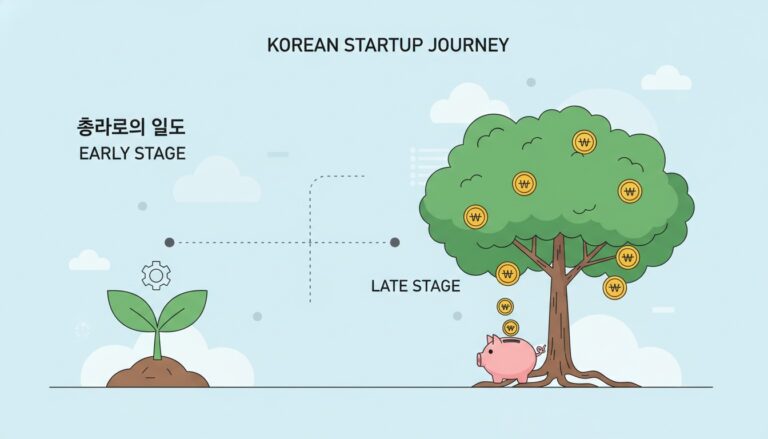
Startup Money: Early vs Late Stage! 💸
1. Intro
Hello, everyone! This is Daily Hangul, here to upgrade your Korean skills! 🚀
Have you watched the K-Drama “Start-Up” (스타트업)? Even if you are a beginner, you might have heard characters like Han Ji-pyeong talking about money and business growth. Today, we are going to learn how to discuss the difference between Early-Stage and Late-Stage investments in the Venture Capital world! 🏢
Don’t worry if business terms sound hard! We will learn the most essential words so you can understand the context when watching dramas or talking about business in Korea. Let’s dive in! 💪
2. Core Expressions (핵심 표현) 📚
Here are 4 key expressions to help you talk about investment stages!
1. 투자 (Tuja)
- Pronunciation: [Tuja]
- English Meaning: Investment
- Detail: This is the most basic word in business. You can use it with the verb ‘하다’ (to do) -> 투자하다 (to invest).
- 💡 Pronunciation Tip: The ‘j’ in ‘ja’ is soft, like the ‘j’ in ‘jar’, but softer. Don’t make a strong ‘Z’ sound!
2. 초기 (Chogi)
- Pronunciation: [Chogi]
- English Meaning: Early stage / The beginning
- Detail: ‘Cho’ means beginning. In the startup world, this refers to the time when a company is just starting out (Seed or Series A).
3. 후기 (Hugi)
- Pronunciation: [Hugi]
- English Meaning: Late stage / The latter part
- Detail: ‘Hu’ means after or back. This refers to a mature company ready for IPO or big expansion.
- 💡 Pronunciation Tip: When saying ‘Hugi’, the ‘H’ is breathy. It’s distinct from ‘Chogi’.
4. 차이점 (Chaijeom)
- Pronunciation: [Chaijeom]
- English Meaning: Difference / Point of difference
- Detail: When comparing A and B, you ask “What is the chaijeom?” (What is the difference?).
- 💡 Pronunciation Tip: ‘Jeom’ sounds like ‘jum’ in ‘jump’.
3. Real Conversation (실전 대화) 🗣️
Let’s see how Min-su and Sarah discuss a startup company.
Situation: Sarah is asking Min-su about a new Korean company.
Sarah: 이 회사는 초기 단계예요?
(I hoesaneun chogi dangyeyeyo?)
Is this company in the early stage?
Min-su: 아니요, 벌써 후기 단계예요.
(Aniyo, beolsseo hugi dangyeyeyo.)
No, it’s already in the late stage.
Sarah: 아, 그럼 투자를 많이 받았어요?
(Ah, geureom tuja-reul mani badasseoyo?)
Ah, then did they get a lot of investment?
Min-su: 네, 맞아요. 규모가 달라요.
(Ne, majayo. Gyumoga dallayo.)
Yes, that’s right. The scale is different.
4. Culture Tip & Drama Scene 🎬
Did you know? The “Series” Culture
Just like in Silicon Valley, Korean VCs use terms like “Series A, B, C.” However, in casual conversation, people often simplify it to 초기 (Early) and 후기 (Late).
In the drama “Start-Up,” the fictional place Sandbox is where 초기 (Early) startups go to grow. Characters often debate whether to focus on potential (Early) or profit (Late). Next time you watch a business drama, listen for the word 투자 (Tuja)! It appears whenever money is involved! 💰
5. Wrap-up & Quiz 📝
Today we learned how to distinguish between early and late stages in Korean business terms! Great job following along! 👏👏
Let’s check your memory!
- What is the Korean word for “Investment”?
( Hint: T _ _ a ) -
Which word means “Early Stage”?
a) 후기 (Hugi)
b) 초기 (Chogi) -
Fill in the blank: “Early and Late stages have a big _______.”
(Korean: 차이점)
[Answers]
1. 투자 (Tuja)
2. b) 초기 (Chogi)
3. Difference
See you next time! 안녕! 👋
Frequently Asked Questions (FAQ)
Q: What does "초기 (Chogi)" mean in Korean and how do you pronounce it?
A: In Korean, "초기 (Chogi)" is pronounced [Chogi] and means: Early stage / The beginning
Q: What does "후기 (Hugi)" mean in Korean and how do you pronounce it?
A: In Korean, "후기 (Hugi)" is pronounced [Hugi] and means: Late stage / The latter part
Q: What does "차이점 (Chaijeom)" mean in Korean and how do you pronounce it?
A: In Korean, "차이점 (Chaijeom)" is pronounced [Chaijeom] and means: Difference / Point of difference







