

Hello! Daily Hangul here! 👋
안녕하세요! Welcome back to [Daily Hangul], your best friend for learning Korean! 🤓
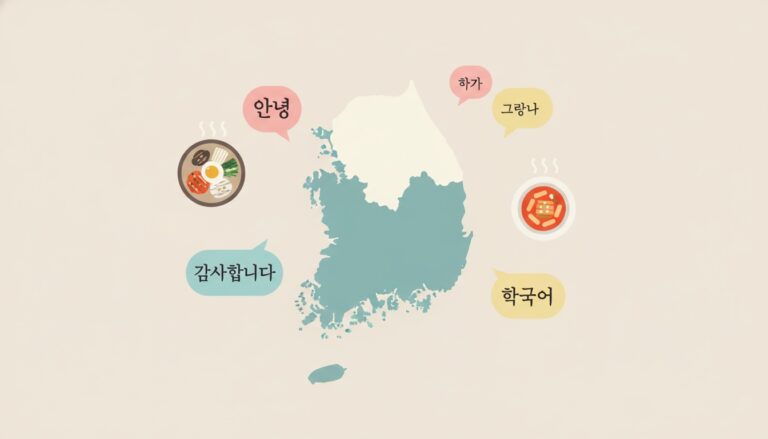
Today, we are taking a special trip to the southwest region of Korea. Have you ever watched the famous K-Drama ‘Reply 1994’ (응답하라 1994)? The character ‘Haitai’ captured everyone’s heart with his rhythmic and catchy accent. That is the Jeolla-do Dialect (Jeolla Satoori)! 🗺️
While standard Korean (Seoul dialect) is what you usually learn, knowing a bit of satoori (dialect) adds incredible flavor to your speaking. It makes you sound friendly, expressive, and like a true Korean culture expert! Are you ready to spice up your Korean? Let’s go! 🚀
Core Expressions 🗣️
Here are 4 magical words that will turn you into a Jeolla-do local instantly!
1. 아따 (A-dda)
- Pronunciation: [A-dda]
- English Meaning: Oh my! / Geez! / Wow!
- Detail: This is a very common exclamation used to start a sentence. It expresses various emotions like surprise, frustration, admiration, or just to grab attention. It’s like saying “Oh boy!” or “Come on!”
- 💡 Pronunciation Tip: Tense your throat for the ‘dd’ (따) sound. It’s a strong, sharp sound. Say “Ah!” then “Dda!” quickly together.
2. 거시기 (Geosigi)
- Pronunciation: [Geosigi]
- English Meaning: Thingy / Whatchamacallit
- Detail: This is the magic word of the Jeolla dialect! Koreans use this when they can’t remember a specific word, name, or object. Sometimes, close friends understand the whole sentence just with this word!
- 💡 Pronunciation Tip: Pronounce it smoothly like “Geo-shi-gi”. The ‘s’ is soft.
3. 허벌나게 (Heobeollage)
- Pronunciation: [Heobeollage]
- English Meaning: Extremely / Very / A lot
- Detail: Standard Korean uses ‘aju’ (아주) or ‘neomu’ (너무). But in Jeolla-do, when something is really intense, they say Heobeollage. It emphasizes the magnitude!
- 💡 Pronunciation Tip: ‘Heo’ is breathy. ‘Beol’ rhymes with ‘Hull’.
4. ~잉 (~Ing)
- Pronunciation: [Ing]
- English Meaning: Right? / Okay? (Ending particle)
- Detail: This is a sentence-ending particle. Instead of the standard ‘~ji’ (지) or ‘~ne’ (네), Jeolla locals add a soft ‘~ing’ sound. It makes the sentence sound affectionate and rhythmic.
- 💡 Pronunciation Tip: Drag the sound slightly at the end. “Mas-it-ne-ing~” (It’s tasty~).
Real Conversation 💬
Situation: Two friends, Min-su and Ji-ho, are visiting a famous restaurant in Jeonju.
Min-su: 아따, 사람 허벌나게 많네!
([A-dda], saram [heobeollage] manne!)
Geez, there are extremely many people here!
Ji-ho: 그치? 여기 맛집이라 그래잉.
(Geuchi? Yeogi matjib-ira geurae-[ing].)
Right? It’s because this place is famous, you know.
Min-su: 우리 뭐 먹지? 그… 거시기 먹을까?
(Uri mwo meokji? Geu… [geosigi] meogeulkka?)
What should we eat? Shall we eat that… whatchamacallit?
Ji-ho: 비빔밥? 좋아! 빨리 들어가자.
(Bibimbap? Joa! Ppalli deureogaja.)
Bibimbap? Good! Let’s go in quickly.
Culture Tip & Drama Scene 📺
Jeolla-do: The Kitchen of Korea 🍚
Jeolla province is famous for being the “Taste Region” (Namdo Eumsik). The food is known to be spicy, salty, and incredibly delicious with many side dishes (Banchan).
In K-Dramas like ‘Reply 1994’, characters using this dialect are often portrayed as having a lot of ‘Jeong’ (정 – warm affection). They might sound loud or rough at first, but they are usually the most loyal and caring friends. Using “A-dda” or ending your sentence with “~ing” is a great way to break the ice with Koreans from this region!
Wrap-up & Quiz 📝
Today we learned how to add some flavor to your Korean with Jeolla-do Satoori! Try using “A-dda!” next time you are surprised! 😲
Let’s check what you learned!
- Fill in the blank: “The weather is ______ hot!” (Meaning: Extremely)
(A) Geosigi (B) Heobeollage -
Which ending particle makes a sentence sound like Jeolla dialect?
(A) ~Ing (B) ~Nika
Answers:
1. (B) Heobeollage
2. (A) ~Ing
See you next time with more fun Korean! Annyeong! 👋
Frequently Asked Questions (FAQ)
Q: What does "아따 (A-dda)" mean in Korean and how do you pronounce it?
A: In Korean, "아따 (A-dda)" is pronounced [A-dda] and means: Oh my! / Geez! / Wow!
Q: What does "거시기 (Geosigi)" mean in Korean and how do you pronounce it?
A: In Korean, "거시기 (Geosigi)" is pronounced [Geosigi] and means: Thingy / Whatchamacallit
Q: What does "허벌나게 (Heobeollage)" mean in Korean and how do you pronounce it?
A: In Korean, "허벌나게 (Heobeollage)" is pronounced [Heobeollage] and means: Extremely / Very / A lot
Q: What does "~잉 (~Ing)" mean in Korean and how do you pronounce it?
A: In Korean, "~잉 (~Ing)" is pronounced [Ing] and means: Right? / Okay? (Ending particle)







