

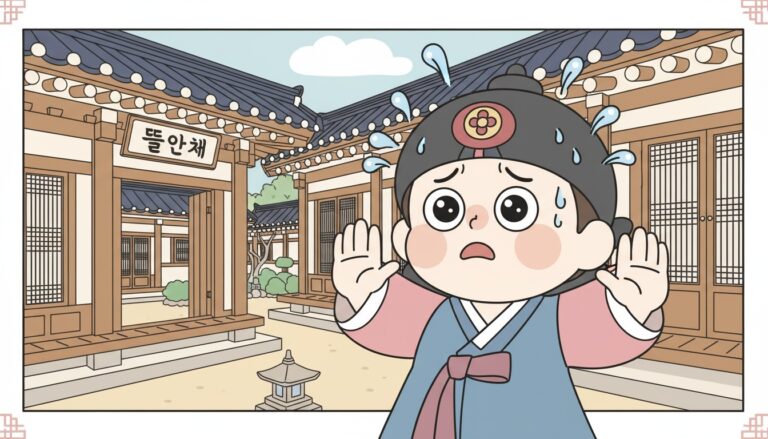
Hello! It’s Daily Hangul! 👋✨
Welcome back, K-culture lovers! It’s your favorite Korean tutor, Daily Hangul! 🍎
Have you ever watched a K-Drama where the main character is falsely accused of something? They look so frustrated and shout, “It wasn’t me!” 😭 Today, we are going to learn how to handle these unfair situations in Korean.
Whether you accidentally took someone’s umbrella or your friend thinks you ignored their text, these phrases will save the day! Let’s clear up those misunderstandings like a pro! 🚀
3 Essential Expressions for “I’m Innocent!” 🛡️
1. 오해예요 (It’s a misunderstanding)
- Pronunciation: [Ohaeyeyo]
- Meaning: It’s a misunderstanding.
- Detail: This is the most standard and polite way to say there has been a mix-up. You can use this with strangers, co-workers, or older people.
- Tip: If talking to a close friend, drop the ‘yo’ and say “오해야 (Ohaeya)”.
2. 억울해요 (I feel so unfair/wronged)
- Pronunciation: [Eogulhaeyo]
- Meaning: I feel treated unfairly / I am falsely accused.
- Detail: 🚨 K-Drama Alert! You will hear this A LOT. It describes the emotion of being misunderstood. It’s not just “I didn’t do it,” it’s “I’m so frustrated and sad because I’m innocent!”
3. 진짜 아니에요 (It really isn’t / It wasn’t me)
- Pronunciation: [Jinjja anieyo]
- Meaning: It’s really not (true) / I really didn’t do it.
- Detail: When you need to strongly deny something, add 진짜 (Jinjja – Really). It emphasizes your sincerity.
💡 Pronunciation Tip (Honey Tip! 🍯)
In 오해예요 [Ohaeyeyo], the ‘H’ sound is very soft. Sometimes it sounds almost like ‘O-ae-ye-yo’ when spoken quickly. Don’t stress the ‘H’ too hard!
Real-Life Conversation: The Missing Coffee ☕
Situation: Min-su thinks Sarah drank his iced americano.
Min-su: 사라 씨, 제 커피 마셨어요? 😠
(Sarah, did you drink my coffee?)
[Sarah-ssi, je keopi masyeosseoyo?]
Sarah: 네? 아니요! 오해예요! 😧
(What? No! It’s a misunderstanding!)
[Ne? Aniyo! Ohaeyeyo!]
Min-su: 정말요? 컵이 비어 있는데요?
(Really? The cup is empty though?)
[Jeongmalyo? Keobi bieo inneundeyo?]
Sarah: 진짜 아니에요. 저도 방금 왔어요. 너무 억울해요! 😭
(It really wasn’t me. I just got here too. I feel so unfair!)
[Jinjja anieyo. Jeodo banggeum wasseoyo. Neomu eogulhaeyo!]
Culture Tip & K-Drama Vibes 🎭
In Korea, emotions are often described very specifically. The word 억울하다 (Eogulhada) is powerful because it touches on the concept of “Han” (한)—a deep sense of sorrow or injustice.
In dramas, when a character yells “억울해!”, they might even beat their chest with their fist! ✊ This gesture signifies frustration that is “stuck” in their heart. If you want to act like a true Korean actor, try the chest-thump gesture (gently!) while saying it. 😉
Let’s Wrap Up! 📝
Today we learned how to defend ourselves when things go wrong. Don’t panic, just say “오해예요!”
Mini Quiz ✍️
- How do you say “It’s a misunderstanding” politely?
( ) - Which word describes the feeling of being falsely accused or treated unfairly?
( )
See you next time! Annyeong! 👋💖
Answer Key:
1. 오해예요 (Ohaeyeyo)
2. 억울해요 (Eogulhaeyo)
Frequently Asked Questions (FAQ)
Q: What does "오해예요 (It's a misunderstanding)" mean in Korean and how do you pronounce it?
A: In Korean, "오해예요 (It's a misunderstanding)" is pronounced [Ohaeyeyo] and means: It’s a misunderstanding.
Q: What does "억울해요 (I feel so unfair/wronged)" mean in Korean and how do you pronounce it?
A: In Korean, "억울해요 (I feel so unfair/wronged)" is pronounced [Eogulhaeyo] and means: I feel treated unfairly / I am falsely accused.
Q: What does "진짜 아니에요 (It really isn't / It wasn't me)" mean in Korean and how do you pronounce it?
A: In Korean, "진짜 아니에요 (It really isn't / It wasn't me)" is pronounced [Jinjja anieyo] and means: It’s really not (true) / I really didn't do it.






