

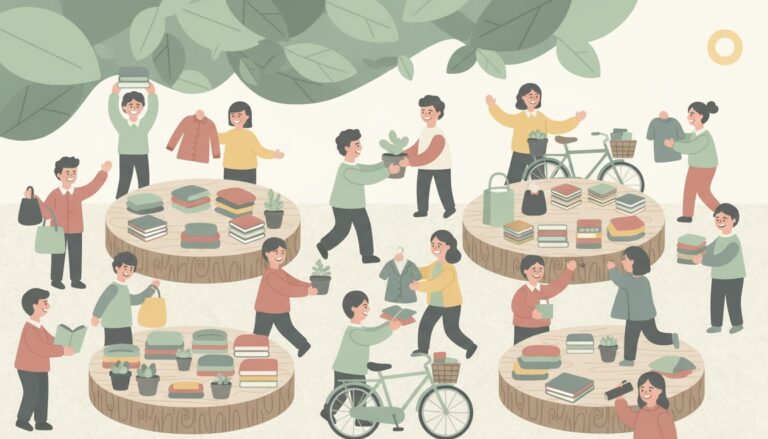
🌿 Save Earth & Money: Join the Anabada Market!
Hello, everyone! Welcome back to Daily Hangul, where we upgrade your Korean skills with fun and energy! 😊
Today, we are going to talk about a very special and meaningful event in Korea: Environmental Protection through a flea market! Have you ever heard of the word “Anabada”? It sounds like a magic spell, right? 🪄
If you want to protect the earth and find cool vintage items like the characters in K-Dramas (think of the retro vibes in Reply 1988!), this lesson is for you. Let’s learn how to announce and enjoy a flea market in Korean! 🌍✨
📚 Key Expressions
Here are 3 essential expressions to talk about an eco-friendly market!
1. 아나바다 (Anabada)
- Pronunciation: [Anabada]
- English Meaning: An acronym for “Save, Share, Exchange, and Reuse”
- Detail: This isn’t just a random word! It stands for Akkyeo sseugo (Save), Nanwo sseugo (Share), Bakkwuo sseugo (Exchange), and Dasi sseugo (Reuse). It represents the Korean spirit of recycling and frugality.
2. 중고 (Junggo)
- Pronunciation: [Junggo]
- English Meaning: Second-hand / Used
- Detail: You put this word before items. For example, 중고차 (used car) or 중고 옷 (used clothes). It’s very useful when buying or selling things!
3. 같이 해요 (Gachi haeyo)
- Pronunciation: [Gachi haeyo]
- English Meaning: Let’s do it together / Join us
- Detail: This is a polite and friendly way to invite people to join an event or activity. You will hear this a lot in Korean variety shows!
- 💡 Pronunciation Tip: Wait! Why is ‘t’ (ㅌ) pronounced like ‘ch’ (치)? 🤔 In Korean, when ㅌ (t) meets 이 (i), the sound changes to 치 (chi). So, strictly speaking, it is written as gat-i, but pronounced as [ga-chi]! This is called Palatalization (구개음화).
💬 Real Conversation
Let’s see how friends talk about a flea market poster at a community center.
A: 와, 여기 좀 봐요! 아나바다 장터가 열려요.
(Wa, yeogi jom bwayo! Anabada jangteoga yeollyeoyo.)
Wow, look here! An Anabada market is opening.
B: 아나바다가 뭐예요?
(Anabadaga mwoyeyo?)
What is Anabada?
A: 물건을 바꿔 쓰고 다시 쓰는 거예요.
(Mulgeoneul bakkwo sseugo dasi sseuneun geoyeyo.)
It means exchanging and reusing items.
B: 정말 좋은 뜻이네요! 우리도 같이 해요.
(Jeongmal joeun tteusineyo! Urido gachi haeyo.)
That’s a really good meaning! Let’s do it together.
A: 좋아요. 저는 중고 책을 팔고 싶어요.
(Joayo. Jeoneun junggo chaegeul palgo sipeoyo.)
Good. I want to sell second-hand books.
🇰🇷 Culture Tip & K-Drama Vibes
Did you know?
The “Anabada Movement” became huge in Korea during the late 90s to overcome the economic crisis. Nowadays, it has evolved into a trendy culture of sustainability! 🌱
If you watch modern Korean life, you might see people using an app called “Danggeun Market” (Karrot Market). When the app notifies them with a “Dang-geun!” sound, they meet neighbors to trade used goods. It’s the modern, digital version of the Anabada market! If you live in Korea, trying this is the best way to make local friends and save money. 🥕
📝 Wrap-up & Quiz
Today we learned about Anabada, the Korean spirit of saving the environment! Try using “Gachi haeyo” (Let’s do it together) when inviting your friends to an eco-friendly event.
🧠 Mini Quiz
- What is the Korean word for “Second-hand”?
( Hint: J_ _ g _ o ) - How do you pronounce 같이 (Together)?
( A. Gati / B. Gachi )
Answers:
1. 중고 (Junggo)
2. B. Gachi (Remember the tip! ㅌ + 이 = 치)
See you next time! 안녕! 👋
Frequently Asked Questions (FAQ)
Q: What does "아나바다 (Anabada)" mean in Korean and how do you pronounce it?
A: In Korean, "아나바다 (Anabada)" is pronounced [Anabada] and means: An acronym for "Save, Share, Exchange, and Reuse"
Q: What does "중고 (Junggo)" mean in Korean and how do you pronounce it?
A: In Korean, "중고 (Junggo)" is pronounced [Junggo] and means: Second-hand / Used
Q: What does "같이 해요 (Gachi haeyo)" mean in Korean and how do you pronounce it?
A: In Korean, "같이 해요 (Gachi haeyo)" is pronounced [Gachi haeyo] and means: Let's do it together / Join us







