

1. Introduction
Hello, everyone! It’s your favorite Korean tutor, Daily Hangul (매일한글)! 😊 Ready to upgrade your Korean skills?
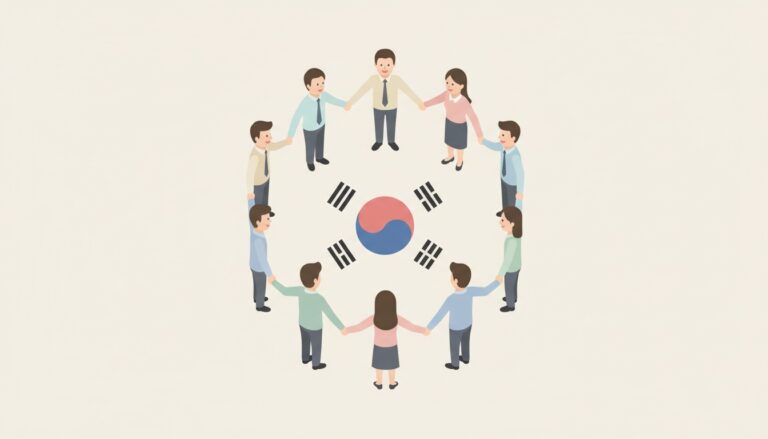
Today’s topic might sound a bit serious—“The Industrial Revolution and Labor Unions”—but don’t worry! We are going to learn essential words related to work, rights, and fairness.
If you love office K-Dramas like Misaeng (Incomplete Life) or Awl (Songgot), you need to know these expressions. These words are used when characters fight for justice or talk about their work life. Let’s learn how to speak up for ourselves in Korean! 💪
2. Core Expressions
Here are 4 key expressions to discuss work and rights!
1. 노동자 (Nodongja)
- Pronunciation: [No-dong-ja]
- English: Worker / Laborer
- Detail: This is the formal word for someone who works. In history, the Industrial Revolution changed how ‘nondongja’ lived. In dramas, you’ll hear this when talking about workers’ rights.
- 💡 Pronunciation Tip: The ‘J’ in ‘ja’ is soft, not a hard ‘Z’ sound.
2. 월급을 올려주세요 (Wolgeubeul ollyeojuseyo)
- Pronunciation: [Wol-geu-beul ol-lyeo-ju-se-yo]
- English: Please raise my salary.
- Detail: One of the main goals of early unions! ‘Wolgeup’ means monthly salary. ‘Ollyeojuseyo’ means ‘please raise/lift up’.
- 💡 Pronunciation Tip: When saying 월급을 (Wolgeubeul), the ‘ㅂ’ (b/p) sound at the bottom moves over to the next empty vowel spot. So it sounds like [Wol-geu-beul]. This is called Liaison!
3. 힘을 합치다 (Himeul hapchida)
- Pronunciation: [Hi-meul hap-chi-da]
- English: To join forces / To combine strength
- Detail: Unions are all about working together. You use this phrase when you want to solve a problem as a team.
4. 권리 (Gwonli)
- Pronunciation: [Gwol-li]
- English: Right (as in human rights/worker’s rights)
- Detail: This is what unions fight for. It’s a very important word in news and serious dramas.
- 💡 Pronunciation Tip: This is tricky! When ‘ㄴ’ (n) meets ‘ㄹ’ (l), they both turn into a flowing ‘L’ sound. So don’t say ‘Gwon-ri’, say [Gwol-li]!
3. Real Conversation
Let’s see how Min-su and Ji-eun talk about fixing their difficult work situation.
Situation: Discussing forming a team to ask for better working conditions.
Min-su: 일이 너무 많아요. 주말에도 쉬고 싶어요.
(Ili neomu manayo. Jumaledo swigo sipeoyo.)
There is too much work. I want to rest on weekends too.
Ji-eun: 맞아요. 우리 권리를 찾아야 해요.
(Majayo. Uri gwonlireul chajaya haeyo.)
That’s right. We need to find (claim) our rights.
Min-su: 혼자 말하기는 무서워요.
(Honja malhagineun museowoyo.)
It’s scary to speak alone.
Ji-eun: 걱정 마세요. 우리 힘을 합쳐서 같이 말해요!
(Geokjeong maseyo. Uri himeul hapchyeoseo gachi malhaeyo!)
Don’t worry. Let’s join forces and speak together!
4. Culture Tip & K-Drama Vibes
🎬 The “Hoesik” (Company Dinner) & Solidarity
In Korea, team bonding is very important. Historically, and even now, many discussions about work problems happen during Hoesik (회식) over grilled pork belly (Samgyeopsal) and Soju.
Also, in dramas like Awl, you see characters wearing matching vests or headbands. This is a common visual in Korea when a Labor Union (노동조합) is protesting or negotiating. It symbolizes that “We are one.” If you see that in a drama, remember the phrase: “힘을 합치다!” (Join forces!)
5. Wrap-up & Quiz
Today we learned how to talk about working together and asking for better conditions! Even though the Industrial Revolution is history, these words are used every day in modern Korea.
📝 Quick Quiz!
- What is the Korean word for “Worker”?
(Hint: N_ _ _ _ _ j _) - How do you say “Please raise my salary”?
A. Wolgeubeul naeryeojuseyo
B. Wolgeubeul ollyeojuseyo - True or False: In the word 권리 (Rights), you pronounce the ‘n’ and ‘r’ clearly separately.
(Scroll down for answers!)
.
.
.
✅ Answers:
1. 노동자 (Nodongja)
2. B (B. Wolgeubeul ollyeojuseyo)
3. False! (It changes to a soft ‘L’ sound: [Gwol-li])
Keep studying hard, and fight for your Korean fluency rights! See you next time! 안녕! 👋
Frequently Asked Questions (FAQ)
Q: What does "월급을 올려주세요 (Wolgeubeul ollyeojuseyo)" mean in Korean and how do you pronounce it?
A: In Korean, "월급을 올려주세요 (Wolgeubeul ollyeojuseyo)" is pronounced [Wol-geu-beul ol-lyeo-ju-se-yo] and means: a key conversational Korean expression covered in this lesson.
Q: What does "힘을 합치다 (Himeul hapchida)" mean in Korean and how do you pronounce it?
A: In Korean, "힘을 합치다 (Himeul hapchida)" is pronounced [Hi-meul hap-chi-da] and means: a key conversational Korean expression covered in this lesson.
Q: What does "권리 (Gwonli)" mean in Korean and how do you pronounce it?
A: In Korean, "권리 (Gwonli)" is pronounced [Gwol-li] and means: a key conversational Korean expression covered in this lesson.







