

Hello! It’s [Daily Hangul]! 👋
Hello, history buffs! Welcome back to Daily Hangul, your guide to mastering Korean in the most fun way possible! 🌟
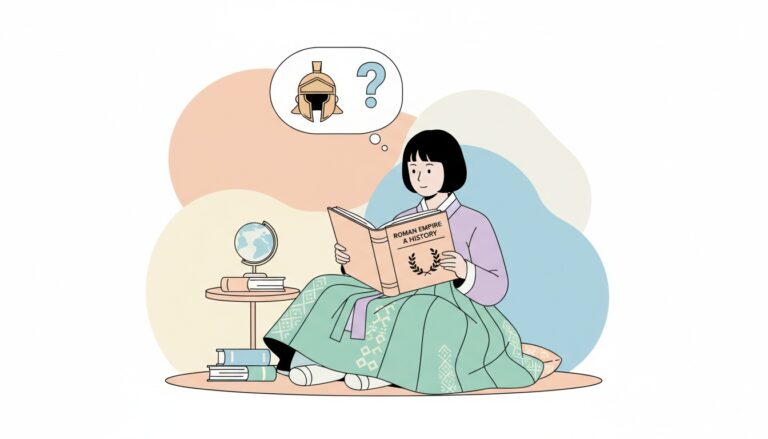
Today, we are going to have a very smart conversation. Have you ever watched a historical documentary or a movie about the Roman Empire and wondered, “Why did such a big empire fall?”
Even if you are a beginner, you can express your opinions on complex topics like the Fall of the Western Roman Empire using simple Korean patterns! 😲
Imagine impressing your Korean friends by discussing history. It sounds difficult, but with today’s magic phrases, you will sound like a professor! Let’s dive in! 📚✨
3 Key Expressions to Discuss Causes & Opinions 🗣️
1. 왜 망했어요? (Wae mang-haesseoyo?)
- Meaning: Why did it fall/fail/go to ruin?
- Explanation: “망하다” (mang-hada) means to fail, go bankrupt, or go to ruin. It is often used when talking about businesses closing or empires falling. It’s a bit direct but very common in conversation.
- 💡 Pronunciation Tip: The ‘h’ is weak. It sounds like [Wae mang-hae-sseo-yo].
2. ~ 때문에 (~ ttaemune)
- Meaning: Because of ~
- Explanation: This is the magic word for explaining causes! You simply put a noun before it.
- Economy (경제) + ttaemune = Because of the economy.
- War (전쟁) + ttaemune = Because of the war.
- 💡 Pronunciation Tip: ‘Tt’ (ㄸ) is a tense sound. Tense your tongue and say it sharply! [Ttae-mu-ne].
3. 제 생각에는… (Je saeng-gag-e-neun…)
- Meaning: In my opinion…
- Explanation: When discussing history, there is no single right answer, right? Use this phrase to politely start your sentence. It softens your argument and makes you sound very intellectual!
- 💡 Pronunciation Tip: ‘Saeng-gak’ ends with a ‘k’ sound, but when followed by ‘e’, it flows. [Je saeng-ga-ge-neun].
Real-Life Conversation: The History Debate 💬
Situation: Min-su and Sarah are talking about a history book regarding the Roman Empire.
Min-su: 로마 제국은 정말 컸어요. (Roma jegug-eun jeongmal keosseoyo.)
The Roman Empire was really big.
Sarah: 맞아요. 그런데 왜 망했어요? (Majayo. Geureonde wae mang-haesseoyo?)
That’s right. But why did it fall?
Min-su: 음, 제 생각에는 경제 때문에 망했어요. (Eum, je saeng-gag-e-neun gyeongje ttaemune mang-haesseoyo.)
Hmm, in my opinion, it fell because of the economy.
Sarah: 경제요? 저는 정치 문제 같아요. 너무 복잡해요! (Gyeongjeyo? Jeoneun jeongchi munje gat-a-yo. Neomu bokjaphaeyo!)
The economy? I think it was political problems. It’s too complicated!
Culture Tip & K-Drama Vibes 🎭
Did you know?
Koreans love history! There is a whole genre of dramas called Sageuk (사극), which are historical dramas. While today we talked about Rome, if you watch dramas like Kingdom or Mr. Sunshine, you will see characters discussing why a dynasty is in danger.
Also, using “제 생각에는” (In my opinion) is very important in Korean culture. It shows respect for the other person’s view, rather than stating your opinion as an absolute fact. It’s a polite way to debate! 👍
Wrap-up & Quiz 📝
Today we learned how to discuss the Fall of Empires using simple Korean phrases! You are now ready to debate history.
Let’s practice! Fill in the blanks:
- Why did it fail? : ______ 망했어요? (______ mang-haesseoyo?)
- Because of the weather : 날씨 ______ (Nalssi ______)
- In my opinion : 제 ______ (Je ______)
Answers:
1. 왜 (Wae)
2. 때문에 (ttaemune)
3. 생각에는 (saeng-gag-e-neun)
See you next time! 안녕! 👋
Frequently Asked Questions (FAQ)
Q: What does "왜 망했어요? (Wae mang-haesseoyo?)" mean in Korean and how do you pronounce it?
A: In Korean, "왜 망했어요? (Wae mang-haesseoyo?)" is pronounced [Tip: The 'h' is weak. It sounds like [Wae mang-hae-sseo-yo] and means: Why did it fall/fail/go to ruin?
Q: What does "~ 때문에 (~ ttaemune)" mean in Korean and how do you pronounce it?
A: In Korean, "~ 때문에 (~ ttaemune)" is pronounced [see lesson guide] and means: Because of ~
Q: What does "제 생각에는... (Je saeng-gag-e-neun...)" mean in Korean and how do you pronounce it?
A: In Korean, "제 생각에는... (Je saeng-gag-e-neun...)" is pronounced [Tip: 'Saeng-gak' ends with a 'k' sound, but when followed by 'e', it flows. [Je saeng-ga-ge-neun] and means: In my opinion...







