

Hello! I’m Daily Hangul, here to upgrade your Korean skills! 😊
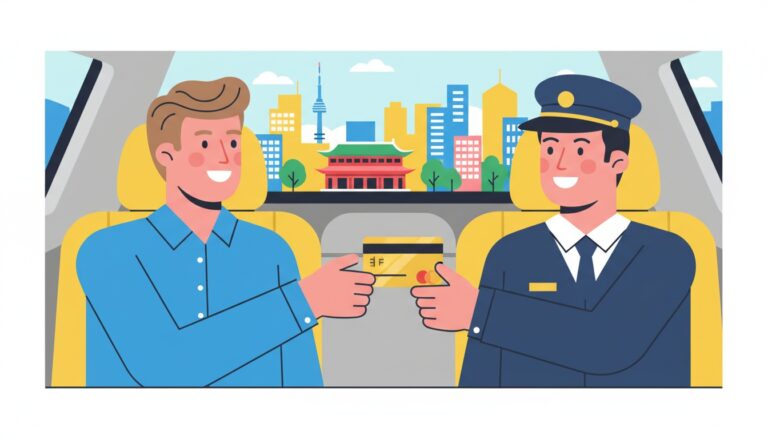
Have you ever enjoyed a comfortable taxi ride in Seoul, only to freeze up when the driver turns around for payment? “How do I say credit card?” “Do I just hand over cash?” 😱
Don’t worry! In K-Dramas, you often see characters coolly tapping their cards or tossing cash before rushing out. Today, we will learn exactly how to handle that moment so you can pay for your taxi like a local!
3 Key Expressions for Paying Taxi Fares
1. 얼마예요? (How much is it?)
- Romanization: [Eolmayeyo?]
- Meaning: How much is it?
- Explanation: This is the universal phrase for asking the price. You can use this in taxis, markets, or shops. It’s polite and essential!
- 💡 Pronunciation Tip: Connect the sounds! It’s not written as Eol-ma-ye-yo, but when spoken, the ‘ㄹ(l)’ sound slides over to the next block. It sounds more like [Eol-ma-ye-yo] -> [Eol-ma-e-yo] smoothly.
2. 카드로 계산할게요. (I’ll pay by card.)
- Romanization: [Kadeuro gyesanhalgeyo.]
- Meaning: I will pay with a card.
- Explanation: Korea is a very cashless society. Almost 99% of taxis accept credit cards and transportation cards (T-money).
- 💡 Pronunciation Tip: ‘Card’ in Korean becomes ‘Ka-deu’ (2 syllables). Also, ‘gyesan’ (calculation/payment) can be tricky. Try saying it slowly: Ka-deu-ro Gye-san-hal-ge-yo.
3. 영수증 주세요. (Please give me a receipt.)
- Romanization: [Yeongsujeung juseyo.]
- Meaning: Please give me a receipt.
- Explanation: If you left something in the taxi, the receipt is a lifesaver! It has the driver’s contact info. Always ask for one if you are traveling.
- 💡 Pronunciation Tip: The ‘ng’ in ‘Yeong‘ and ‘Jeung‘ is a soft nasal sound like the ‘ng’ in ‘Sing‘.
Real-life Dialogue 🗣️
(In a taxi, arriving at Hongdae)
Driver: 도착했습니다. (We have arrived.)
[Dochakaetseumnida.]
You: 감사합니다. 얼마예요? (Thank you. How much is it?)
[Gamsahamnida. Eolmayeyo?]
Driver: 15,000원입니다. (It is 15,000 won.)
[Man-o-cheon-won-imnida.]
You: 여기요. 카드로 계산할게요. (Here. I’ll pay by card.)
[Yeogiyo. Kadeuro gyesanhalgeyo.]
Driver: 네, 결제되었습니다. (Okay, payment is complete.)
[Ne, gyeoljedoe-eotseumnida.]
You: 아, 영수증 주세요! (Ah, please give me a receipt!)
[A, yeongsujeung juseyo!]
Culture Tip & K-Drama Vibes 🎬
Did you know? T-money cards work too!
In Korean dramas, you often see characters paying with their phones or transportation cards. You don’t need a special credit card; the same T-money card you use for the subway and bus works in taxis too! Just hand it to the driver or tap it on the pad if requested.
Pro Tip: If you want to seem like a generous K-drama CEO (even with a small amount), you can say “거스름돈은 됐어요” (Keep the change) when paying with cash. 😎
Wrap-up & Quiz 📝
Today we learned how to pay for a taxi without panic! Remember, confident pronunciation is key.
Let’s check what you remember:
- How do you ask “How much is it?” in Korean?
( ) -
True or False: You cannot use a T-money card in a Korean taxi.
( )
Answers:
1. 얼마예요? (Eolmayeyo?)
2. False (You can use T-money!)
See you next time! 안녕! 👋
Frequently Asked Questions (FAQ)
Q: What does "얼마예요? (How much is it?)" mean in Korean and how do you pronounce it?
A: In Korean, "얼마예요? (How much is it?)" is pronounced [Tip: Connect the sounds! It’s not written as Eol-ma-ye-yo, but when spoken, the 'ㄹ(l] and means: How much is it?
Q: What does "카드로 계산할게요. (I'll pay by card.)" mean in Korean and how do you pronounce it?
A: In Korean, "카드로 계산할게요. (I'll pay by card.)" is pronounced [Tip: 'Card' in Korean becomes 'Ka-deu' (2 syllables] and means: I will pay with a card.
Q: What does "영수증 주세요. (Please give me a receipt.)" mean in Korean and how do you pronounce it?
A: In Korean, "영수증 주세요. (Please give me a receipt.)" is pronounced [Tip: The 'ng' in 'Yeong' and 'Jeung' is a soft nasal sound like the 'ng' in 'Sing'.] and means: Please give me a receipt.







