

Hello! I’m Daily Hangul! 👋
Hello, everyone! It’s your friendly Korean tutor, Daily Hangul (매일한글)! 🌟
Have you ever ridden the subway in Seoul and felt like it was as quiet as a library? Or have you stood in front of a trash can in Korea, confused about where to throw your coffee cup? ☕️💦
Don’t worry! Today, we are going to learn about Public Etiquette in Korea. Understanding these cultural rules will save you from awkward situations and help you blend in like a local! Plus, you’ll understand why K-Drama characters always whisper on the bus! 🚌✨
Let’s dive in! 🚀
3 Core Expressions for Public Manners 🗣️
Here are three essential expressions to help you navigate public spaces in Korea.
1. 조용히 해 주세요 (Please be quiet)
- Pronunciation: [Joyonghi hae juseyo]
- Meaning: Please be quiet.
- Detail: In Korea, public transportation (subways, buses) is considered a place for rest. If someone is talking too loudly on their phone, you might hear this. It’s a polite request.
- 💡 Pronunciation Tip: The ‘ㅎ’ (h) in ‘히’ (hi) is often pronounced very softly, almost silent. So it sounds like [Joyong-i] in fast speech!
2. 분리수거 (Recycling / Sorting waste)
- Pronunciation: [Bullisugeo]
- Meaning: Recycling / Sorting trash.
- Detail: Korea is very strict about recycling! You cannot just throw everything in one bin. You must separate plastic, paper, cans, and general waste.
- 💡 Pronunciation Tip: This is a tricky one! When ‘ㄴ’ (n) meets ‘ㄹ’ (l), the ‘n’ sound changes to an ‘l’ sound. So, instead of ‘Bun-li’, we say [Bul-li]. Try it: Bul-li-su-geo!
3. 여기 앉아도 돼요? (Can I sit here?)
- Pronunciation: [Yeogi anjado dwaeyo?]
- Meaning: Can I sit here?
- Detail: You can use this when asking for a seat in a crowded cafe or waiting area. It’s a polite way to ask permission.
- 💡 Pronunciation Tip: ‘앉아’ is pronounced [anja] because the ‘ㅈ’ sound carries over to the next vowel.
Real Dialogue: In the Subway 🚇
Let’s see how these expressions work in real life! Alex is visiting Korea and is excited to be on the subway with his Korean friend, Minji.
Alex: (Loudly) WOW! Minji! The subway is so clean and cool! 😲
Minji: 쉿! 알렉스, 조용히 해 주세요. (Shh! Alex, please be quiet.) 🤫
Alex: Oh, sorry! Why is everyone so quiet?
Minji: In Korea, we keep our voices down on the subway. It’s manners.
(They get off the train and Alex finishes his coffee)
Alex: Where do I throw this cup?
Minji: Wait! You have to do 분리수거 (recycling). Liquids go here, plastic goes there! ♻️
Culture Tip & K-Drama Moment 🎬
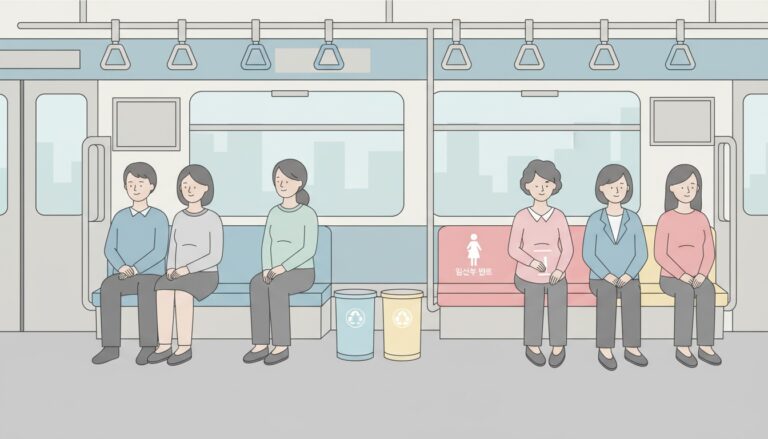
1. The “Pink Seat” Mystery 🤰
Have you seen the Pink Seats on the subway? These are exclusively for pregnant women. Even if the train is full and the seat is empty, most Koreans do not sit there out of respect. If you sit there in a K-Drama, you might get scolded by a grandmother! Keep it empty to be a respectful traveler! 👍
2. No Food on the Bus! 🍔❌
Unlike some countries, eating or drinking (takeout cups) is prohibited on city buses in Seoul. The driver might not let you on if you are holding a cup of coffee. Finish your drink before you hop on!
Wrap-up & Quiz 📝
Today we learned how to be polite and handle trash in Korea! Remember, a little “noonchi” (awareness) goes a long way. 😉
Let’s practice!
Q1. How do you say “Recycling” in Korean?
(Hint: Bul-li-su-geo)
Answer: [ __________ ]
Q2. True or False?
It is okay to sit in the Pink Seat if you are not pregnant, as long as no one is looking.
Answer: [ O / X ]
Q3. Fill in the blank:
If your friend is shouting in the library, you can say: “______ 해 주세요.”
Answers:
1. 분리수거 (Bun-li-su-geo)
2. X (It’s better to leave it empty!)
3. 조용히 (Joyonghi)
See you next time! 안녕! 👋
Frequently Asked Questions (FAQ)
Q: What does "조용히 해 주세요 (Please be quiet)" mean in Korean and how do you pronounce it?
A: In Korean, "조용히 해 주세요 (Please be quiet)" is pronounced [Joyonghi hae juseyo] and means: Please be quiet.
Q: What does "분리수거 (Recycling / Sorting waste)" mean in Korean and how do you pronounce it?
A: In Korean, "분리수거 (Recycling / Sorting waste)" is pronounced [Bullisugeo] and means: Recycling / Sorting trash.
Q: What does "여기 앉아도 돼요? (Can I sit here?)" mean in Korean and how do you pronounce it?
A: In Korean, "여기 앉아도 돼요? (Can I sit here?)" is pronounced [Yeogi anjado dwaeyo?] and means: Can I sit here?






