

1. Introduction
Hello! It’s Daily Hangul, here to upgrade your Korean skills! 🌟
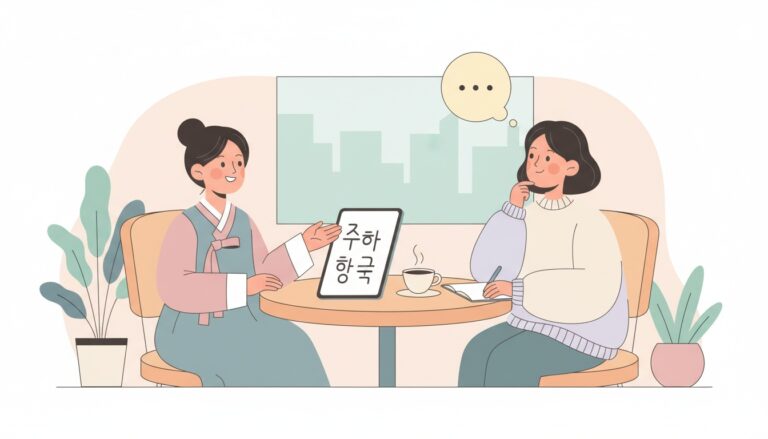
Have you ever been talking to a Korean friend and suddenly faced a moment of silence? Or have you watched a K-Drama where the main characters just stare at each other without saying a word? 😲 In many Western cultures, silence can feel awkward or uncomfortable. However, in Korea, silence is a part of the conversation! It’s not just “empty space”; it conveys meaning.
Today, we will learn how to interpret these pauses and use the right expressions to fill them naturally. Mastering this will make you an expert in K-Nunchi (reading the room)! Let’s dive in! 🚀
2. Core Expressions
Here are 3 essential expressions to handle silence or show you are thinking, just like a native!
1️⃣ 음… / 저… (Eum… / Jeo…)
- Pronunciation: [Eum… / Jeo…]
- English Meaning: Um… / Well…
- Detail: These are the most common “filler words.” Instead of staying completely silent, Koreans use these sounds to show they are thinking or hesitating. “저… (Jeo…)” is slightly more polite and is often used before asking a favor or saying something difficult.
- 💡 Pronunciation Tip: Don’t make it short! Elongate the sound slightly like “Euuuum…” to show you are deep in thought.
2️⃣ 글쎄요 (Geulsseyo)
- Pronunciation: [Geul-sse-yo]
- English Meaning: Well… / I’m not sure.
- Detail: This is a magical word! ✨ When Koreans want to say “No” but don’t want to be rude, or when they really don’t know the answer, they use this. It implies, “I need to think about it” or a soft “Probably not.”
- 💡 Pronunciation Tip: The double consonant ‘ㅆ’ (ss) creates a strong, tense sound. It’s not a soft ‘s’, but a sharp hiss like a snake! 🐍
3️⃣ 생각 좀 해볼게요 (Saenggak jom haebolgeyo)
- Pronunciation: [Saeng-gak jom hae-bol-ge-yo]
- English Meaning: I’ll think about it.
- Detail: If you need more time to decide, use this phrase. It’s a polite way to fill the silence and delay an answer.
- 💡 Pronunciation Tip: In ‘생각 (Saenggak)’, the final ‘k’ sound stops abruptly. It flows into ‘jom’. Try saying it smoothly: “Saeng-gak-jom”.
3. Real-life Dialogue
Let’s see how these expressions work in a real situation. Minji is inviting Mark to a hiking trip, but Mark isn’t sure.
👩 Minji: 마크 씨, 내일 우리랑 같이 등산 갈래요?
(Mark, do you want to go hiking with us tomorrow?)
👨 Mark: (Silence…) 음… (Eum…)
👩 Minji: 바빠요?
(Are you busy?)
👨 Mark: 글쎄요 (Geulsseyo). 내일은 좀 쉴까 했어요.
(Well… I was thinking of resting tomorrow.)
👩 Minji: 아, 그래요? 알겠어요!
(Ah, really? Okay!)
👨 Mark: 미안해요. 생각 좀 해볼게요.
(Sorry. I’ll think about it.)
4. Culture Tip & Drama Moment 🎬
🤫 Silence is “Consideration”
In Korea, answering immediately with a refusal (like “No, I can’t”) can be considered too direct or hurtful. The silence before speaking acts as a cushion. It shows, “I am considering your offer seriously because I respect you.”
📺 Drama Scene
Think of a scene in a romance drama where the guy confesses his love, and the girl stays silent for a long time. She isn’t ignoring him! She is showing the weight of her emotions. Next time you see a pause in a K-Drama, don’t check if your audio is broken—enjoy the emotional tension! 😉
5. Wrap-up & Quiz
Today we learned that silence in Korean is a language of its own! Use filler words like “Eum…” and soft expressions like “Geulsseyo” to sound natural and polite.
📝 Mini Quiz
- Which word is used when you are not sure or want to refuse softly?
(A) 네 (Ne) (B) 글쎄요 (Geulsseyo) -
How do you say “I’ll think about it” in Korean?
Fill in the blank: [ _____ ] 좀 해볼게요.
Answer Key:
1. (B) 글쎄요
2. 생각 (Saenggak)
See you next time! 안녕! 👋







