

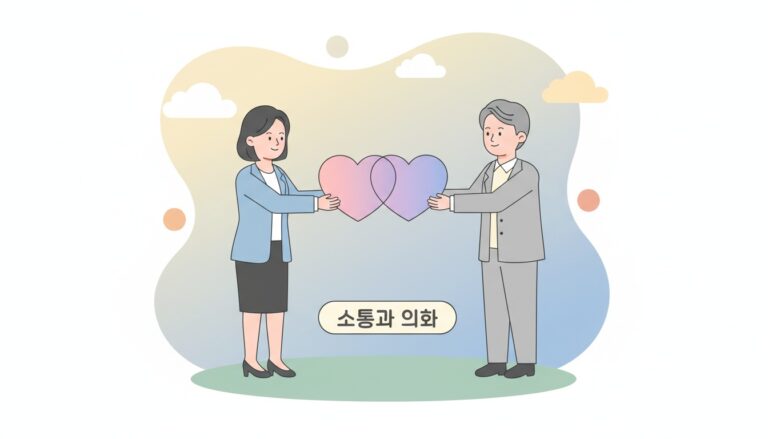
🇰🇷 “Latte is Horse”? Solving Korean Generation Gaps!
Hello, K-Culture fans! 👋 Welcome back to Daily Hangul! 😊
Have you ever watched a K-Drama set in an office and heard the boss say, “Back in my day…”? Or have you seen young characters sighing because their parents just don’t get it?
Today, we are going to dive into a slightly serious but very interesting topic: Generational Conflict (세대 갈등). But don’t worry! We will learn simple and useful expressions to describe differences and understanding. By the end of this post, you’ll understand why Koreans make jokes about “Latte”! ☕
Let’s bridge the gap together! 🌉
📚 Key Expressions
Here are 3 essential expressions to talk about generations and differences.
1. 세대 차이 (Sede Chai)
- Pronunciation: [Se-dae Cha-i]
- Meaning: Generation Gap
- Explanation: ‘세대’ means generation, and ‘차이’ means difference. You use this when you feel a distance between age groups due to different thinking styles.
- 💡 Pronunciation Tip: In ‘차이’ (Chai), the ‘ch’ is an aspirated sound. Make sure to burst a little air out, like the ‘ch’ in “charge”!
2. 생각이 달라요 (Saenggagi Dallayo)
- Pronunciation: [Saeng-ga-gi Dal-la-yo]
- Meaning: Our thoughts are different / We think differently.
- Explanation: This is a polite way to say you disagree or have a different perspective. It’s much softer than saying “You are wrong.”
- 💡 Pronunciation Tip: Linking sound! ‘생각이’ sounds like [Saeng-ga-gi] because the final consonant ‘ㄱ’ moves to the next vowel spot.
3. 이해하다 (Ihaehada)
- Pronunciation: [I-hae-ha-da]
- Meaning: To understand
- Explanation: This is the magic word to solve conflicts! In dramas, you often hear “이해해 주세요” (Please understand me).
- 💡 Pronunciation Tip: The ‘h’ sound in ‘해’ (hae) can be weak when speaking fast. It often sounds soft, almost like [I-ae-ha-da].
💬 Real-life Dialogue
Let’s see how Min-ji (Junior employee) and Jun-ho (Senior colleague) talk about their boss.
Situation: At a cafe during lunch break.
Min-ji: 부장님은 옛날 이야기를 너무 좋아해요. 😓
(Bujangnimeun yennal iyagireul neomu joahaeyo.)
The manager loves talking about old times too much.
Jun-ho: 맞아요. 세대 차이가 좀 느껴지죠?
(Majayo. Sede chaiga jom neukkyeojijyo?)
That’s right. You feel the generation gap, right?
Min-ji: 네, 우리랑 생각이 달라요.
(Ne, urirang saenggagi dallayo.)
Yes, his thoughts are different from ours.
Jun-ho: 그래도 우리가 조금 이해해 드려요.
(Geuraedo uriga jogeum ihaehae deuryeoyo.)
Still, let’s try to understand him a little.
🎭 Culture Tip & Drama Scene
☕ “Latte is Horse” (나 때는 말이야)
Have you heard the joke “Latte is horse”?
In Korean, older people often start lectures with “나 때는 말이야…” (Na ttae-neun mal-i-ya…), which means “Back in my time…” or “When I was your age…”.
If you say “Na ttae-neun” quickly, it sounds like “Latte”! And “mal” means “Horse” (as well as “words”).
So, young Koreans playfully call older people who preach too much “Latte”!
Drama Tip: Next time you watch a workplace K-Drama, look for the boss holding a cup of coffee. If young employees roll their eyes, he is definitely doing a “Latte” speech! 🤣
📝 Wrap-up & Quiz
Today we learned how to talk about the generation gap politely. Remember, even if thoughts are different, trying to understand (이해하다) is the key to K-Culture!
🧠 Pop Quiz
Fill in the blanks with the words we learned today!
- We feel the ________ between the boss and us. (Generation Gap)
= 우리는 부장님과 ( _______ )를 느껴요. -
Please ________ my situation. (Understand)
= 제 상황을 ( _______ ) 주세요.
Did you get it? Check the answers below! See you next time! 안녕! 👋
Answers:
1. 세대 차이 (Sede Chai)
2. 이해해 (Ihaehae)
Frequently Asked Questions (FAQ)
Q: What does "세대 차이 (Sede Chai)" mean in Korean and how do you pronounce it?
A: In Korean, "세대 차이 (Sede Chai)" is pronounced [Se-dae Cha-i] and means: Generation Gap
Q: What does "생각이 달라요 (Saenggagi Dallayo)" mean in Korean and how do you pronounce it?
A: In Korean, "생각이 달라요 (Saenggagi Dallayo)" is pronounced [Saeng-ga-gi Dal-la-yo] and means: Our thoughts are different / We think differently.
Q: What does "이해하다 (Ihaehada)" mean in Korean and how do you pronounce it?
A: In Korean, "이해하다 (Ihaehada)" is pronounced [I-hae-ha-da] and means: To understand







